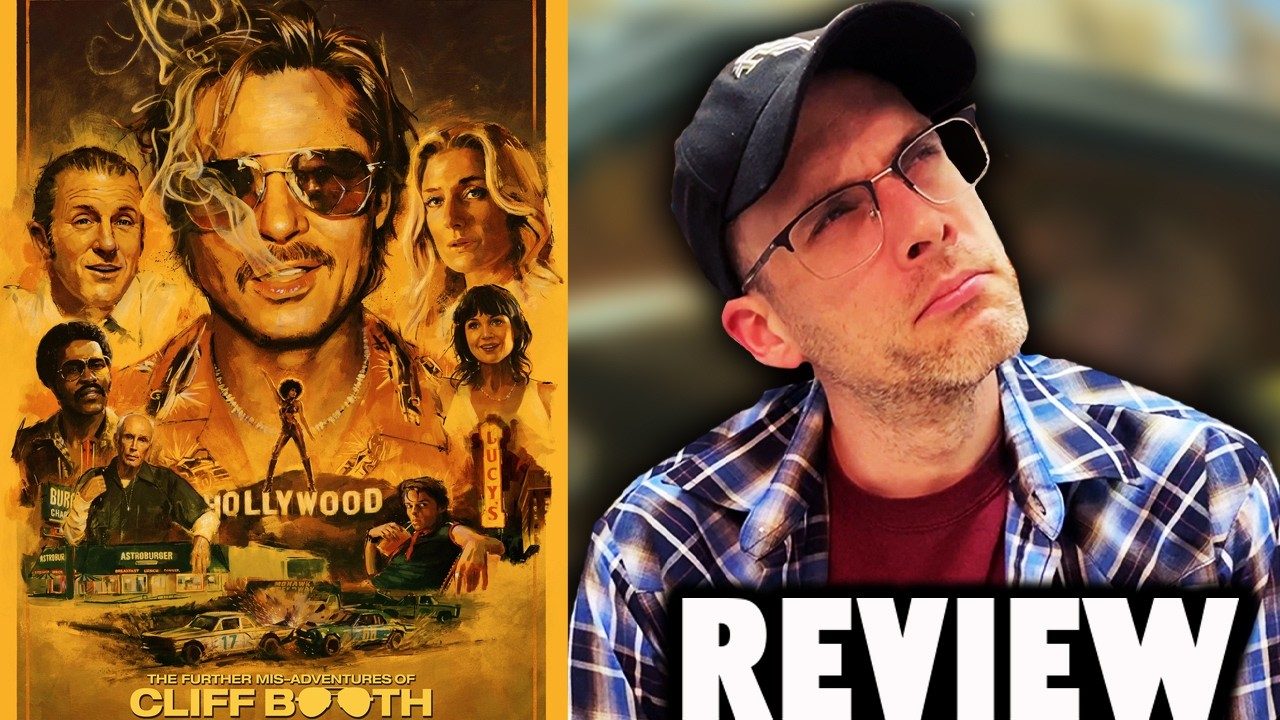
David Fincher’s sequel to Once Upon a Time… in Hollywood opened in IMAX worldwide on 25 November for a two-week exclusive run, and reaches Netflix on 23 December. Brad Pitt is back as Cliff Booth, the script is Quentin Tarantino’s, the setting is 1977, and the argument that has followed it into release is about which of its shots a machine generated. That argument started before the reviews did.
Seven numbers, five points apart
I could verify seven published verdicts carrying a number. Converted to a ten-point scale they run 8, 10, 8, 7, 7, 5 and 5 — an arithmetic mean of 7.0, rounded to the nearest half point, across a five-point spread.
That spread is worth more than the mean. The aggregators agree with it: Metacritic sat at 68 from 49 critics on the 19 November embargo day, and Rotten Tomatoes snapshots reported through the week ranged from 83 percent of 70 reviews to 77 percent of 145, with a critics’ average of 7.3 out of 10 at the larger count. Three different methods landing within a few tenths of each other usually means the sample is real rather than lucky. Call it a 7.
For comparison, the 2019 film holds a Metascore of 84 from 62 critics. This is a sixteen-point drop against a predecessor, with the same character and the same writer.
I have written this shape up before, when critics split hard over Sunrise on the Reaping — six verdicts, a six-point spread, and near-unanimous praise for the photography sitting next to a complete disagreement about everything else. The pattern repeats here. Almost nobody disputes that Fincher can still build a frame. That part holds.
What people say they can see
The complaints did not come from the review embargo. They came from early screenings and from the trailer, and they are unusually specific for an audience argument. The critic Patrick Tomasso listed faces that change mid-scene, physics that behave oddly, fine lines that garble, and whole-body performance swaps. A trailer shot doing the rounds reportedly shows a cart positioned in front of the horse pulling it.
Netflix has not commented on any of it.
Take that list as a technician rather than as a fan, because every item on it describes a different failure.
A face that changes mid-scene is temporal instability: the model solves each frame well and the frames do not agree with each other. Garbled fine lines are the same problem at higher frequency, which is why hair, fabric weave, chain link and lettering are where it shows first. Odd physics is a model with no simulation underneath it, producing something that looks like a cart and a horse without knowing which one pulls. And a whole-body performance swap is the expensive one, because the shot was replaced outright.
None of those four are what a rough composite looks like. A bad comp has a hard edge, a mismatched black level, a grain plate that does not sit. It is wrong in a way that holds still. The things being described here are wrong in a way that moves. Movement is the tell. A trained eye catches it at twenty-four frames a second even when it cannot say why.
Fincher’s own account
Fincher addressed AI on The Ringer’s Big Picture podcast, in an interview recorded before the screening complaints surfaced. His example was lip sync: when the best vocal take and the best picture take came from different performances, “we could use AI to re-lip that thing,” and he called the result freeing. By his account ADR covers about five percent of the film, with the cast spending four or five days re-recording.
He has gone further on the general principle. The pitch, as reported, is that crews keep handcrafting sets and keep shooting masters, while a model absorbs the technical accidents — a focus pull that missed, a hair drifting across the lens. Bloomberg reported in March that he was using post tools from Ben Affleck’s InterPositive. In an El País interview he dismissed the broader argument as a culture war that “has nothing to do with movies.”
That account is coherent and it is narrow. Re-lipping a performance explains mouths. It does not explain a cart in front of a horse, and it does not explain a body swap. Nobody has published a shot-by-shot breakdown, and until a VFX house talks or Netflix releases a credit list, the gap between what Fincher has described and what viewers are reporting stays a gap. Sources disagree even on who shot the reshoots — Erik Messerschmidt was announced as cinematographer, and later reports put Jeff Cronenweth on the additional photography, which I could not resolve.
The part that affects the people doing the work
Strip out the politics and Fincher is describing a pipeline change. Shoot the master, derive the coverage. Pay for generation instead of correction.
Compare it with the approach ILM took on Digger, where scanning the finished miniatures and splatting them kept the physical object as the source of truth and used the digital copy only to multiply it. The thing in front of the lens still decided what the shot looked like. A generated close-up derived from a master inverts that: the performance that reaches the screen was never photographed.
I do not think that is automatically worse. Plenty of what artists do all day is already synthesis, and the re-lipping case is a genuine improvement over dragging an actor back into a booth. What I would want to know, if I were on that crew, is who reviews the output. The four artefacts people are listing are not subtle to anyone who has spent a week looking at playblasts. They reached a worldwide IMAX release anyway. Somebody had to sign those shots off. That says the review step either did not exist or did not have the authority to send one back.
Fincher has said this could be his last film — “I don’t have as much patience as I once had.” The 7.0 is a solid number for a hangout noir. Reports of the runtime differ, so I will not put one here. What the film will be remembered for is a question about provenance that nobody in the chain has answered.