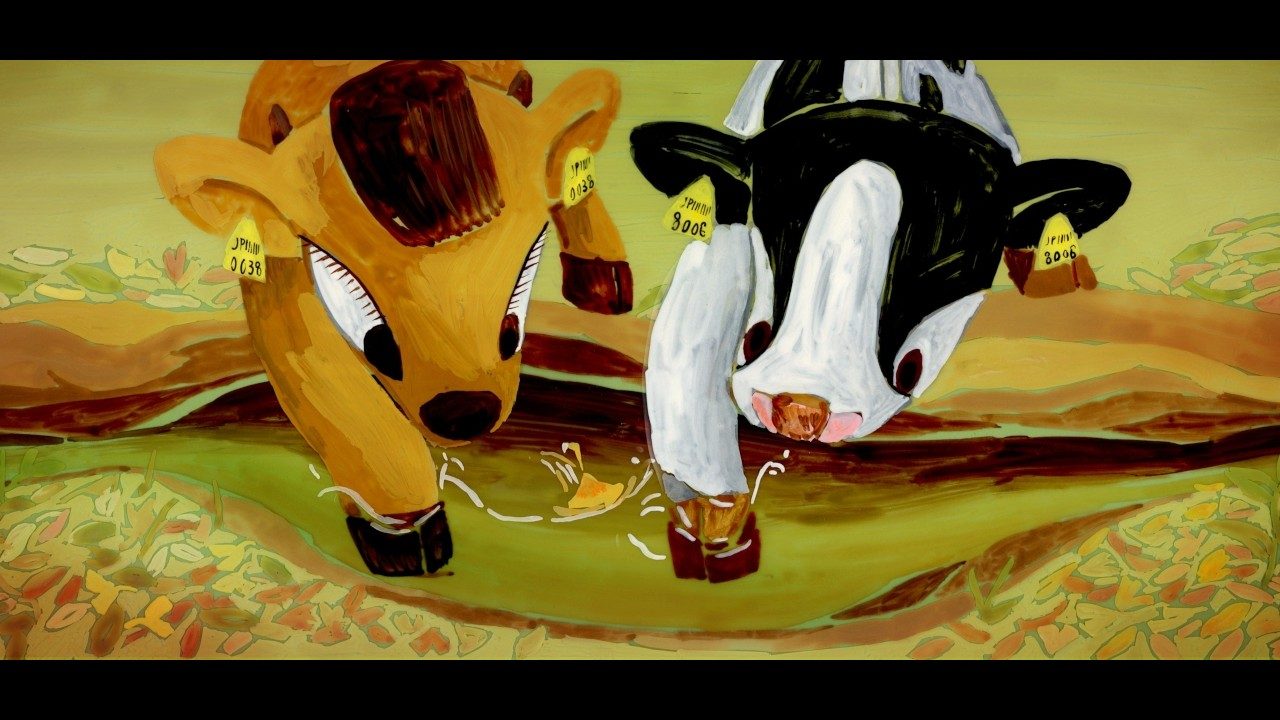
The interesting thing about Eri is where its shadows come from. Honami Yano draws on cel, which plenty of people still do. She also paints her backgrounds on cel — on transparent sheets rather than on paper or board — and stacks them so the characters’ shadows fall onto the background lying beneath them. The dark patch under a cow is light that a sheet of acetate physically interrupted.
That film won Best Animated Short at the Ottawa International Animation Festival this weekend, at the festival’s fiftieth edition. We Are Aliens took the Grand Prize for animated feature and Candy Caries won in the young audiences category. Yano has been here before: her earlier short A Bite of Bone took Ottawa’s Grand Prix, along with a New Face Award at the Japan Media Arts Festival.
Eri premiered at Cannes this year, in the Directors’ Fortnight selection. It is a story about a Holstein cow who is permitted to go on living only while she keeps producing calves, and who falls in love with another cow called Sawa. A France–Japan co-production, between Au Praxinoscope and Miyu Productions.
Two things I could not pin down. The runtime is given as twelve minutes and nine seconds on the producer’s own listing and as fifteen minutes in the festival write-ups, and I have no way to tell which is the finished cut. The film is also reported as an adaptation of a manga by Kasumi Asakura, whose English title I have seen rendered one way in one place and cannot confirm against a publisher.
The stack used to be a tax
For most of the century in which cel animation was the industry, the cel was the thing you worked around. Every sheet of acetate you laid over a background swallowed a little light and pushed the art underneath it slightly green. Two sheets, more green. Four, and the background painter’s careful colour had drifted somewhere else entirely.
So studios kept the stacks shallow. Three levels, four at a push, and colour stylists painted the lower layers deliberately brighter to survive being looked at through the layers above. Whole craft traditions exist because of that absorption — it is part of why cel-era film has the palette it has, and part of why restoring it is delicate work. Scan an original negative at 4K and you are resolving the acetate along with the paint, which is roughly where a cel scan hits its own ceiling.
Yano takes the artefact and uses it as a light. Put the background on cel, raise it a few millimetres under the camera, and the sheet above casts onto the sheet below because that is what happens when you interrupt light with an object. The tax becomes the tool.
Why anyone lighting things for a living should care
Contact shadow is the cheapest honest trick in rendering and the one we spend the most on. The darkening in the crevice where two surfaces meet, the small gradient under a foot — that is what convinces the eye an object is in a scene rather than pasted on top of one. Ambient occlusion passes exist for it. Ray budgets get spent on it. Shadow map resolution gets argued about in meetings because of it.
Yano gets it by stacking paint under a lens.
And the comparison that keeps nagging at me runs the other way. CG anime spends real money travelling in the opposite direction: dropping frames on purpose, bending models per-camera, having faces redrawn by hand, giving up most of the asset reuse that 3D is supposed to pay you back with. Everything Studio Orange does to make its CG read as drawn is work aimed at a look that Yano’s stack of sheets produces as a side effect of being made of matter.
These are answers to different questions — one has to fill twelve episodes a season, the other has twelve minutes and a festival deadline, and the economics of those two facts decide almost everything else.
The part that would frighten a production manager
The catch in Yano’s method is that the lighting is baked at the moment of exposure. A digital pipeline keeps shadow separable from drawing until the last possible minute, which is in practice an insurance policy: it means a note from a producer in week thirty costs a slider rather than a reshoot. Yano has no slider. Change the shadow and you repaint the cel and photograph it again.
Twelve minutes is survivable that way. A series is not, which is most of the reason the industry stopped.
What I would like to see is the shooting setup — the spacing between the levels, whether she lit for the shadow or let it happen, how she kept the density consistent across a thousand-odd frames when every sheet of acetate is very slightly different from the last. None of that is in a press release. It rarely is, and it is usually the only part worth knowing.