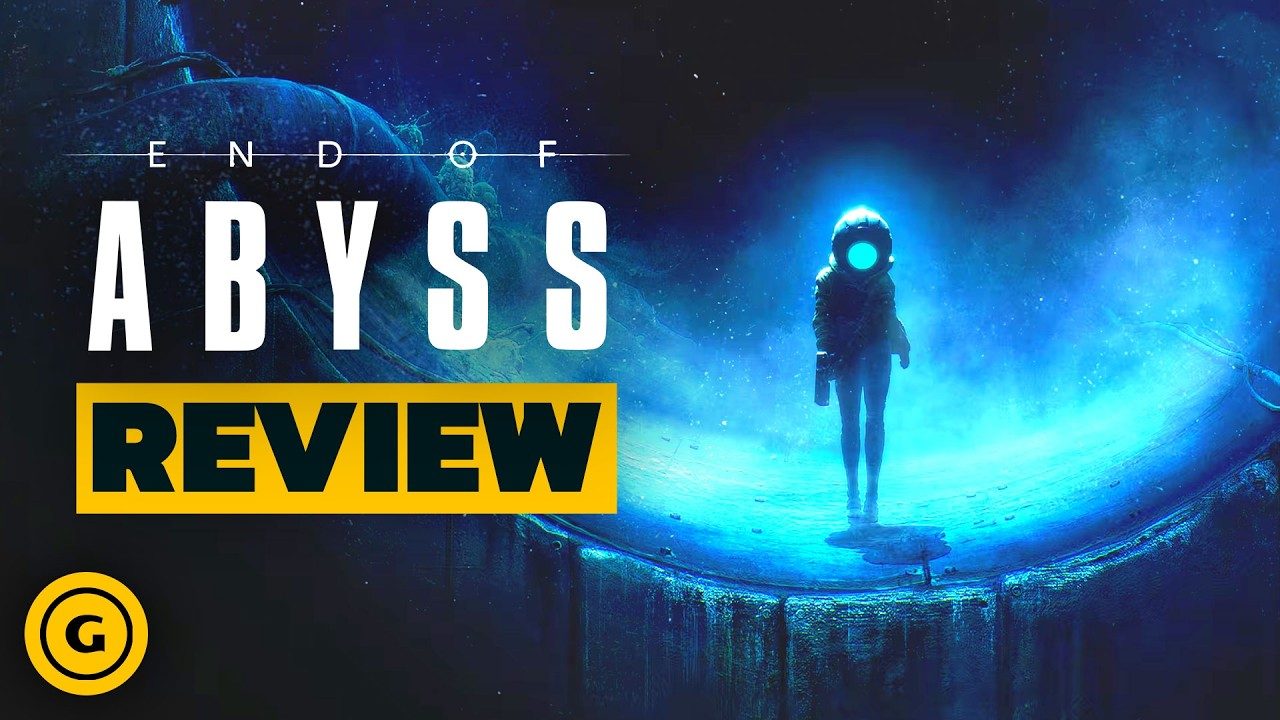
Eleven published verdicts I could verify put End of Abyss at 7.5, and they run from 6 to 9. Three full points. OpenCritic has it at 73 from seventeen critics, Metacritic at 76 from fourteen, so the aggregate and my smaller sample land in the same place. A range that wide on a debut tells you the critics were unsure.
Section 9 Interactive is a Malmö studio, founded by people who worked on Little Nightmares at Tarsier. This is their first game. Epic Games Publishing put it out on 1 October 2026 for PS5, Xbox Series X and S, and PC through the Epic Games Store. Top-down, twin-stick, sci-fi horror, built as a Metroidvania: you play Cel, a combat technician, going down into the derelict parts of a facility.
Plenty of debuts get a spread like that. The interesting bit here is where the disagreement sits: the outlets at the bottom of the range and the ones at the top both say the game is frightening. What they argue about is a data problem.
The map was wrong
GameSpot’s Mark Delaney filed a 6 under the headline that the game commits a Metroidvania cardinal sin, and the sin is the map. It would tell him a door was locked that he had already unlocked. It would fail to mark that he had found the key to a door. In a game whose whole structure is going back through places you have already been, that sends you on twenty-minute walks to doors that were never shut.
I want to sit on what that bug is, because from a pipeline seat it is a familiar shape.
A Metroidvania door has a state: open or shut, and if shut, whether you are carrying the thing that opens it. That state lives somewhere in the level — a volume, a flag on a trigger, something the gameplay code reads when the player walks into it. The map screen has to show the same fact. So either the map is generated from the same data the door reads, or somebody authors a second representation of the level for the map layer and keeps the two in step by hand.
The second way is extremely common and it is cheap and it looks fine for most of production, because for most of production the level is being rebuilt weekly anyway and the designer who moved the door also moved the map icon. It falls over at the end, when the level stops changing, the map icons stop being touched, and a late edit to a gate goes into the gameplay data without going into the map data. Nothing crashes. No artist sees anything wrong in the viewport. The only symptom is a player walking somewhere for no reason, and that is close to invisible in a QA pass that is testing whether the level is completable.
Remedy got caught by something adjacent two weeks ago. Control Resonant split its reviewers on everything except its environments, and one of the dividing complaints was its map. Same month, same genre of mistake, two studios of wildly different size.
The patch, and what it did to the reviews
The fix landed on 2 October, one day after release. Delaney wrote a second piece saying so, and saying that most of his complaints were now gone — which puts a published 6 in front of a game that no longer has the thing the 6 was mostly about.
That is a real problem for an average like the one at the top of this page, and I am not going to pretend otherwise. Of the eleven scores, several were written against a build whose map lied. Nobody is going back to re-score it. The number stays where it is, pointing at a version of the game that existed for about thirty hours.
Worth saying plainly: the patch arriving that fast is a point in the studio’s favour. They had the fix ready and shipped it the moment the embargo window stopped protecting them from the complaint. The cost is just that the permanent public record of the game was written in the window before it landed.
Where the 9s are coming from
Gaming Trend and PlayStation Universe both filed 9s, and the high end of the range is consistent about what it liked: the atmosphere and the combat. Game Informer’s 8 reaches for Samus explicitly in its headline, which tells you the shape of the thing — isolation, a facility, tools that unlock geography.
On a top-down camera that praise carries more weight than it would on a first-person horror game. Fixed distance, no neck, nothing can lunge at the lens. Every bit of dread has to be built out of what the room looks like and where the light stops. Well Dweller managed something similar last month with hand-drawn 2D and near-unanimous scores, and the comparison is not flattering to End of Abyss in one specific way: Well Dweller’s dissent was about ambition. The dissent here is about execution, and execution is the part you can patch.
The number
7.5, from eleven verdicts between 6 and 9, collected on 3 October 2026 and converted to a ten-point scale before averaging. The aggregate figures are OpenCritic’s and Metacritic’s own.
If you are reading the score to decide whether to buy it, the spread matters more than the mean, and the spread was partly manufactured by a bug that is no longer in the game.
Section 9 Interactive has not published a studio-hosted press gallery I could reach, so the still above is a frame from GameSpot’s review video.