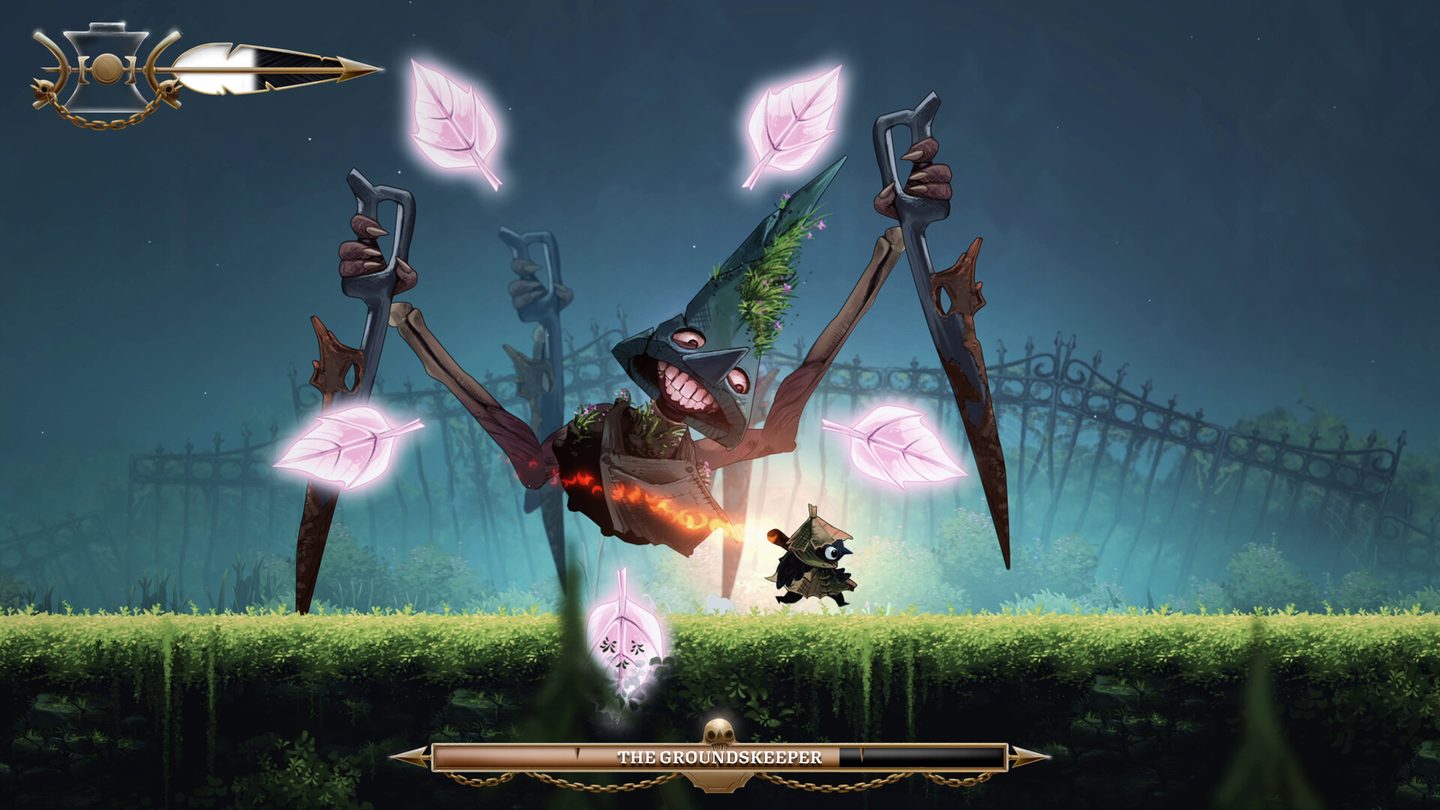
This was supposed to be Konami’s week, or Remedy’s. Silent Hill: Townfall and Control Resonant both shipped into it, both with the marketing spend that implies. The highest-scoring game of the three came from a man in Portland, Oregon. He drew it. All of it.
Well Dweller sits at 90 on OpenCritic from eighteen critics with every one of them recommending it, and 91 on Metacritic from a smaller PC sample. Of the individual verdicts I could verify with a number attached, the average is 9, from six scores running 7.5 to 10. That is a wider spread than the aggregates suggest, and the low end is worth a paragraph of its own further down.
For comparison on the same seven days: Control Resonant averaged 7.5 across eight verdicts, and Silent Hill: Townfall an 8 across eleven.
What “hand-drawn” costs, and how one person pays it
Kyle Thompson writes the code, draws the art and designs the levels. His brother Eric writes the music. That is the whole credits roll. It is his fourth game in six years, after Sheepo, Islets and Crypt Custodian — a pace that should be impossible for something that looks like this.
The toolchain he has described is GameMaker, Spine and Photoshop, and Spine is the load-bearing name in that list. Spine is skeletal 2D animation: you draw a character once, cut it into parts, rig those parts to bones, and animate the rig. A walk cycle becomes a curve on a bone rather than eight drawings. The source art is still painted, so the look survives. The frame count stops mattering, because nobody is drawing frames.
Anyone who has tried genuine frame-by-frame animation at twelve drawings a second knows what that arithmetic does to a schedule. It is the difference between a solo project shipping and a solo project becoming a decade-long apology on a devlog.
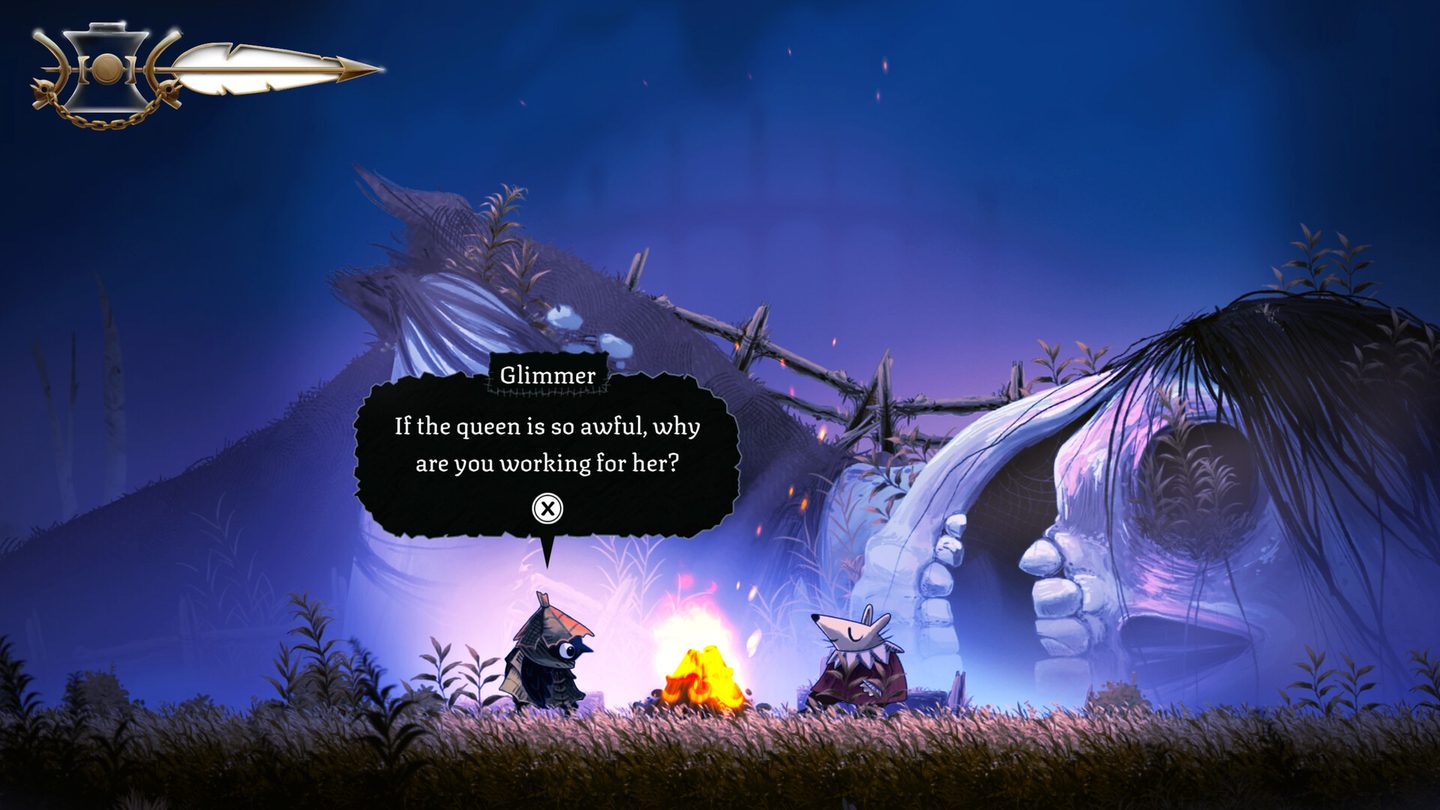
The trade is real and visible if you look for it. Skeletal rigs are weakest at overlapping forms — a limb crossing the body, a head turning through three-quarters, anything that needs new drawing rather than new transform. Which is why games built this way tend to shoot their characters in profile and near-profile, and why the silhouettes stay clean and readable. Glimmer is a small bird carrying a matchstick. That is not only a storybook decision; it is a silhouette that rigs well and reads at any size on a Switch screen.
There is a version of this argument that runs the other way. Orbitals animated its characters at 12 and 24fps on purpose and let the constraint become the house style. Well Dweller does the opposite — it spends its technical budget on hiding the seams rather than framing them. Both are honest answers to the same question about what one small team can afford to move.
The 7.5 in the middle of the 10s
Press Start’s verdict is the outlier. A 7.5, sitting under five scores of 9 or higher. I could not read the review body from here, so I will not guess at its reasoning beyond what the headline carries.
What I can say is that the same reservation shows up in the wording of several other reviews that scored the game highly. One video review is titled “Finding Flow in a Familiar Metroidvania”. A Portuguese-language one calls it a good Metroidvania that will not surprise you. The word that keeps appearing around the edges of the praise is familiar. They mean it descriptively.
That is a fair thing to hold against a genre that has been iterating on the same map-and-ability loop since 1994. It is also, in this case, the consequence of the pipeline above. A solo developer on his fourth game in the same lane is not going to spend his one shot at a novel traversal system; he is going to spend it on the thousand small drawings and the enemy tells, because that is where his hours actually go and where he already knows the work pays.
The spread, then, is a disagreement about how much novelty a genre entry owes you. Nobody in the sample argues about the craft.
The number
9, from six published scores between 7.5 and 10, collected on 23 September 2026 and converted to a ten-point scale before averaging. Six is a thin sample next to OpenCritic’s eighteen, and it is thin because a lot of the coverage here comes from outlets that review without scoring. Read the aggregate alongside it. Eighteen critics beat my six.
The game shipped on 22 September across Switch, Switch 2, PS5, Xbox Series X|S, PC and GOG, and it is on Game Pass from day one. If you have the subscription, the question of whether a 7.5 or a 10 is closer to right costs you nothing to answer yourself.