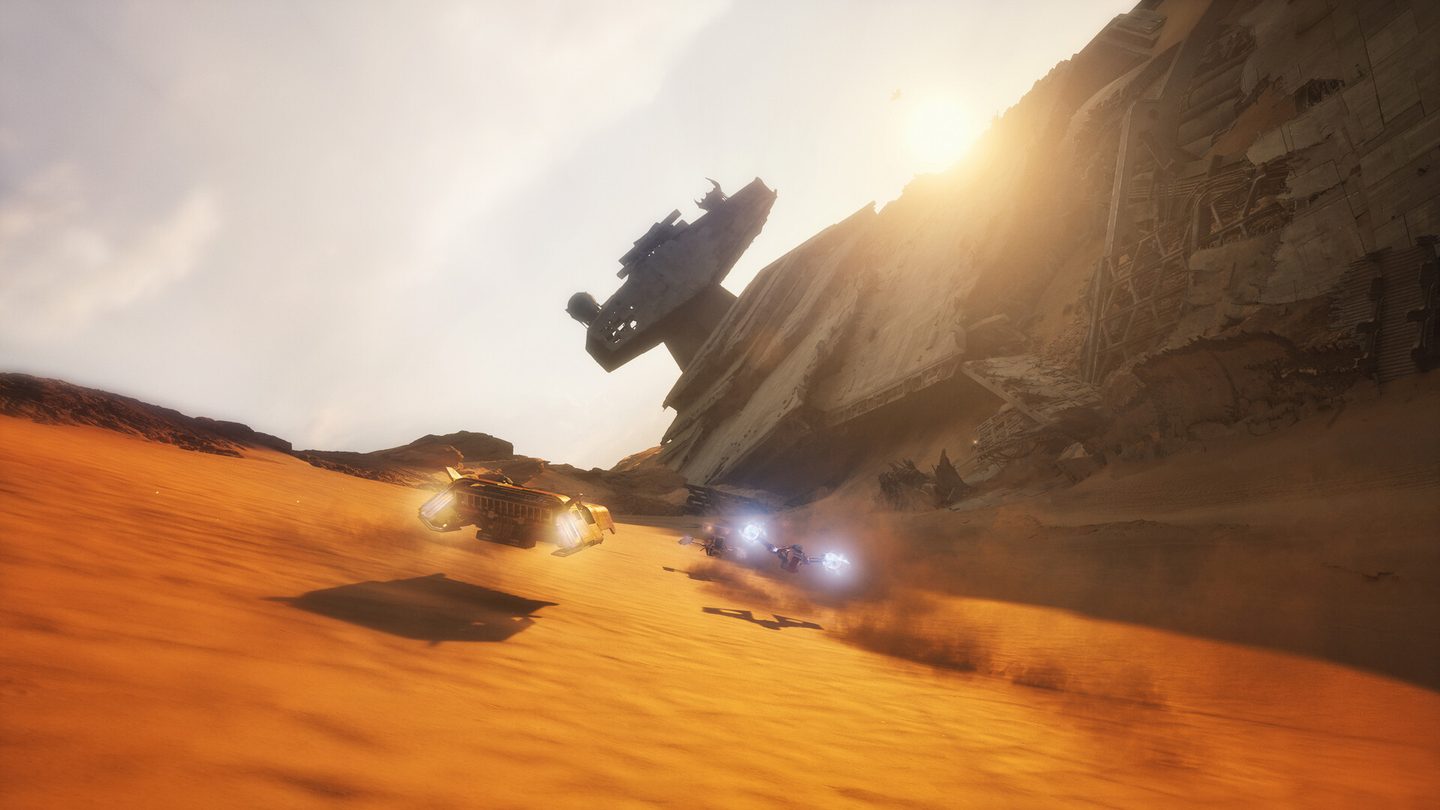
Star Wars: Galactic Racer arrives on 6 October on PC, PS5 and Xbox Series X|S, at €59.99 on Steam. It is the first game from Fuse Games, the Guildford studio Matt Webster set up in 2023 with senior staff out of Criterion, now around seventy-five people, published by Secret Mode with Lucasfilm Games. Reviews went up earlier this week and they are good: as of 4 October, Metacritic sits at 88 from fifty reviews and OpenCritic at 87 from sixty-six critics, with 97 per cent recommending it. The best-reviewed Star Wars game since Knights of the Old Republic took 94 in 2003.
The number I keep coming back to is a smaller one. Sixty.
The tick rate is the design
Fuse made 60fps the minimum target on every platform the game ships on, including Series S, and set the internal tick rate for vehicle physics and handling at 60 as well — reported as a decision taken mainly to keep network behaviour consistent between players. Webster has talked about the goal as a 4K 60 Star Wars spectacle in Unreal.
Pin that down and a lot follows.
A fixed physics tick means the handling model does the same amount of work per step regardless of what the renderer is doing. Collision response, the way a pod settles after you clip a wall, the exact window in which a correction counts as a save rather than a wreck — all of it resolves identically on a Series S and on a 4090. Racers that let physics float with the frame rate end up with a game that handles differently on better hardware, usually in ways nobody intended and nobody can patch cleanly afterwards.
It also costs you. A 60Hz tick is a ceiling on how fine the simulation can be. At two hundred-odd miles an hour a pod covers real distance between steps, and the usual fix is sub-stepping or continuous collision detection, both of which are CPU you now have to find twice a frame. Fuse chose the stability.
And the floor on Series S tells you when the decision was made. A 60fps minimum on the weakest machine comes out of the first blockout — polygon counts, draw distances, how many lights get to move, how much of the canyon is geometry and how much is painted. That is a three-year commitment to a number, which is a different kind of discipline from shipping a performance mode. We looked at the opposite end of the same problem when Metro 2039 got ray tracing and 60fps onto a base PS5: there the frame rate was the thing being defended against a feature. Here it was the premise.
Where the art has to catch up
So the input side is handled. Then you read the reviews and find the same complaint turning up in different words: at high speed the environments blend together and it stops being obvious where the track goes.
That is an environment-art problem, and it is the one I would have been worried about from the first concept pass.
Making a route readable at speed is a small set of levers, and a Star Wars canyon fights most of them:
- Value separation between the surface you can drive and the surface that kills you. Easy on tarmac with a kerb. Hard in a slot canyon where the floor and the walls are the same rock, lit by the same sun, at the same roughness.
- Landmark spacing. You need something distinct enough to register at a glance, far enough apart that you are not reading three at once, and consistent enough that it means the same thing every lap.
- Silhouette priority. The hazard has to win against the background. A gnarly beautiful rock face is a wall of competing silhouettes.
- Where the eye is. At that velocity a player is looking at a small box in the middle of the screen. Detail outside it is decoration, and detail inside it that is not information is noise.
Criterion knew this. Burnout’s roads were wide, its hazards were traffic — coloured, lit, moving against the world — and its tracks were urban, which gives you kerbs, lane markings, signage, a horizon. Every one of those is free legibility, and a podracing canyon on the Outer Rim hands you none of them.
The blog’s own review on 2 October, pulling eight verdicts to an average of 9.0, read legibility as the thing Fuse got most right, and flagged repeat legibility as the risk instead. With the fuller set in — fifty reviews rather than eight — the complaint has shifted onto the first pass as well. Both can be true. A track that reads beautifully when you know it is a track that has taught you its landmarks, and a run-based campaign teaches you fast. The reviewers describing lost racing lines are mostly describing the first few hours.
Which makes it a tutorial-pacing failure as much as an art one — cheaper to fix than re-lighting six planets.
The structure argument
The other recurring criticism is the roguelike layer: stat points spent before a run, RNG, difficulty spikes, and the same slim set of planets visited over and over. Scores spread accordingly. Eurogamer gave it five out of five, PC Gamer 76 out of 100 — a two-and-a-half point gap on a ten scale, between two outlets reviewing the same build.
A spread like that on a racer usually means people are rating different games. One cohort is rating the driving, which by every account is excellent. The other is rating the campaign wrapped around it, which asks you to accept a wrecked run as progress. Fuse’s old studio shipped a game whose entire identity was that crashing was the best part. Asking players to lose on purpose is a Criterion instinct. Asking them to lose two hours is not.
Nobody has published a technical breakdown yet. Base PS5 holds its 60 without strain according to TechRadar, which is the claim I would most want checked against a frame-time graph, since a locked tick rate makes the traversal stutter you do get much easier to see. If the Series S build holds too, that is the more impressive number by a distance.