Nightdive spent the weekend making a joke of its own leak. A mass Steam achievements dump earlier this month spilled a set of strings nobody was meant to read, and the teaser that followed on 11 September 2026 is a montage of every article and post that ran with them, closing on fresh Garrett key art by Alexandru “Dominus” Negoita and one line of dialogue: “Huh, not so secret anymore.”
The secret was The Tarnished Mirror, a new campaign for Thief: The Dark Project Remastered. Three story missions. Five new enemy types. The full reveal is held until 2 November, and the remaster itself carries a winter window on its Steam page.
Where the port work ends
Everything else on the feature list is Nightdive doing what Nightdive does. The Dark Project and the Gold content go onto KEX, their in-house engine, and come out at 4K and 120fps with gamepad support, rumble and gyro, an item and weapon wheel, mission replay, updated models, textures and cutscenes. One line in that list is doing more work than the rest: “small fixes to the original level design”. Alongside it, built-in support for the custom campaigns written for the 1998 release.
Three new missions is a separate job from any of that. Somebody has to author levels for a twenty-eight-year-old engine, in that engine’s terms, and hand them to an audience that has been building in the same toolset since 1999 and will spot a seam instantly. It is original level design, on a deadline, in a toolchain older than most of the people who will play it.
Everything hangs off the light gem
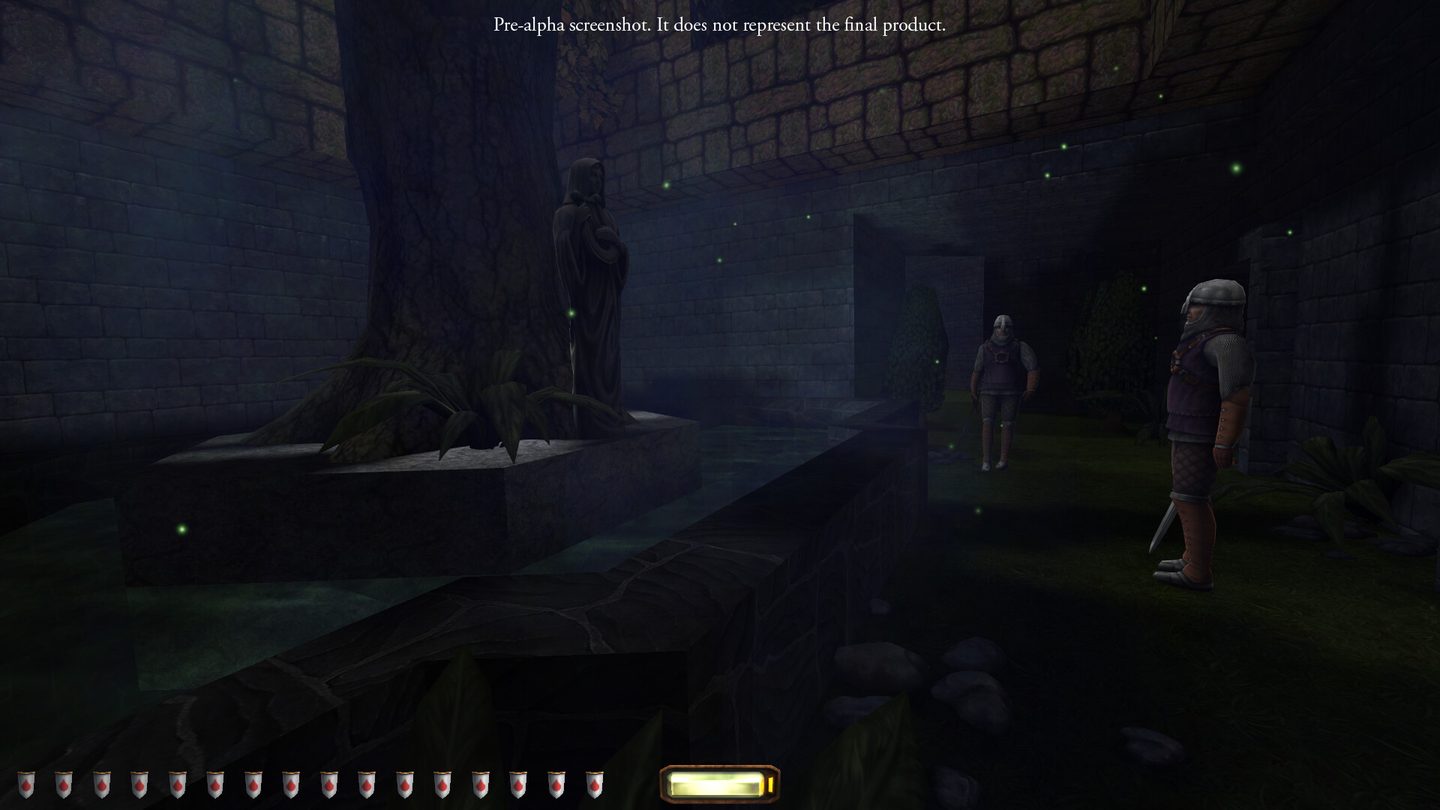
Thief’s stealth runs on the lighting. The light gem in the middle of the HUD samples the illumination where Garrett is standing and shows it back to you, and the AI’s chance of seeing you is driven off roughly the same value. That single loop is why the game still works twenty-eight years on. The thing you are reading is the room itself, and it is legible at a glance because a lamp looks like a lamp.
Which puts a hard floor under the remaster. The light is baked — lightmaps computed offline and stored in the mission file, the way a 1998 engine had to do it. The gem samples the bake. So you cannot relight a Thief level to modern taste. Lift the exposure, warm up the torches, throw in a bounce pass, and you have quietly moved where the player is safe. Every shadow in the game is a decision somebody placed, tested and signed off. The bake is the record of it.
New missions inherit the same rule from the other side. For whoever is building The Tarnished Mirror, the lighting pass is the stealth pass. Get a corridor a shade too bright and a patrol route that read fine on paper stops working.
That kind of tension — where the new thing added on top changes how the old thing reads — is the recurring problem with remasters. Ubisoft ran into a small version of it this month and shipped a switch: Black Flag Resynced now lets you turn the perk glow off, because an emissive aura nobody asked for was sitting on Edward’s gear in a game whose whole look predates that idea.
Rooms you can’t see
There is a second layer under every Thief level, and it is invisible.
Dark Engine geometry is carved rather than assembled — you subtract rooms out of solid space, and the engine chops the result into cells and portals so it knows what can see what. Over the top of that, an author hand-places room brushes: volumes that carry no geometry at all and exist so the engine knows where sound goes, where AI can hear, which space an object is in. Footstep noise on stone against carpet, a guard hearing you two rooms away through an open door — that comes out of the room graph, not the visible walls.
So a new Thief mission is really two builds. The one you look at, and the one you listen through. Miss a room brush and nothing breaks visually. The level just goes deaf in one corner.
Why the fan campaigns pin everything down
The best promise on that store page is the smallest one. Support for custom campaigns made for the original game. Twenty-eight years of community missions — some of them longer and better constructed than the shipped campaign — become playable at 4K without anyone porting them one at a time.
To do that, KEX has to keep reading the original mission format, brushes, lightmaps, room graph and all. Which in turn sets the ceiling on how far Nightdive could modernise the renderer even if it wanted to. You cannot swap in a dynamic lighting model underneath a format whose light is a stored array, and you cannot re-portalize twenty-year-old fan levels on load without breaking the ones that exploited the quirks. The compatibility promise and the visual restraint are the same decision.
Restoration work keeps arriving here. The source sets the ceiling. No amount of budget lifts it — the same wall a 4K scan of 35mm cel animation runs into, where the resolution is free and the thing being scanned simply has no more detail in it.
What is actually confirmed
Confirmed: The Tarnished Mirror exists, three story missions, five new enemy types, reveal on 2 November 2026, remaster dated to a winter window, KEX, 4K/120, fan campaign support.
Not confirmed: what Nightdive is authoring those missions in. Nothing published says whether the new levels were built in DromEd, the original in-house editor that eventually reached the public, or in something the studio wrote itself against the same file format. For anyone who has ever fought that editor, it is the single most interesting question about the whole campaign, and 2 November is when we find out.
Campaign details, reveal date and feature list from Nightdive Studios’ teaser and the Thief: The Dark Project Remastered Steam page, as reported on 11–12 September 2026 by PC Gamer, TheGamer and Eurogamer. Dark Engine specifics — baked lightmaps, the light gem, room brushes, subtractive geometry — are long-documented behaviour of the 1998 engine and its editor, not statements from Nightdive about the remaster.