There is a shot in the second season of Netflix’s Avatar: The Last Airbender where Aang lies down against Appa in a barn and nothing happens. No bending. No Fire Nation. A boy resting against an animal, the camera drifting up off Appa’s face and onto the actor, held long enough that you end up looking at the surface.
Nobody filmed fur in that shot. What the actor is lying on is a chroma blue-black dummy with foam under it.
Season one built the fur for real
Appa began as a physical object. The production put up a large structure covered in fur, solid enough that actors climbed on it and rode it, which is a good deal more real object than Momo ever got.
Anyone who has worked a creature show knows what that buys. An actor resting on something that holds their weight rests differently. Contact shadows land where contact happened rather than where a comp artist guessed. Hair gets crushed under a forearm and stays crushed for the length of the take. The eyeline is a thing in the room instead of a number the supervisor shouts from behind the monitor, you can light it, and the grips can rig to it.
Then the material came back and read synthetic. Framestore VFX supervisor Ross Wilkinson, talking to What’s on Netflix about the season two work, describes season one as having an Appa back with fur on it that had to be largely cleaned out and replaced with a CG groom anyway. The build survived. The pelt did not.
Motion forgives fur, stillness does not
Fake fur is fine in motion. A bison charging through a shot at speed gives you motion blur, changing light, a camera that is busy, and an audience with no time to study anything. Push all that through a 24fps shutter and the eye fills in what it expects to see, which is why a practical pelt reads perfectly well in the action beat and comes apart in the quiet one.
Stillness takes all of that away. The camera settles, the light settles, the actor settles, and the shot hands the viewer several uninterrupted seconds with nothing to look at but the surface. Now the things that make manufactured fur manufactured are the whole frame: fibres of one length where an animal’s would vary, an even density where an animal has thin patches and cowlicks, a reflectance too consistent across the whole pelt, clumping that broke the wrong way when someone last brushed it. Real fur is inconsistent in ways nobody has ever finished cataloguing. Fake fur is inconsistent in about four ways, and after ten seconds you have seen all four.
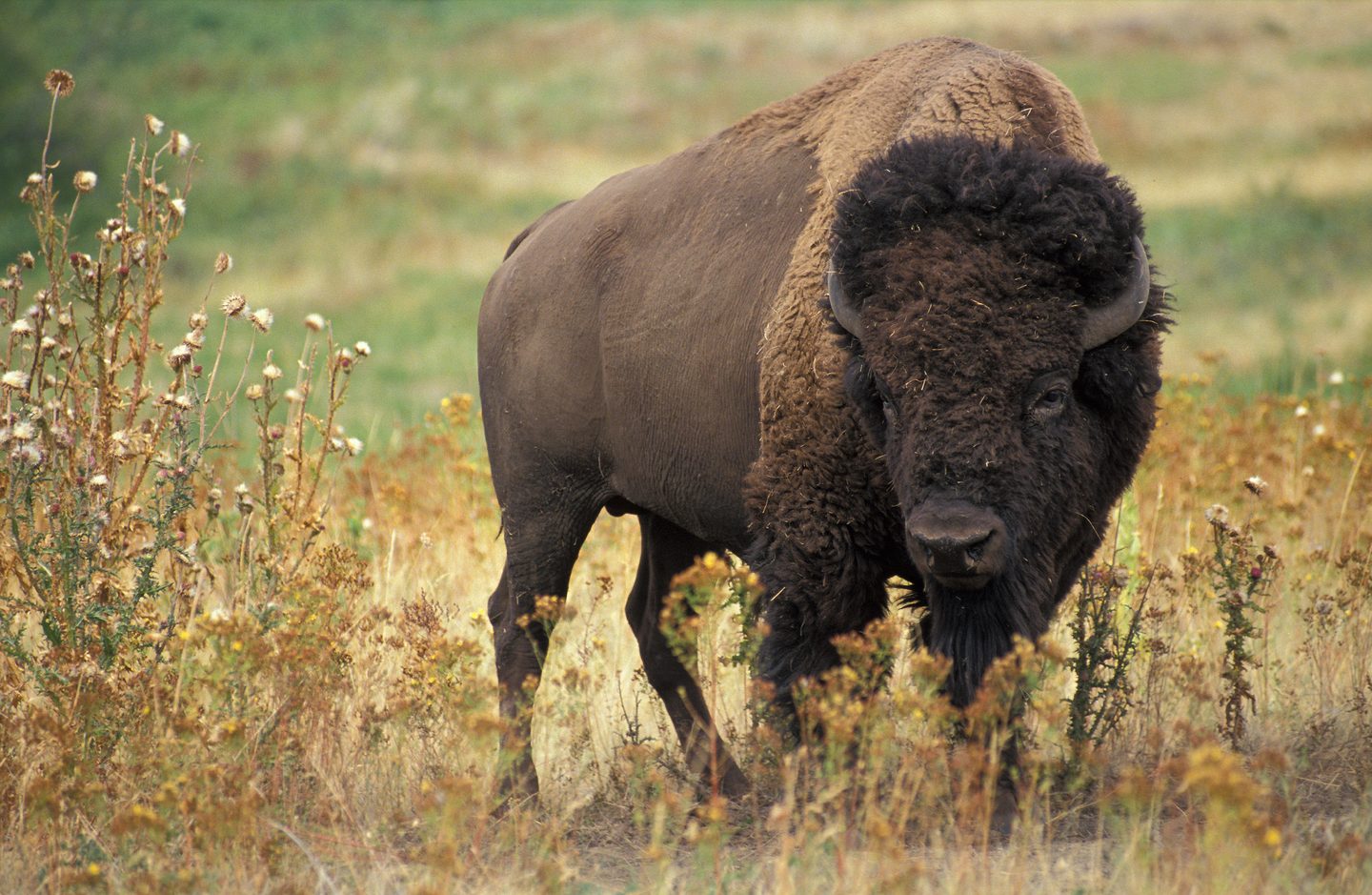
Go and look at a bison in winter if you want the reference Framestore was chasing. The coat is four or five different lengths depending on where you are on the animal, it mats differently on the shoulder than on the flank, and the hump is a completely separate problem to the rump. The season one team reached for manatees and hippos as well, hippos in particular for how Appa moves through air — slow, heavy, unhurried.
Season two stopped pretending
For season two there is no transition into practical groom at all. It is CG from the skin out, and the on-set object was rebuilt for the one job it is still better at than a computer: being somewhere.
So Wilkinson’s team shot the barn against a chroma blue-black material with foam underneath it, tuned so the actor compresses into it and the body reads as something that gives. Weight, contact, occlusion, the actor’s arm meeting resistance — that all comes off the plate. Everything from the surface outward is grown in post.
That division of labour is the modern creature pipeline stated as plainly as it ever gets, and it is worth noticing which half moved. HBO went the opposite way on Lanterns and built a real ring suit rather than rendering one, which worked because a suit is fabric and panel lines and a human inside it, all surfaces that photograph honestly when they sit still. Fur does not have that property, and no amount of budget gives it one.
Millions of hairs, and most of them in one place
Wilkinson puts Appa’s coat in the millions of individual hairs, which on its own is unremarkable for a modern groom. The interesting number is the distribution. For the shots where Aang is pressed into him, Framestore built a denser pocket of hair on Appa’s head, around the point of contact, carrying roughly as much hair as the entire rest of the animal.
Anyone who has fought a groom will recognise that immediately. Hair density is not spent evenly, it is spent where the camera is, and the camera in this season is repeatedly six inches from a boy’s face buried in an animal’s neck. The pocket is a hero asset living inside a hero asset. It also means the barn sequence is not cheaper than the flying, whatever the storyboard suggested, and somebody had to argue that in a bid meeting.
Aggressive airbending
The other season two problem Wilkinson has talked about is Appa defending himself. Long Feng and the Dai Li take him, and the show needed what has been described as aggressive airbending — Appa’s own defence mechanism, coming from the animal rather than from Aang.
Consider what that asks for. Every piece of bending established so far has a human body driving it: a stance, an arm that winds up, a readable moment of intention before the element moves. The choreography carries the physics. Take the human out, put a six-tonne flying bison in its place, and the vocabulary has to be rebuilt from nothing. A bison has no wrists to snap. Its tail is the only limb shaped for a big sweeping gesture, and it hangs off a body that weighs as much as a truck, so anything it does has to look like it cost something to do.
Air is also the element with no material. Fire has light and colour, water has refraction and a surface, earth has geometry that breaks. Air has to be inferred entirely from what it does to everything else — dust lifted off a floor, cloth snapping, hair laid flat, shimmer where the density changes. The whole effect lives in the set dressing, which means the FX work and the environment work get planned as one thing rather than handed off.
Three months late, which is normal
Season two dropped complete on 25 June 2026, and the breakdowns are landing now, in the back half of September. That gap is standard. Vendors sit on their reels until the show has finished its run and the client says yes, so the trade reads the craft of a season a quarter after the audience has moved on.
The season was split across several houses, as a show this size always is. Rodeo FX published numbers for its share: 163 shots, 14 sequences, 15 assets, 14,286 frames, 117 people. Its brief was the ground — earthbending, which the studio says it had not tackled before, built out of sand simulations, crumbling rock and shattering debris on custom solvers, plus Toph Vision, an Avatar State digital double and the Soul Glow work. The Boulder fight is the showcase, and it is three problems stacked in one sequence: rock animation, a crowd, and a vision effect that has to read as a different mode of seeing without turning the shot into a filter.
A hundred and seventeen crew for a hundred and sixty-three shots, on one vendor’s portion of one season. Folks managed more than 600 shots on Chad Powers as the only vendor with a smaller headcount, which reads like the better deal until you remember that crowd extension is a problem you solve once and then repeat across a stadium. Creatures do not repeat. Every shot of a furred animal in contact with a human is its own negotiation between a plate and a simulation, and Appa is the show that decided to stop having that negotiation on set.