The Battle of Tumbleton closed House of the Dragon’s third season on 9 August, eight episodes after the season opened on 21 June. When the wall of fire comes through the town gate, a good part of what you are watching is a real flame. HBO’s behind-the-scenes featurette describes a flamethrower set up on the far side of the gate, firing through the structure, with the dragon Caraxes digital above it.
A conference talk doing the rounds this week fills in the other half. At Houdini HIVE Equinox 2026 on 22 September, Bahador Mehrpouya, FX supervisor at Rodeo FX, gave a talk called “Raining Fire: Building the Battle of Tumbleton’s Fire Simulation for House of the Dragon Season 3”, and befores & afters pointed at the recording on 1 October, which is how I came to it.
I should say up front that I have not watched it. The pages hosting it are closed to me from here, so what follows is read off the session abstract and off what the production has said publicly about the shoot. The abstract is unusually specific about where the difficulty sat, which is enough to work with.
Three things, in its own order: scaling fire simulation to battlefield proportions, the look-development choices that gave Tumbleton its visual signature, and the workflow innovations the production developed to get there.
Fire does not scale
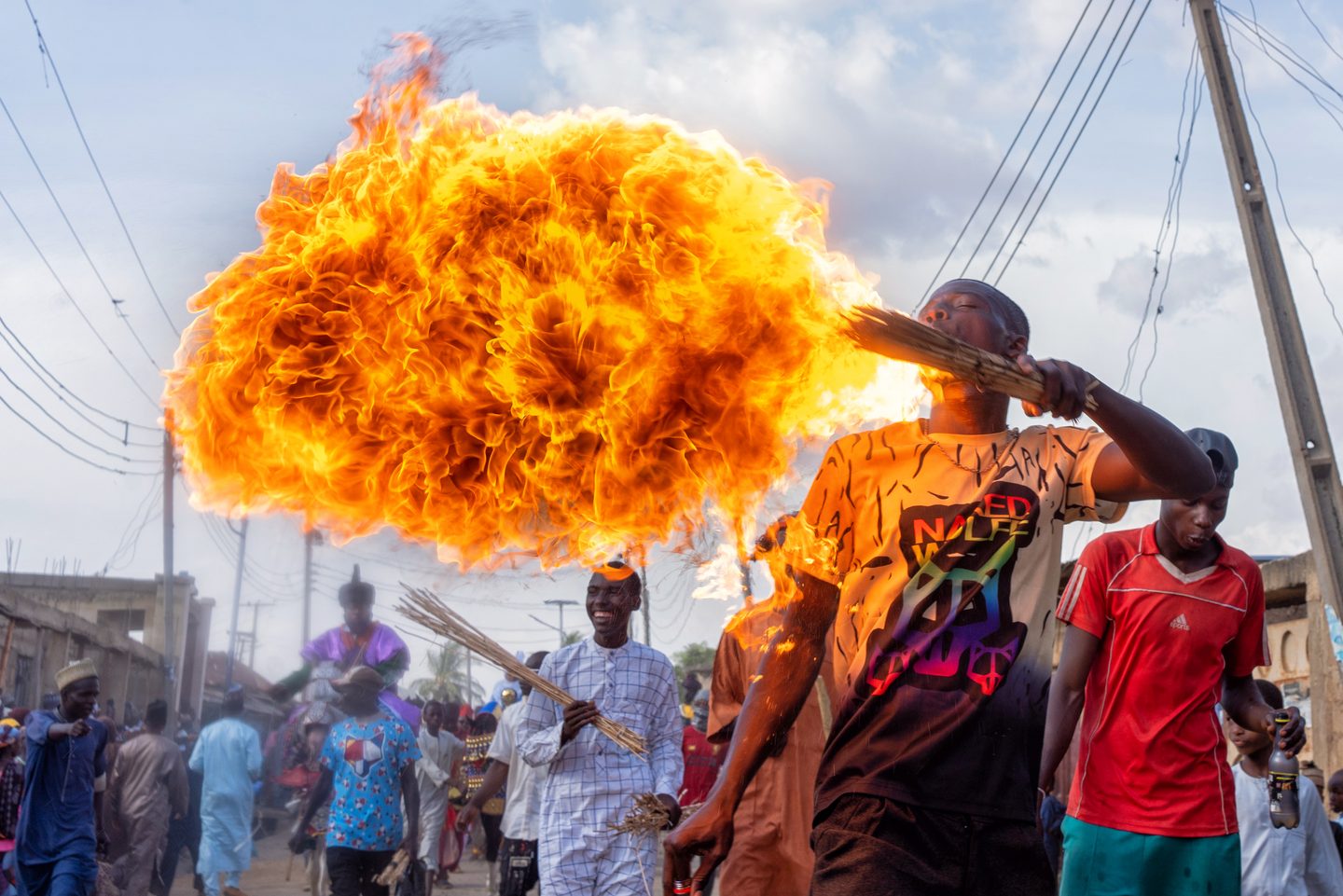
A dragon breathing once at a castle gate is a single simulation. You can throw resolution at it, push it through a few rounds of notes, cache it and hand it to lighting. Season three asked for something different — per the abstract, dragonfire as a sustained, sky-wide barrage coming down on whole armies rather than one dramatic strike.
The reason that is hard is that fire genuinely does not scale. A pyro solve is driven by physical quantities: buoyancy, cooling rate, the size of the voxels you are sampling turbulence into. Take the setup that gives you a convincing one-metre flame, scale the whole thing up until it covers a field, and what you get reads like a tabletop effect shot in slow motion. Too much fine curl. Dissipation that happens far too quickly for the mass on screen. Smoke that has lost its argument with the flame feeding it.
Big fire behaves differently. It moves slower than you expect, holds its gross shape much longer, and loses its detail at the edges rather than throughout. Finding that is look-dev the first time. After that it is arithmetic, because every one of those qualities costs voxels.
And there is never one of them. A barrage means dozens of sources that have to agree — with each other, with the plate, and with the dragons flying over the top. Same cooling, so two fires at the same height are the same colour. Same timing, so the fire lands when the wing beat says it should. Same light reaching the same armour in the foreground. Holding agreement across dozens of simulations is a different discipline from making one of them beautiful, and it is the one that eats schedules.
Why workflow is the word in the title
Put rough numbers on a sequence like this — mine, not Rodeo FX’s — and the shape of the problem shows up. Volume caches at battlefield scale run into terabytes. Solves run overnight, sometimes across a weekend. The note that changes the timing of the barrage arrives after the cache is written, because that is when the sequence first becomes watchable.
A pipeline that answers a late note by re-simulating everything will lose. So the interesting work in a sequence like Tumbleton goes into layering: a few hero solves carrying the look, cheaper elements filling the field, and a structure that lets you add or retime a layer without touching the ones already signed off. The blog covered a neat version of that problem earlier this week in Houdini’s own toolset — adding fracture detail to a rigid-body sim that has already been approved rather than re-running it. Same instinct, different solver. Protect the cache you have already paid for.
It also rhymes with the season’s other big set piece. When I went through the Battle of the Gullet in August, the ships turned out to be the hard part — an asset and pipeline story wearing a dragon story’s clothes. Two set pieces, two departments, the same conclusion about where a season of this size is won.
The flamethrower earns its place
A show with eight visual effects vendors on it could have made that gate fire entirely in Houdini. Putting a real flamethrower behind a practical set still pays, for reasons that have nothing to do with purism.
Interactive light is the big one. Real flame throws moving, uneven, coloured light onto faces, onto wet stone, onto the inside of smoke, and it does it with the falloff and the flicker that a comp-side glow only approximates. Lighting gets a ground truth to match instead of a taste argument. The cast get something to flinch at.
Then there is the look target. Once a plate carries real fire, every simulation cut next to it is judged against that reference rather than against the memory of the last fire the department made. That constraint is what keeps a long fire sequence from drifting into orange soup by episode’s end.
And the small things nobody budgets to model: ash, heat shimmer off the ground, the way a lens responds when something that bright enters frame.
The 1/100-scale model of Tumbleton the production built before shooting is part of the same logic. A fire simulation has no opinion about how large the town is. Somebody has to decide, early, and hold everyone to it.
What is still not public
Rodeo FX shared the season with Pixomondo, Weta FX, RVX, Zoic Studios, Red Visual Effects, Digital Domain and Incessant Rain Studios. Beyond the fire work in this one talk, there is no shot-level account of who delivered what, which for a season built on two enormous battles is a thin public record.
The recording is out there, and it is the part I want. An abstract will tell you that scale was the problem. Only the talk will say what they did about it.