House of the Dragon’s third season closed out its eight-episode run on 9 August, four days ago as I write this, and season four is already confirmed. Good — because the episode people keep bringing up is not the finale. It is the Battle of the Gullet, the season’s big naval set piece, and the more I read about how it was actually made the less it looks like a dragon story and the more it looks like an asset-pipeline story. Which is exactly the kind of thing I can’t resist picking apart.
Three theaters, not one battle
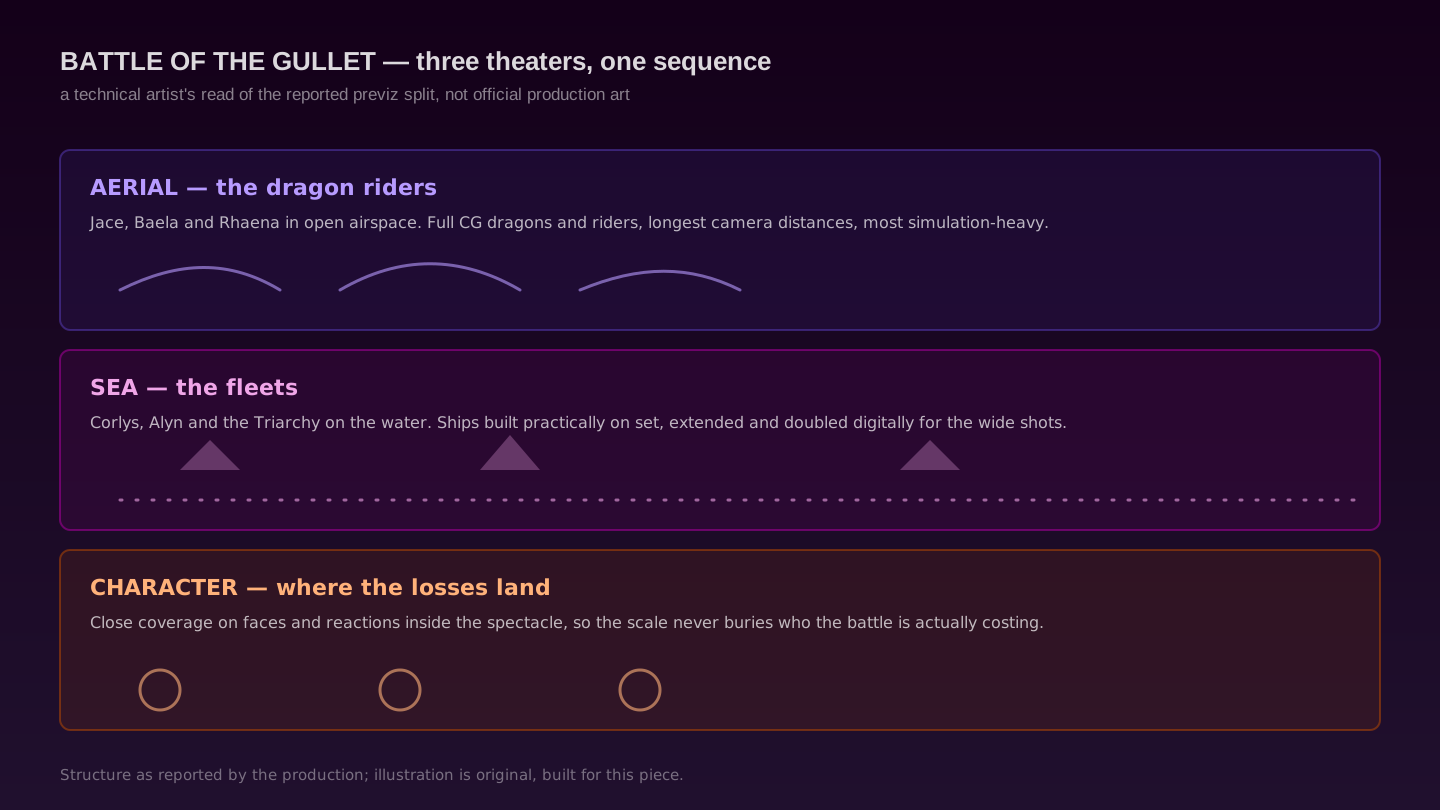
Showrunner Ryan Condal has called the episode, in his own words, close to the craziest thing television has attempted — the production-effort equivalent of a franchise movie, for a single hour of TV. What made that manageable at all, by his account, was refusing to treat it as one giant battle. The directing team split it into three storytelling theaters and previsualized each one on its own: the dragon riders — Jace, Baela and Rhaena — fighting in open air; Corlys, Alyn and the Triarchy fleet fighting on the water; and a third, quieter thread of close character coverage running underneath both, so the spectacle never buries who the battle is actually costing.
That structure is the part I’d steal for any large production, VFX or not. Previz-by-theater turns one unmanageable sequence into three sequences with independent shot lists, independent asset needs and independent review passes — you can lock the character coverage while the aerial unit is still iterating on dragon flight cycles. It’s the same instinct as splitting an open-world environment into biomes before anyone touches a single asset: break the impossible thing into pieces you can actually finish.
The ships were the real technical problem
Here’s the part that surprised me. Production VFX supervisor Dadi Einarsson and his team have spent three seasons refining how the dragons move and read, and that work shows — but the hardest asset problem in the Gullet sequence, by the crew’s own account, was the ships.
The fleet was built practically wherever actors needed to stand on deck, and then extended, doubled or fully replaced digitally for anything wide or effects-heavy — which in a naval battle is most of it. That’s a routine practical-to-digital handoff. What isn’t routine is how well it worked: Weta FX’s visual effects supervisor on the sequence, Nick Epstein, has described the crew running what he called Pepsi challenges on their own shots — genuinely unable to tell, without checking the plate, which ship in frame was the built set and which was the digital extension.
That’s the bar. Not “looks good on a TV screen” — indistinguishable to the people who built both versions, looking for the seam on purpose. Getting there on a hero asset is hard enough. Getting there on a fleet, where every hull has to survive close-ups on set and hold up in VFX-driven wide shots without the seam showing between the two, is a much bigger ask, because the digital ship has to match not just the geometry of the practical one but its specific wear, its specific waterline, its specific way of catching light on that specific day.
And underneath all of it was the actual stated hard problem: water. Dragons are enormous and they do not sit still near it — every pass, landing and strike had to displace, splash and settle convincingly against ships that were themselves half practical, half digital, in a body of water that was entirely simulated. Water sim punishes bad thinking, because the eye is calibrated on it every single day, in a way it just isn’t for dragon flight. You can get away with an unusual wingbeat. You cannot get away with water that doesn’t weigh anything.
The dragons still had to earn their character
None of which is to undersell the creature work — it’s just not where the season’s hardest new problem lived. Einarsson has talked about the show’s three-season arc for its dragons in terms I recognize immediately: the goal was never scale or color variation, it was giving each animal, as he put it, its own nuanced and multifaceted character. Season 3 leaned on that with Sheepstealer, introduced as a stray who was never raised by dragonkeepers and so never learned the house manners the Velaryon dragons were taught — and that backstory is meant to read entirely through how the animal behaves on screen, not through exposition.
It’s worth remembering how large that differentiation problem actually is. This show is tracking well over a dozen dragons across multiple factions, and the audience needs to identify most of them at a glance, mid-battle, at a distance, in poor light — the exact silhouette-and-gait problem I keep running into from the opposite direction, trying to make one hero creature read clearly against a background. HotD is solving it at fleet scale: each dragon needs a distinct flight profile, a distinct way of holding its neck, a distinct temperament in how it commits to an attack, so that “which dragon is that” is never a question the shot has to answer with a name card. When Vermax died in the season premiere, Einarsson noted that the audience reaction was grief for the character, not commentary on the water simulation around him — which is the actual goal of all of this work. Nobody notices the sim when it’s right. They only notice the dragon.
Worth noting, since it’s the same industry
One footnote that’s easy to miss: Pixomondo, one of the VFX houses credited on this season alongside Weta FX, Rodeo FX and several others, is the same studio Sony announced back in March it was winding down, folding its work into Sony Pictures Imageworks in Vancouver. It’s a five-month-old story at this point, not new — but it’s a reminder that a season this technically ambitious was built across a vendor list that was already shrinking while the work was happening. The craft holds up. The industry underneath it is still contracting.
Sourced from interviews and reporting on House of the Dragon Season 3’s production in Variety, GoldDerby and the trade press covering the show’s VFX credits; quotes are as reported by those outlets. All images on this page are original diagrams and typography made for this article, not stills from the show.