Watch a close-up in BEASTARS and wait for the head turn. A normal CG character rotates and the face stays rigid — same nose, same skull, seen from a new angle, because that is exactly what a model is for. Orange’s characters do something else. The features slide slightly. The nose holds a shape it should have lost ten degrees ago. It reads as a drawing, and a drawing is allowed to lie about anatomy in a way a mesh is not.
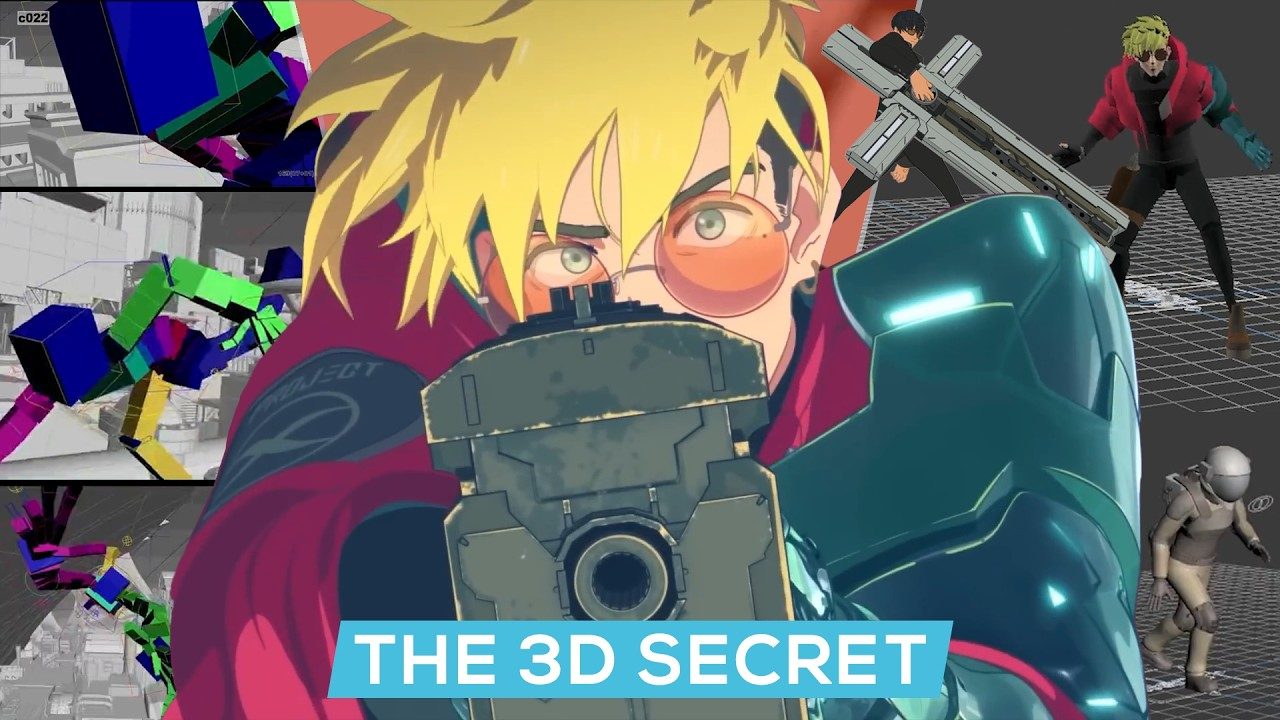
A behind-the-scenes breakdown has been going round this week — Class Creatives working with Hobbes Sakuga — walking through how the studio gets there. Almost everything that gives Orange its look has already happened by the time anything reaches the shader.
Throwing frames away on purpose
The first thing Orange does is refuse the frame rate. CG on television is usually rendered at a steady 24 — every frame new, motion continuous, because smoothness is what the hardware gives you for free and nobody thinks to decline it. Hand-drawn anime almost never works that way. A key animator holds a pose for three frames, snaps to the next one, holds again. The stutter is half the language.
Eiji Inomoto, who founded Orange in 2004 after CG work on Ghost in the Shell: Stand Alone Complex, has talked about dropping frames on his early television jobs — the Zoids CG, back when the received wisdom was that CG should look as fluid as the renderer could manage, and dropping frames looked like a fault rather than a choice. He kept doing it anyway.
What makes it hard is that it is not a global setting. The stepping changes inside a single shot. A body might run on twos while the cape runs on ones, because cloth reads as cloth only when it moves continuously, and the character reads as drawn only when it does not. So somebody decides, per element, per shot, how much of the simulation survives. That decision does not live in a file you can copy to the next episode.
The model is wrong on purpose
The shading is the part everyone photographs, and it is genuinely clever — normals pushed around so a curved surface takes flat light and a face holds one clean shadow shape instead of the soft gradient geometry wants to give it. But edited normals are a solved problem. Plenty of studios do it. Nobody else gets Orange’s result from it.
The rest of it is worse, in the sense that pipeline people mean when they say a thing is worse. Orange employs 2D animators inside a 3D production. They draw guide animation for the CG animators to match, and they correct faces after the first pass. They draw the expression as it should have been, and that drawing gets worked back into the geometry for that shot, at that camera angle. The model that shipped in episode four is not quite the model that shipped in episode two.
That is the trade. Everything Orange does to make a frame read as hand-drawn is local to the frame. A bent silhouette works from one camera. A hand-corrected mouth shape works for one line of dialogue. The whole promise of a CG pipeline is that you build the asset once and amortise it across a season, and Orange keeps spending that saving back, shot by shot, to buy something a drawing gets for nothing.
Which is roughly the problem Imageworks solved for Spider-Verse by building ink lines that follow a moving face, and the reason that solution took a feature-film R&D budget. A drawn mark on a 3D surface wants to slide. You either build machinery that stops it sliding, or you pay a human to redraw it every time it does. Orange, for a long stretch, chose the human.
Why nobody has copied it at scale
The methods are public. Orange staff have described them at length for years, and the technique has stayed rare anyway, because it resists the thing studios buy CG for. You cannot staff it up quickly, because the judgement — which frames to drop, which silhouettes to break — sits in the heads of people who have done it for a decade. You cannot outsource a shot easily when the shot’s assets are unique to it. And you cannot promise a producer that episode nine will be cheaper than episode one.
It also explains the studio’s output. Orange makes a small number of shows and they look like nothing else, which is what happens when a pipeline is optimised for a look rather than a throughput number.
Worth remembering what the target actually is. Cel animation has a specific material character — ink edge on the front of the acetate, paint behind it, each layer catching light slightly differently — and when you scan it at 4K you can see where that physical stack starts to hit its own ceiling. Orange is chasing the memory of that stack rather than the stack itself, which is looser, more forgiving, and — judging by how long the studio has been closing in on it — still extremely difficult to hit with a renderer.