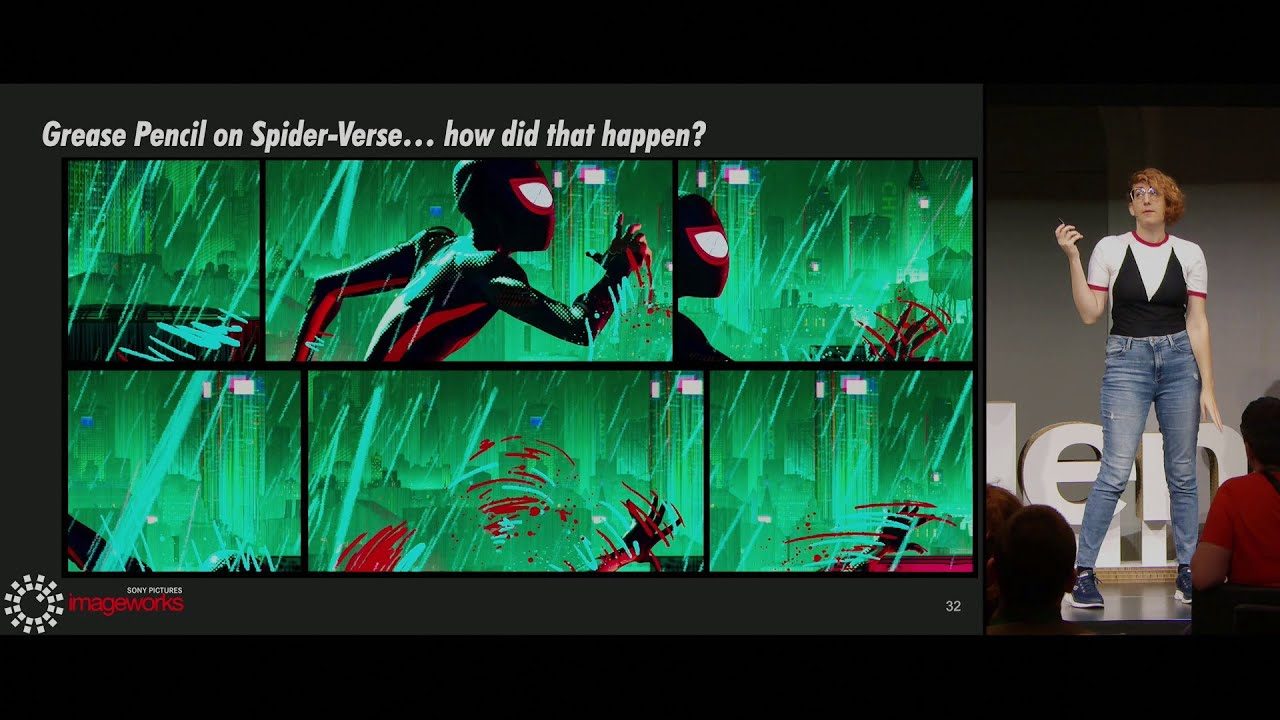
Draw a line on a character’s cheekbone. Hold the frame and it reads as ink — a confident hand-drawn mark on top of a render, exactly the thing everyone has been chasing since 2018. Now play the shot. The head turns, and the line stays where you put it, sliding off the face like a smudge on the lens.
That is the whole problem. Everything else in stylised linework is bookkeeping.
A hand-drawn stroke has no idea what it was drawn on. It knows a position in space and a time, and a face that moves underneath it might as well be weather. Get one line to hold and you have solved a shot. Get every line on every character to hold, across a feature, drawn by people rather than generated by a shader, and you have solved a film.
Sony Pictures Imageworks solved it twice, expensively, and the second solution was a department.
What it cost the first time
Into the Spider-Verse had a dedicated inking team — people whose job was to put marks on frames that a renderer had already finished with. Artists who worked on it have described that as the first they had heard of on a CG animated feature. Staffing a crew to do it means the studio had already concluded the look could not be shaded into existence. Somebody had to draw it.
By Across the Spider-Verse in 2023 that conclusion had turned into tooling. The main one is Kismet, a linework system built inside Houdini under FX supervisor Pav Grochola, and the descriptions of it are all about handing control back: different kinds of line for different worlds, lines that redraw themselves continuously rather than being locked to one frame, the whole thing procedural but driven by artists rather than by a solver. Gwen’s Earth-65, Mumbattan and the Vulture each needed their own line behaviour, and one tool had to make all three without a rewrite.
Around it sat a scattering of smaller things. A curve system in Nuke for hand-drawn strokes. Hatching tools that ran interactively, in Nuke, at a responsiveness a compositor would tolerate. Miguel’s face got curves drawn with an early version of the Nuke tool, then rigged to the model and rendered through Katana — drawn once, bound to a rig, and after that it was the rig’s problem rather than the inker’s.
Blender is in there too, which is the part that tends to surprise people. Imageworks artists took the inklines workflow to the Blender Conference in 2023 and talked through how Blender ended up in the pipeline at all, and how curves get generated in 3D space so that linework and the 3D render agree with each other.
The bit Blender was missing
Grease Pencil could always draw in 3D. What it could not do, for most of its life, was be operated on. A stroke was a stroke. You could parent it, key it, push it through a modifier or two, and past that you were writing Python.
Blender 4.3, at the end of 2024, changed the category the data belongs to. Grease Pencil became geometry that Geometry Nodes can read — points with positions and radii and attributes, evaluated fresh on every frame like any other node tree output. One line in a release note, and it separates a drawing that sits in front of a character from a drawing that belongs to one.
Because once the stroke is geometry, sticking it is a graph rather than a feature request. Sample the nearest point on the deforming surface. Keep what you found — a face, a coordinate, an offset along the normal. Re-evaluate that lookup per frame instead of the position you drew at. The line stops living in world space and starts living on the mesh, and when the head turns the line goes with it because it was never really at that point in space to begin with.
Derek Flood published a walkthrough of exactly this last week, using animation by Tiffany Huang in the painterly register of Gwen’s world. One person, no proprietary anything.
Why binding a mark is never free
Here is where I would slow down before promising anyone a Spider-Verse look by Friday. The moment you attach a 2D mark to a 3D surface, you inherit every problem that surface has.
Surfaces stretch. A line bound across a cheek and a jaw will get dragged when the jaw opens, and ink that stretches stops reading as ink — the weight goes wrong, and line weight is most of what makes a mark look drawn. Surfaces also turn away. A stroke on the far side of a head is still perfectly valid geometry; it just should not be visible, and nothing about sampling a mesh tells you that. Occlusion has to be handled on purpose or the character wears their linework like a net.
And every one of these has a threshold where the fix starts fighting the look. Too little correction and lines swim. Too much and they lock down so hard they read as a shader, at which point you have spent a week of node work arriving at an outline modifier.
This is the same trade that shows up any time a drawing has to survive a camera. Projecting a 2D concept onto a ZBrush sculpt gives you something that looks hand-drawn from one angle and comes apart the instant you orbit it, which is fine when the deliverable is a turntable-free hero image and fatal when it moves. Tools like PaintBridge projecting paint back onto Blender geometry live in the same territory — the projection is the easy half, and everything that happens after the camera moves is the work.
What a tutorial does not hand you
Imageworks had a linework department, a tool with a name and a supervisor, and several years across two films to find out where it broke. A node graph you built on a Sunday gives you the mechanism. It does not give you the taste calls that mechanism was built to serve: which lines are drawn once and inherited, which are redrawn every frame on purpose because the flicker is the charm, how much a line is allowed to stretch before an artist would have redrawn it by hand.
Those calls are why the films look the way they do, and they are not in any node tree. What is genuinely new is that the price of asking the question has collapsed. Getting an ink line to hold on a moving face used to require a studio willing to fund the attempt. Now it requires an evening and a mesh with decent topology.
Kismet, the Nuke curve and hatching tools, and the Katana render path for Miguel’s face are as described in published coverage of Across the Spider-Verse (fxguide, VFX Voice and befores & afters). The Blender Conference 2023 inklines presentation and the SIGGRAPH 2023 linework talk are both listed publicly; the SIGGRAPH paper itself I could not open at the time of writing, so nothing above is drawn from it. Grease Pencil support in Geometry Nodes arrived in Blender 4.3. Derek Flood’s walkthrough was picked up by BlenderNation on 6 September 2026.