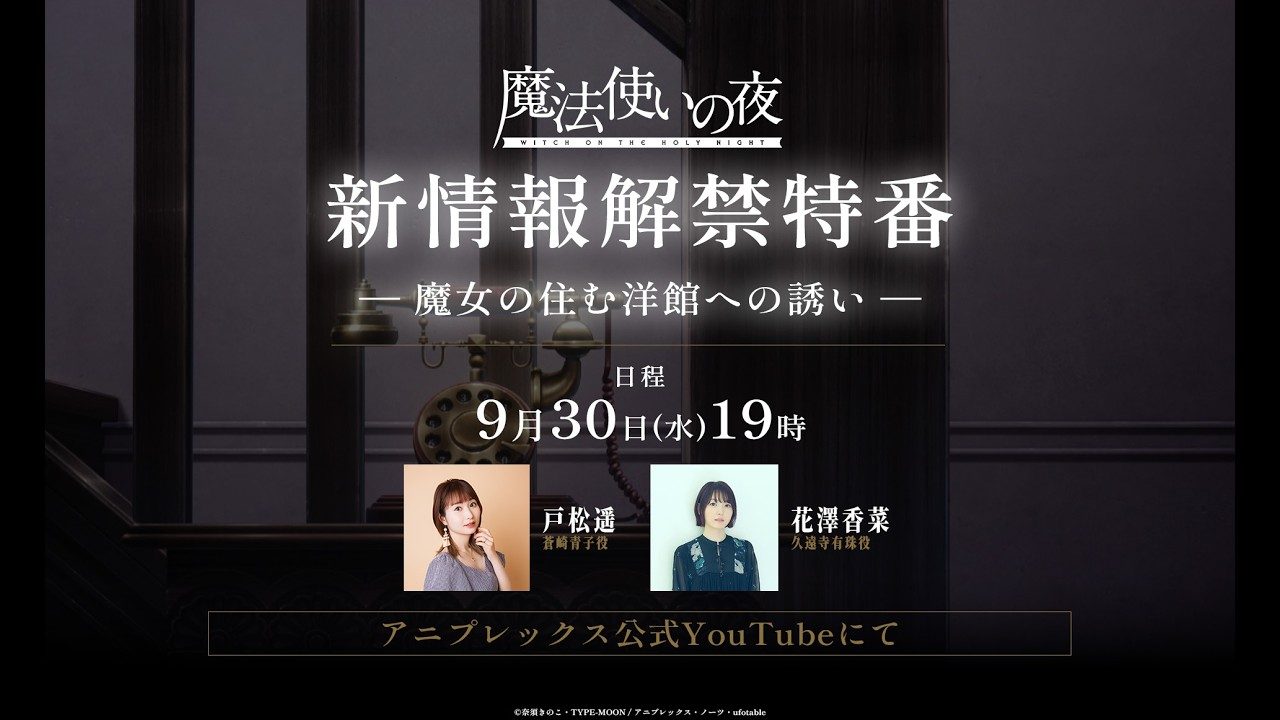
Aniplex ran an information programme for the Witch on the Holy Night film on 30 September and came out of it with the three things people were waiting for: a 90-second final trailer, a theme song, and — at last — a staff list. The film opens in Japan on 20 November 2026, with a global theatrical run following in January 2027.
The theme is supercell’s, with Nagi Yanagi singing; outlets covering the stream noted it is the first new supercell song she has sung in roughly fifteen years, which loops back to the visual novel’s own music. That is the headline most places ran with.
The line in the staff list that actually tells you what the film will look like is further down. Director of photography: Yuichi Terao.
Photography, in the anime sense
Outside Japan the credit reads like a mistake. There is no camera on an anime production. There hasn’t been film in the path for twenty-odd years.
The word survives from when there was. The photography stage used to mean an optical bench: cels stacked over a background, lights above and below, filters and diffusion gels in between, and a camera shooting the stack one frame at a time. Fog, glows, flares, the halo around a lamp — all of it was done there, physically, by the people operating the rig. When the whole industry moved to digital compositing in the late nineties the department kept its name and inherited the job.
So the director of photography on a modern anime is the head of compositing. Every glow, every depth-of-field falloff, every grade, every particle of atmosphere, every bit of grain goes through that desk. On most productions it is a finishing stage. On a ufotable production it is closer to the main event.
Terao joined the studio in December 2003 and has been its lead on photography for the run that made the house look famous: Fate/Zero, Unlimited Blade Works, the Heaven’s Feel films, Demon Slayer and its features. If you have ever watched a ufotable fight and thought the image seemed lit rather than drawn, that is his department.
What a visual novel actually hands you
Here is why that credit is more interesting on this film than on another Demon Slayer.
Mahoutsukai no Yoru is a Type-Moon visual novel from 2012. A visual novel’s images barely move. Character art sits on a painted background and the drama is carried by things a compositor does: a colour shift as the sun goes down, a rack focus onto a face, a slow push across a still, rain layered over the plate, the whole frame going cold when someone stops being friendly. Mahoyo was admired for doing a lot of that — people called it the best-looking thing Type-Moon had made, and they were describing effects work over static art.
Which means the adaptation problem is not the usual one. Normally you take a manga, with its drawn motion and its panel grammar, and you work out how much animation you can afford. Here the source is already a compositing-led piece of visual storytelling. The grammar transfers almost directly. The job is to take a language built out of filters and camera moves over stills and make it work at twenty-four frames a second.
Putting the studio’s strongest compositing lead on it is the obvious call, and it is the one they made.
The part that could go wrong
The glow is also the tell.
ufotable’s photography pass is heavy. Diffusion, bloom, atmospheric haze, a soft falloff on nearly every edge — it is gorgeous on a sword fight in a burning building, and it tends to treat every surface the same way. Line art loses its tooth under it. Texture flattens. A frame that should feel like paper feels like glass.
Mahoutsukai no Yoru is mostly two girls and a boy in a Western-style mansion in a snowbound town, talking. Long stretches of it are interior dialogue. Dialogue scenes are where a house style gets exposed, because there is no spectacle sitting on top to distract from it.
There is a version of this film where the photography department does the subtle work — lamp light that behaves like lamp light, snow outside a window that reads as cold rather than as a particle layer — and a version where every shot gets the same silk. The trailer suggests the first. Trailers are cut by people who know which shots are finished.
Worth putting next to what a shadow costs when the sheet itself blocks the light, where Honami Yano paints on transparent cel and the darkness in the frame is a physical event rather than a layer. Two opposite answers to the same question about where the image actually gets made.
And the optical bench that the word “photography” is a fossil of has its own ceiling, which is roughly what a 4K scan of 35mm cel animation runs into: past a point you are resolving the film stock and the dust on the glass instead of the drawing.
The rest of the list
Masashi Takeuchi directs, with Hikaru Kondo as chief director. Moe Tsuzuki on character design, Masato Nagamori as chief animation director, Koji Eto on art direction, Hideyuki Fukasawa on music. Takeuchi’s most-cited prior credit is episode direction on Mugen Train, which is a reasonable place to learn how this studio’s pipeline fits together.
Japan gets it on 20 November. Everyone else waits until January.