The closure notice went up on LinkedIn on 12 September, a day after the studio actually stopped. Attached to it was a Google Doc listing every person who had been at Polyarc when the lights went out — names, job titles, contact details, links to portfolios. Twenty-nine of them. A studio spending its last administrative act on getting its own team hired somewhere else is not a thing you see often, and it is the detail I keep going back to.
Polyarc was founded in Seattle by three people who came off Destiny at Bungie — Chris Alderson, Danny Bulla and CEO Tam Armstrong. Most of the write-ups say twelve years. The founding is usually dated to 2015, which makes eleven. I cannot reconcile the two and it does not change anything below.
What Moss actually was
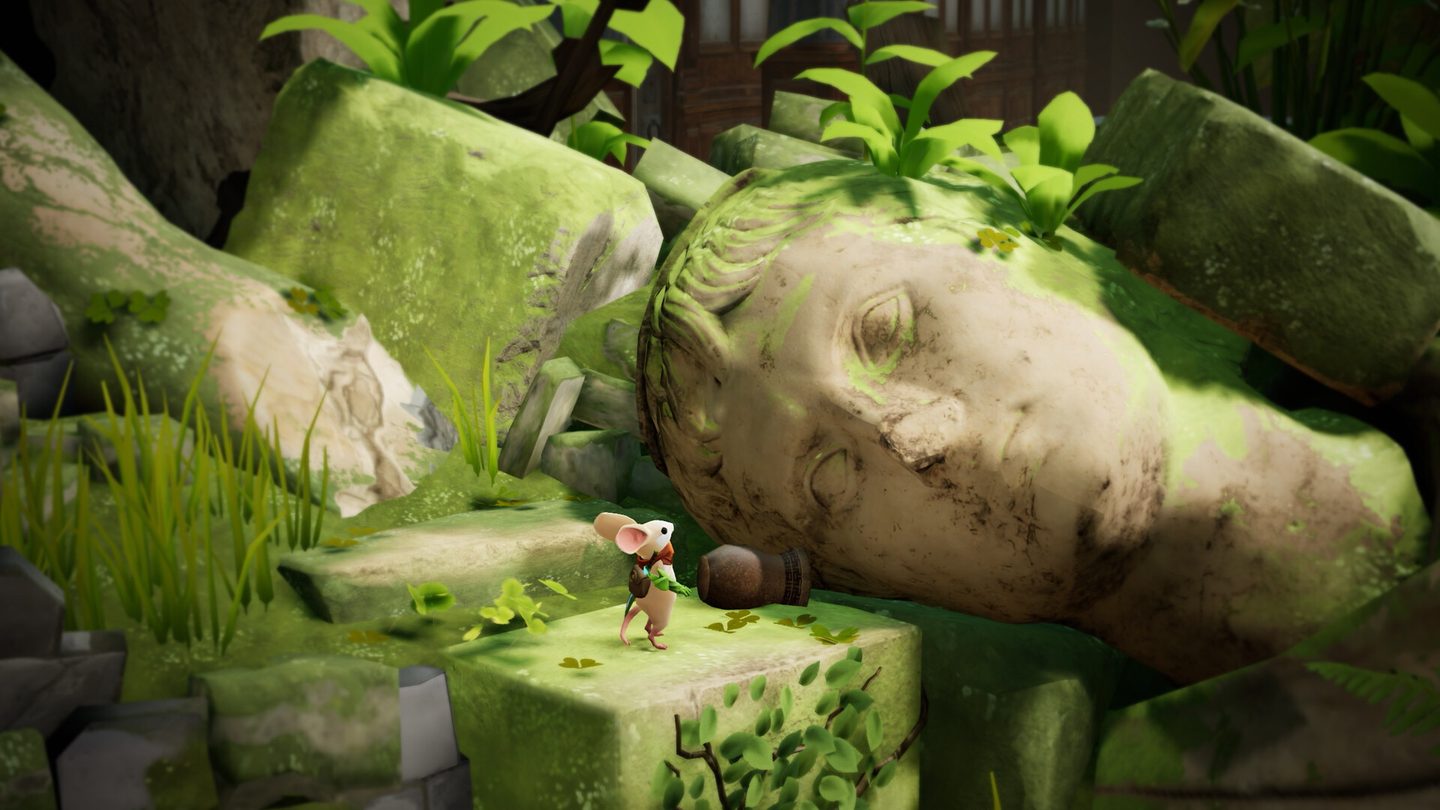
The first one landed on PSVR in 2018. You play a mouse called Quill, except you do not, quite — Quill is down in the diorama and you are above it, a presence she can see and occasionally asks for help. The book is open in front of you. You lean in. Book II followed in 2022 and kept the frame.
That setup reads as a storytelling conceit. It is also, and I suspect first, a budget decision, and a very good one.
What VR does to an art pipeline
Start with the frame contract, because everything follows from it. Ninety frames a second, two eyes, roughly eleven milliseconds to do both. A flatscreen game that drops frames gets complained about in a Digital Foundry video. A VR game that drops frames makes the player’s inner ear disagree with their eyes, and they take the headset off and do not put it back on. There is no graceful degradation. You hold the budget or you lose the person.
Then stereo takes away the toolkit. Nearly every trick real-time art has accumulated for faking depth is a trick played on one eye:
- Normal-mapped brick reads as a sticker on a flat wall the moment both eyes look at it.
- Foliage cards read as cards.
- Parallax occlusion mapping, which is genuinely convincing on a monitor, reads as a slightly swimmy painting.
- Screen-space reflections resolve differently per eye, so the reflection sits in two places at once.
- Motion blur and heavy depth-of-field, which flatscreen art leans on to hide aliasing and pop-in, are actively unpleasant in a headset.
What survives is geometry, silhouette and honest materials. Scale gets strict too. On a monitor you can quietly scale a prop up fifteen percent because it reads better in the composition, and nobody will ever know. In VR the player’s own arm is the ruler. A door at the wrong height is immediately a wrong door.
So the diorama. Bound the scene like a model box, fix roughly where the player’s head will be, and suddenly every polygon can go where someone will actually look — no horizon to render, no streaming, no LOD chain running out to two kilometres, light you can bake and trust. Moss looks expensive because the budget was spent in a box eighteen inches across instead of spread over a landscape.
That is a constraint turned into a house style, which this blog has an affection for: Orbitals animating its characters at 12 and 24fps on purpose is the same instinct arriving from a different direction.
The last move
On 16 July 2026 Polyarc shipped Moss: The Forgotten Relic — both games reimagined into one, on PS5, Xbox, both Switches and Steam, with Blackbird Interactive alongside. No headset required. It had gathered more than two hundred thousand wishlists before launch and did not convert them into the kind of revenue that keeps twenty-nine people employed.
Take the headset off a VR-native design and the diorama becomes a fixed camera. Careful, pretty, and competing with everything else on Steam that has a fixed camera. The leaning in was the mechanic.
The market underneath
None of this happened to Polyarc alone. Reality Labs lost $19.1 billion across 2025 by Meta’s own Q4 filing, against something north of $70 billion since 2020. In January Meta cut around 1,500 jobs there, roughly a tenth of the division, and shut first-party VR studios — the reports named Armature, Sanzaru, Twisted Pixel and Within, though the exact list moved around depending on who was writing. External funding and publishing support went with it. nDreams, one of the larger independents, laid off 78 people and closed two locations in March. Meta’s public enthusiasm has moved to smart glasses, where it can point at Ray-Ban growth of 211% in 2025 rather than a decade of headset subsidy.
A platform holder stepping back from first-party output is survivable. A platform holder that was also most of the third-party funding stepping back is a different shape of problem, and it arrives about eighteen months later, which is roughly now.
There is a version of this week’s news that reads as a studio failing. It did not. Polyarc shipped two well-reviewed games in a category with almost no audience, then did the sensible commercial thing and ported them out of that category, and the sums still did not work. It sits next to Bit Reactor furloughing most of its staff while its game was in Steam’s top sellers — two studios doing the work and two teams out of a job anyway.
Twenty-nine people now on the market know how to hit a hard real-time budget, model to true scale, and build depth with geometry rather than with texture tricks. Every one of those habits makes a flatscreen game better. The category that taught them is the part that is gone.
Closure date, headcount and the staff list from Polyarc’s own LinkedIn post and the Seattle coverage at GeekWire; Forgotten Relic release details from its Steam page; Reality Labs figures from Meta’s Q4 2025 earnings as reported, with the studio-closure list compiled from Engadget and The Game Business and noted above where accounts differ.