
Half a millisecond. That is what CyanideX reports the rain in Torrent costs on Ultra during a heavy storm — between 0.15 and 0.5ms a frame — and it is the most useful line on the whole mod page.
Torrent landed on Nexus Mods on 11 November 2026 and got picked up by the trade press over the weekend. It replaces Night City’s rain with individual 3D drops that fall through the world in depth, catch light from neon, headlights and street lamps, and stop at roofs, bridges and the roof of your own car. There is a new lightning system with branching bolts that flicker before they fade, and spray thrown off tyres on wet road. Thunder is a separate mod.
The numbers are the part worth reading.
What flat rain is, and why everyone ships it
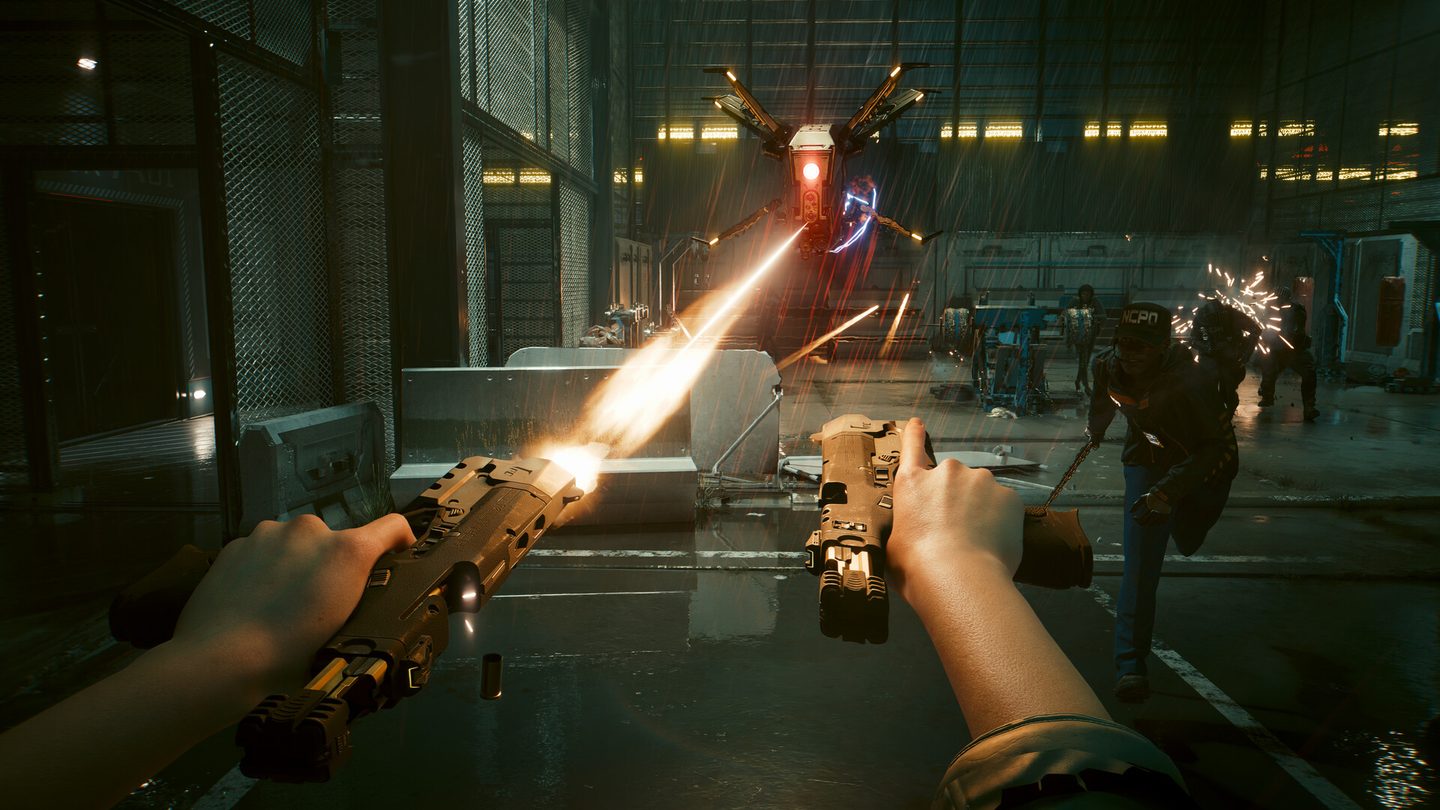
Rain in a real-time engine is almost never water. It is a camera-locked particle volume of stretched billboards — thin quads with a streak texture, rotated to always face you — plus, in the distance, a handful of big scrolling textured planes that sell density for the price of a few draws. The mod page calls those far rain cards, and Torrent hides both them and the vanilla particles before drawing its own.
That technique is cheap, predictable and has been the default since the mid-2000s. It also throws away two things. A billboard that always turns to face the camera has no depth, so it never passes convincingly behind a railing or in front of a sign. And unless you pay for it, a drop that small takes no local lighting at all.
The second one is the real loss in this particular game. Night City is lit almost entirely by emissive surfaces at short range: signage, windows, strip lighting, headlights. Rain that ignores all of it is rain falling through a city it is not actually in. Get a drop to pick up the red of a sign three metres away and the whole street reads as wet.
The budget, written out
A 60fps frame is 16.67ms. Stack what Torrent’s author published:
- rain, 0.15 to 0.5ms on Ultra in heavy weather
- wheel spray, peaking around 0.4ms
- storm mist, about 0.15ms, drawn at half resolution
Call it roughly a millisecond with everything running hard. On a 60fps budget that is around six per cent of the frame, spent entirely on weather, in a game where it is not raining most of the time. At 30fps it is half that share.
Six per cent is a decision, and it is the decision CD Projekt Red was making in 2020 on a console generation whose CPUs were already the constraint. Flat cards cost a fraction of this. A studio shipping to a fixed frame target picks the fraction, every time, and spends the millisecond somewhere the player is looking more often.
The design choice that makes Torrent affordable at all is on the mod page too: it adds a few draws to the existing rain pass and runs no simulation on the CPU. All of it is GPU work, slotted into a pass the engine was already doing. That is also why it costs almost nothing when the sky is clear — there is no system sitting there ticking.
Weather is a budget line, and which processor it lands on decides how much of it you can afford. GTA 6’s localised, persistent weather pushes that cost onto the CPU instead, which is a much harder bill to pay on this hardware than a millisecond of GPU particles.
Why a mod gets to do this and a studio does not
Torrent has a settings menu. Quality can drop to High or Medium, rain cover can be set to Simple, storm mist can be switched off entirely. A PC mod can hand the budget decision to whoever installed it, and assume a machine from 2026.
A console build cannot. It has one budget, fixed six years ago, and it has to hold it in the worst case — rain, traffic, a chase, a crowd, all at once. Most of what looks like a studio settling for less is a studio holding a line in a case you never saw.
None of which makes the vanilla rain good. It reads flat because it is flat, and six years of GPU headroom have gone by since the call was made. Night City has always been built at roughly twice the texel density of Witcher 3, which is why the surfaces hold up to a camera pushed right against them and the weather in front of them does not. A mod closing that gap for a millisecond is a fair trade on a 2026 PC.
One caveat on all of the above. Every figure here is the author’s own, measured on hardware nobody has named, and no outlet has run independent numbers yet. Treat them as the shape of the cost rather than the cost.