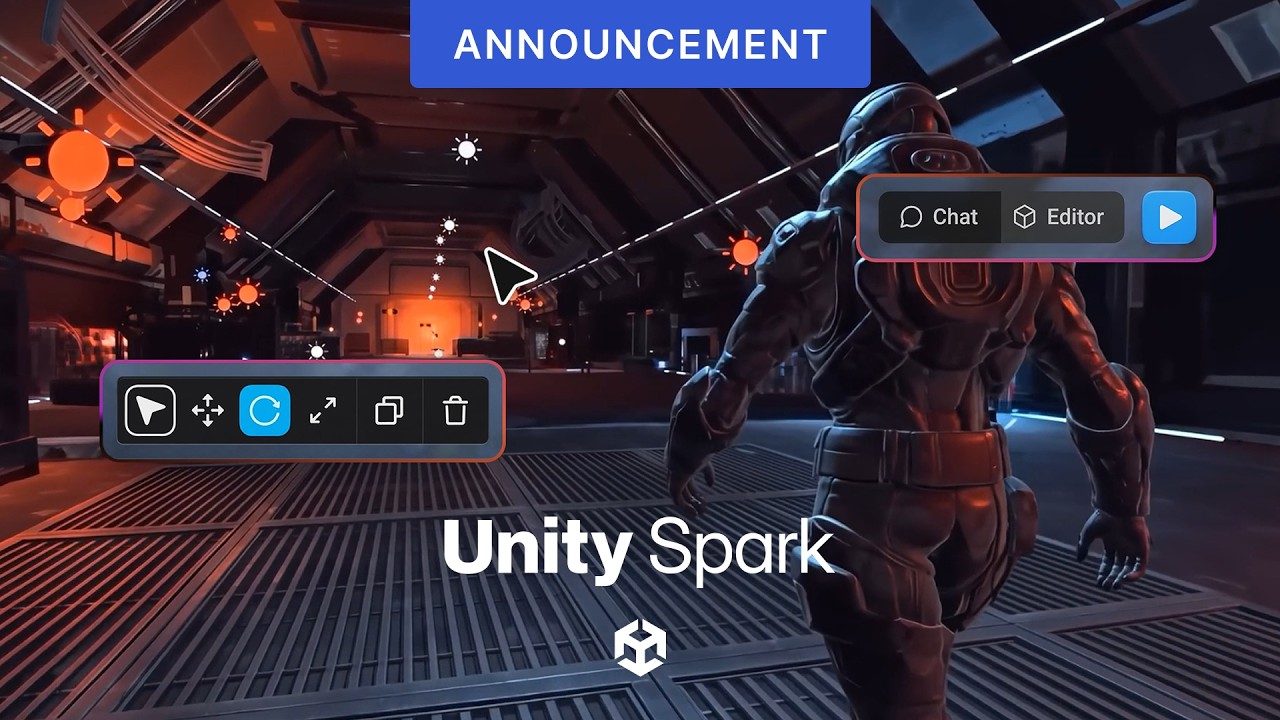
Unity announced Spark on 7 October 2026: a browser tool that assembles a playable 3D game from typed prompts, running on the Unity engine, no code required. Where the art comes from is the thing to look at. Spark builds out of packages from the Unity Asset Store — work modelled by people, sold by people, credited to people. In the demo Unity showed, a prompt asking for a cape came back as a selection of capes somebody had actually made.
Hold that against the last two years of generative game tooling. The usual architecture is a model trained on whatever could be scraped, producing a mesh or a texture that resembles the training data closely enough to be awkward and vaguely enough to be unusable. Spark’s asset layer is a shop. The shop has terms, the terms have names attached, and the coverage says contributing artists are credited and compensated.
Which is genuinely new, and is also where the reading has to get careful.
The number nobody has published
Unity has not finalised the commercial model. Both 80 Level and PocketGamer.biz say so plainly, and Unity’s own Spark page is a closed-beta waitlist rather than a terms sheet. Free and paid access tiers are planned. What a publisher earns when Spark drops their cape into a stranger’s game is unwritten.
The Asset Store’s long-standing split gives publishers 70 per cent of a sale, and a sale is a legible event: one person, one package, one transaction. Spark is not that shape. A prompt that reaches for eleven packages across four publishers and uses two meshes from each is a usage event, and usage events need a rate, a counting method and somebody auditing the count. None of those three exist in public yet.
The Provider Agreement that Asset Store publishers signed grants Unity a non-exclusive licence to use their assets to operate and market the store. As it stands, that is scoped to running a shop. Whether an editor that serves those assets into someone else’s game falls inside it, or needs a new agreement and a new rate, is exactly the question the unfinalised commercial model has to answer. This blog has been here before from the other direction: on Space Marine 3, the licence holder turned out to be the dividing line for what generative tools were allowed near the work at all.
What the restrictions tell you about the build
Per the reports, the launch version will not let creators sell what they make, and will not export projects to the desktop Unity editor. Both are described as launch limitations rather than permanent policy, and they are informative.
No export means the asset licensing question stays inside Unity’s walls. A Spark game that could be opened in the desktop editor is a Spark game whose Asset Store contents are sitting on somebody’s drive, and the compensation model would have to survive contact with that. Keeping everything in the browser is the version of this product that can ship while the lawyers are still working.
No monetisation points the same way. You cannot sell a game assembled from assets whose commercial terms for this use have not been written.
Matt Bromberg has been careful to say Spark is not about one-shotting — typing a sentence and receiving a finished game. Creators still design, iterate, polish and finish. Read alongside the two restrictions, that is a company describing a toy and building the pipework for something else. Spark co-launches with Google Playground, a Google platform that generates games from natural-language prompts and will host a Unity-based, agent-driven version; Spark games will be shareable through it. Both are 18-plus only.
What an asset publisher should actually watch
The Asset Store has spent fifteen years as a shop where you list a pack, set a price and get 70 per cent. Spark proposes something closer to a library with a royalty pool, and the difference between those two businesses is enormous for anyone whose rent comes off that store page. A pack that sells forty times a month at thirty euros is a known quantity. The same pack, drawn on by a prompt engine with an unpublished per-use rate, is not.
Three things will tell you which business it becomes, and none of them has been said:
- The rate, and whether it is per generation, per session, per published game, or a share of a subscription pool.
- Whether opting out is possible without delisting from the store entirely.
- Whether Spark usage counts toward the store rankings that decide whether a pack gets seen at all.
Marketplace ownership has been moving for a while now — KitBash3D took ArtStation and Sketchfab off Epic in August, and the reassuring noises there followed the same pattern: nothing changes today, terms later. Unity is at least starting from the honest position that the terms are not done.
The closed beta arrives later this year. The waitlist is open. The rate sheet is the document worth waiting for, and when it appears it will say more about the next five years of selling 3D work than the demo does.