
Ambient occlusion has a slanted-surface problem, and it has had one for a decade.
Here is the shape of it. GTAO — Jimenez et al., 2016, the technique that put physically based ambient occlusion into real-time rendering and has sat in more or less every engine since — works by measuring horizon angles. It slices the hemisphere above a pixel and asks how high the surrounding geometry rises in each slice. Lovely idea. The slices skew when the surface is not facing the camera, though, and a ground plane running away from you under a tree is about as not-facing-the-camera as a surface gets. The result is grounding that looks confident and is wrong, plus shadows that shift as you turn your head.
Daniel Isheden hit this on vegetation and went looking for the reason. On 12 November, Fenris Creations — the studio that was CCP Games, the one that makes EVE Online — put his answer on GitHub under the MIT licence. It is called CORTAO, for Circular Occluder Ray-Traced Ambient Occlusion, and it keeps the screen-space budget while throwing out the horizon-angle idea entirely.
What it does instead
It samples the depth buffer, builds a crude stand-in for the neighbourhood around each pixel out of circular occluders, and then traces rays against that proxy geometry. Up to 32 of them per pixel. Tracing 32 rays per pixel in screen space is normally the kind of thing you cost out and then quietly abandon, so the load-bearing part is a precomputed lookup table that resolves ray-occluder intersections in bulk instead of one at a time. Without the table the technique runs, but the repository says plainly that it is there for debugging and not for shipping.
Three compute passes. A prepass that builds a mipmapped buffer packing linear depth with a low-precision spheremap-encoded normal, the main pass that does the tracing and spits out occlusion plus optional bent normals, and an optional spatial filter.
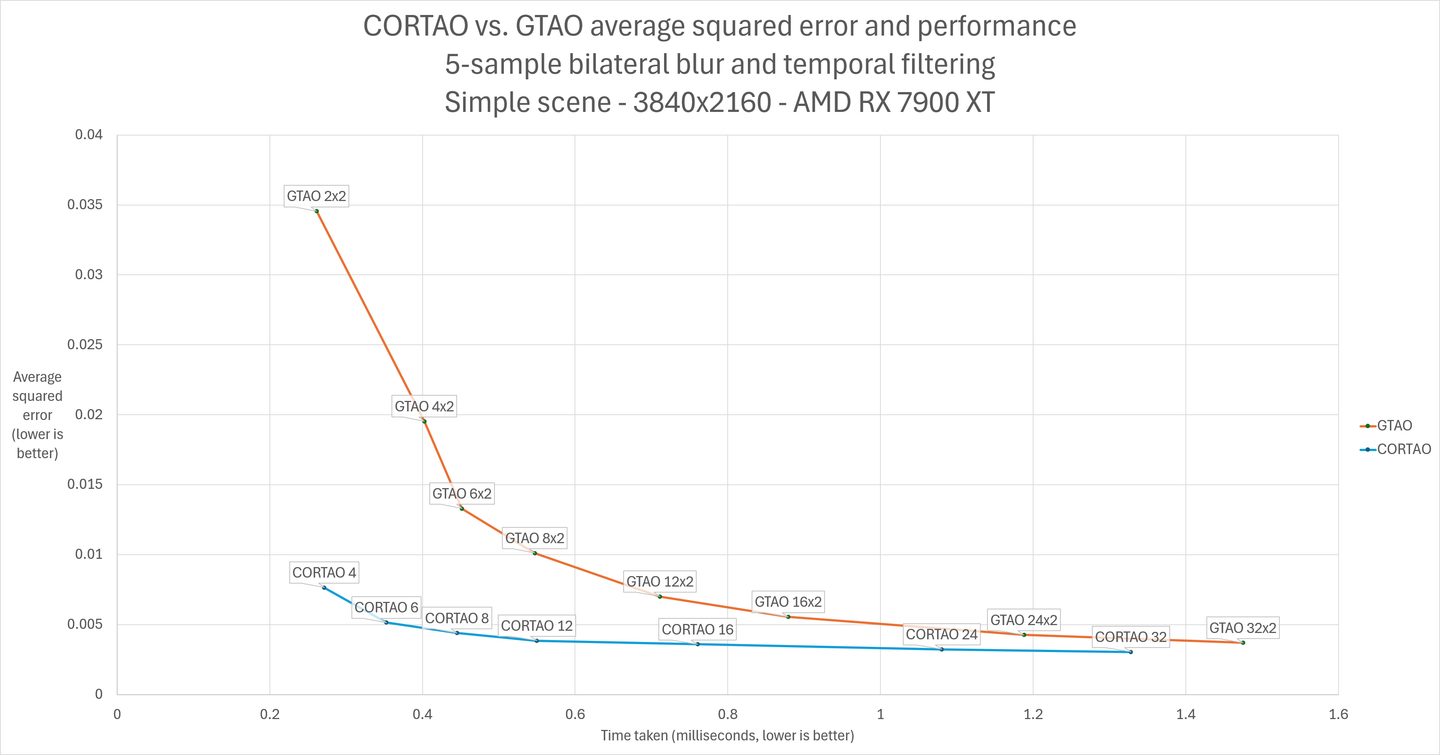
The numbers Fenris published are for simple and complex scenes separately, which is honest of them, because the gap between the two is where the interesting part sits. In a simple scene CORTAO reaches GTAO’s quality in under half the GPU time, or, held to the same time budget, lands up to four times lower on average squared error. In spatially complex scenes — the ones full of depth discontinuities, which is to say foliage, fences, grates, anything thin — GTAO struggles and CORTAO converges to a much lower error outright. Those are the vendor’s own benchmarks. They are also the only ones that exist on day one.
The part that matters if you light things
Forget the error numbers for a second.
GTAO tracks the maximum horizon angle it finds. Drop the sample count and you reduce the chance of finding the true maximum, so a lower quality preset loses occlusion outright. The scene gets brighter and flatter as the setting goes down. Anyone who has lit a level on a workstation at maximum quality and then watched it on a mid-range card knows that feeling: the contact shadows that were holding objects onto the floor have thinned out, and everything floats.
CORTAO’s error behaves differently. Reducing samples makes the circular proxies coarser, which pushes the result over and under the true value rather than consistently under it. Filtered spatially or temporally, that error largely cancels. The overall level of occlusion stays put across quality settings.
Which means the artistic look survives the settings menu. For a team shipping to a wide hardware spread that is worth more than a benchmark win, and it is the reason this release reads like it was written by someone who has sat next to a lighting artist.
What it costs you
No temporal filter. CORTAO assumes you have one — TAA, DLSS, FSR, XeSS, whatever is already in your frame — and its spatial pass is deliberately a sparse 5-tap prefilter designed to make the noise more palatable to that downstream pass rather than to remove it. Reasonable in 2026, when almost everything ships with temporal reconstruction. Less reasonable if you are one of the holdouts, and worth remembering that those temporal passes are not free either: DLSS 5’s neural pass cost around half a frame before Nvidia moved it to a second GPU, and an AO technique that leans on reconstruction is leaning on something with its own bill.
The sample count has to be a compile-time constant so the loop unrolls, so supporting four quality levels means four shader permutations. HLSL compilation wants Shader Model 6.7, for integer texture format sampling. And the mipmap chain does not need all eight levels — down to 64x64 is usually enough, which is the sort of note that only turns up when someone has already shipped the thing.
Why it came out of a space game
Carbon, the engine under EVE Online and EVE Frontier, was open-sourced earlier this year. The live game logic, the art, the server binaries and the database layer all stayed shut, which is the normal shape of these things. The renderer did not.
There is a Carbon-specific build of CORTAO alongside the reference one, streamlined and tuned for the depth ranges a space scene produces. Those ranges are extreme in a way a corridor shooter never has to deal with — a cockpit rail at half a metre and a station hull at forty kilometres in the same frame, which is precisely the condition under which screen-space techniques fall apart. Having to solve that first is probably why the general version handles depth discontinuities as carefully as it does.
The claim in the README that stands out is that CORTAO reaches a correctness and stability “previously only possible with expensive hardware raytracing”. That deserves scepticism, and it also deserves context: hardware ray tracing on console-class silicon is affordable right now mostly where the geometry cooperates, which is why 4A Games could promise ray tracing and 60fps on a base PS5 for a game built out of corridors. A screen-space technique that closes part of that gap for free, in open foliage, is aimed squarely at everyone who does not have corridors.
Go and look at the pictures
The reference repository carries the comparison footage — GTAO against CORTAO against a brute-force ray-traced ground truth, plus a bent-normals clip and the filtering comparison. They are the evidence for everything above and they are hosted as video rather than on YouTube, so there is nothing to embed here. If you work in this area, the ground-truth comparison is ten seconds well spent.
Isheden says other extensions are being tested. Given that the bent-normal path already exists and already costs about half what GTAO’s does, the obvious one is feeding it into a wider global-illumination approximation, and the repository hints in that direction without committing.
Technique description, benchmark figures, pass structure, licence and integration requirements read from the CORTAO reference repository’s own README and LICENSE. Release date and studio framing from GamesIndustry.biz and CGMagazine, 12 November 2026. Carbon’s open-sourcing date is reported as earlier in 2026 by the coverage and is not restated here from a primary source.