Five scored verdicts on Minecraft Dungeons II were up by the morning of 29 September, and they run from 6 to 9. IGN sits at the bottom, Destructoid at the top, and GameSpot, GamesRadar+ and Game Informer bunch around seven. The arithmetic mean of the five is 7.25, which rounds to 7.5.
Three points is a wide range. What makes it strange is that the five reviews describe more or less the same game.
The list of improvements barely changes between them
Combat has more weight. Traversal is less of a slog. The build variety that the 2020 original ran out of somewhere around the twentieth hour now goes further. Nobody in the five claims it reinvents the formula, and IGN’s Travis Northup, who scored it lowest, still calls it a beautiful and fun dungeon crawler — his complaint is that it plays it extremely safe.
So the spread measures something narrower than quality. It measures how much credit each reviewer gives a sequel for doing the same thing better.
That question had a cleaner answer here six weeks ago, when Mortal Shell II cleared its original by a full grade on a nearly identical strategy — sharpen the systems, replace nothing. The scores moved as a block. Dungeons II ran the same play and the critics scattered instead, which suggests the strategy only pays when the original left a lot of obvious room.
What a game made of boxes can spend a graphics budget on
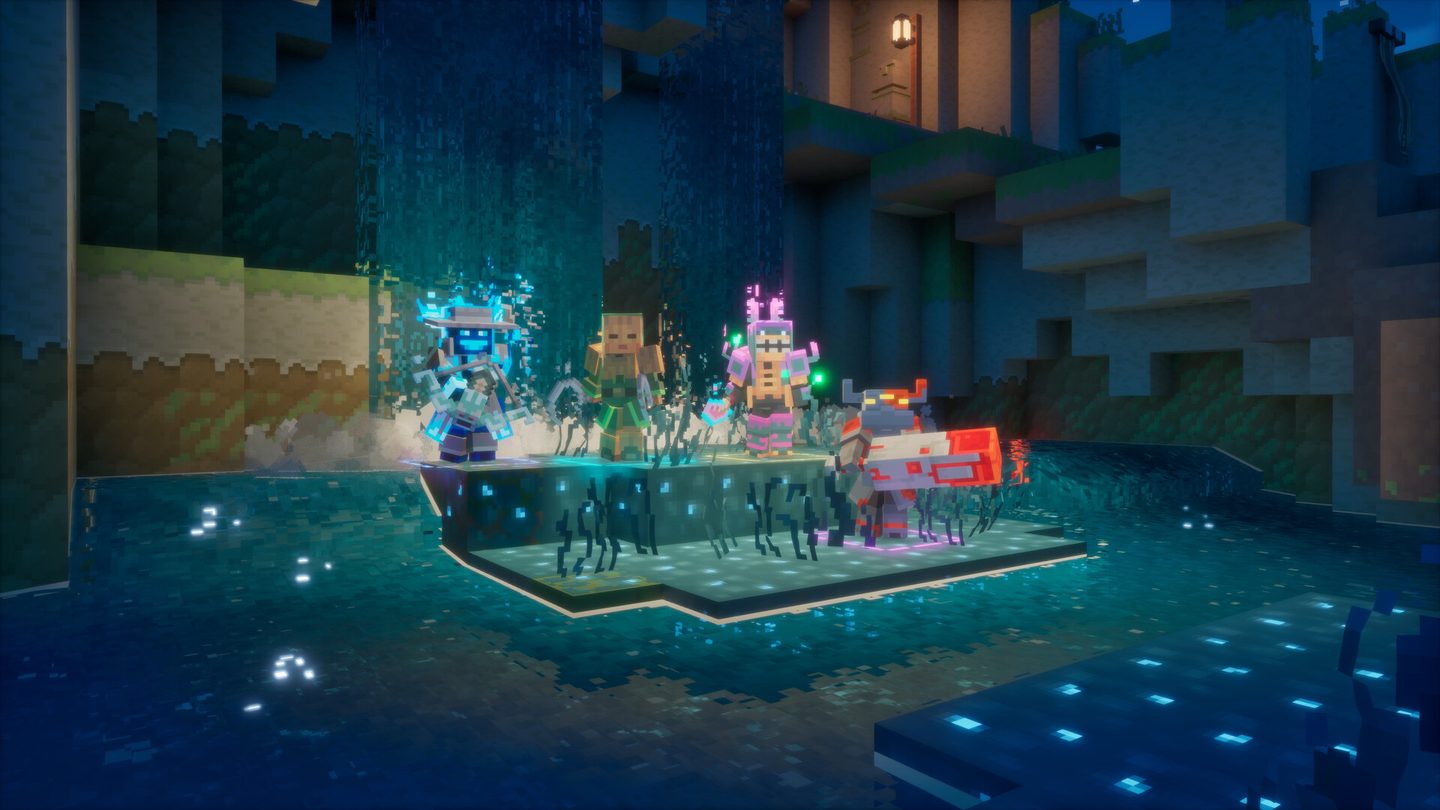
Dungeons inherited a hard constraint from the thing it is spun off from. Everything is built out of rectangles, and the camera sits far enough back that a player character occupies a small slice of the frame — then you add three friends and a crowd of mobs on top.
Boxes are cheap. Keeping twenty of them distinguishable on a loud screen is not, because no asset is allowed a silhouette more complicated than a block. The work moves into colour, contrast and motion. An enemy wind-up has to land as a shape change or a flash, since there is no face to grimace and no blade to catch the light. It is the same legibility problem that makes porting Diablo 4 to Switch 2 a real cost to the art team rather than a resolution slider — a busy ARPG screen has to stay parseable whatever the hardware does.
Which is why “prettier” is a specific claim in a game like this, and several of the five make it. The gains have to be in how light falls across a cube, how fog sits in a corridor, how a hit registers. Destructoid’s headline points at a new area called the Sift as the reason for its 9, and a new dimension is the one place a boxy game can genuinely change what it looks like: new palette, new light, new fog.
The number
7.5, from five scores between 6 and 9, collected on 29 September 2026. It is the plain mean of what was published, converted to a ten-point scale and rounded to the nearest half.
Five is a small sample on release morning and the figure will move this week. The aggregate numbers circulating — a Metacritic in the mid-seventies, an OpenCritic in the mid-eighties — sit far enough apart that neither is worth leaning on until the critic lists fill in, so I have left both out of the arithmetic.
The range is the part to carry away. A sequel can be competently made, agreed on by everyone who played it, and still leave two experienced reviewers three points apart on whether the improvements add up to a reason to buy it.
Minecraft Dungeons II, Xbox Game Studios, released 29 September 2026 on PC, Xbox Series X|S, PS5 and Switch at €29.99. Scores collected the same day from the outlets’ own reviews and the round-ups above, converted to a 1-10 scale and averaged.