Eurogamer reported this week that Diablo 4 is headed to Switch 2, bundled with both expansions — Vessel of Hatred and Lord of Hatred — as an “Age of Hatred Collection,” reportedly landing 15th September, days after BlizzCon. It’s not just one outlet’s sourcing — VGC, Nintendo Life, Nintendo Wire and several others have converged on the same leak, traced back to Dealabs leaker billbil-kun and backed up by age-rating listings in Indonesia and Taiwan that already list Switch 2 as a platform. But it’s still a leak, not an announcement: when Eurogamer asked Blizzard directly, the studio said it had “nothing to comment on.” The closest thing to an official word is Diablo’s series head telling TechRadar there’s “opportunity” for Diablo 4 on Switch 2, while adding that live-service games have historically been “a little bit challenging” on Switch hardware — which is commentary, not a confirmation. I’m flagging the sourcing up front because I’d rather say plainly that this rests on unconfirmed leaks than let it read like news.
But assume for a second it’s true, because the premise is the interesting bit regardless of the exact date. Diablo 4 has never shipped on a Nintendo platform. The original Switch was never going to run it — this is a game that puts a boss, forty adds, three players’ worth of skill-effect particles and a screen-filling blizzard of damage numbers in the same frame and expects it to hold up. That’s the actual engineering problem a Switch 2 version has to solve, and it’s worth walking through, because it’s the same problem every “surprise” hybrid-console port of a dense AAA game runs into.
The thing that makes Diablo 4 hard to port isn’t the world, it’s the noise
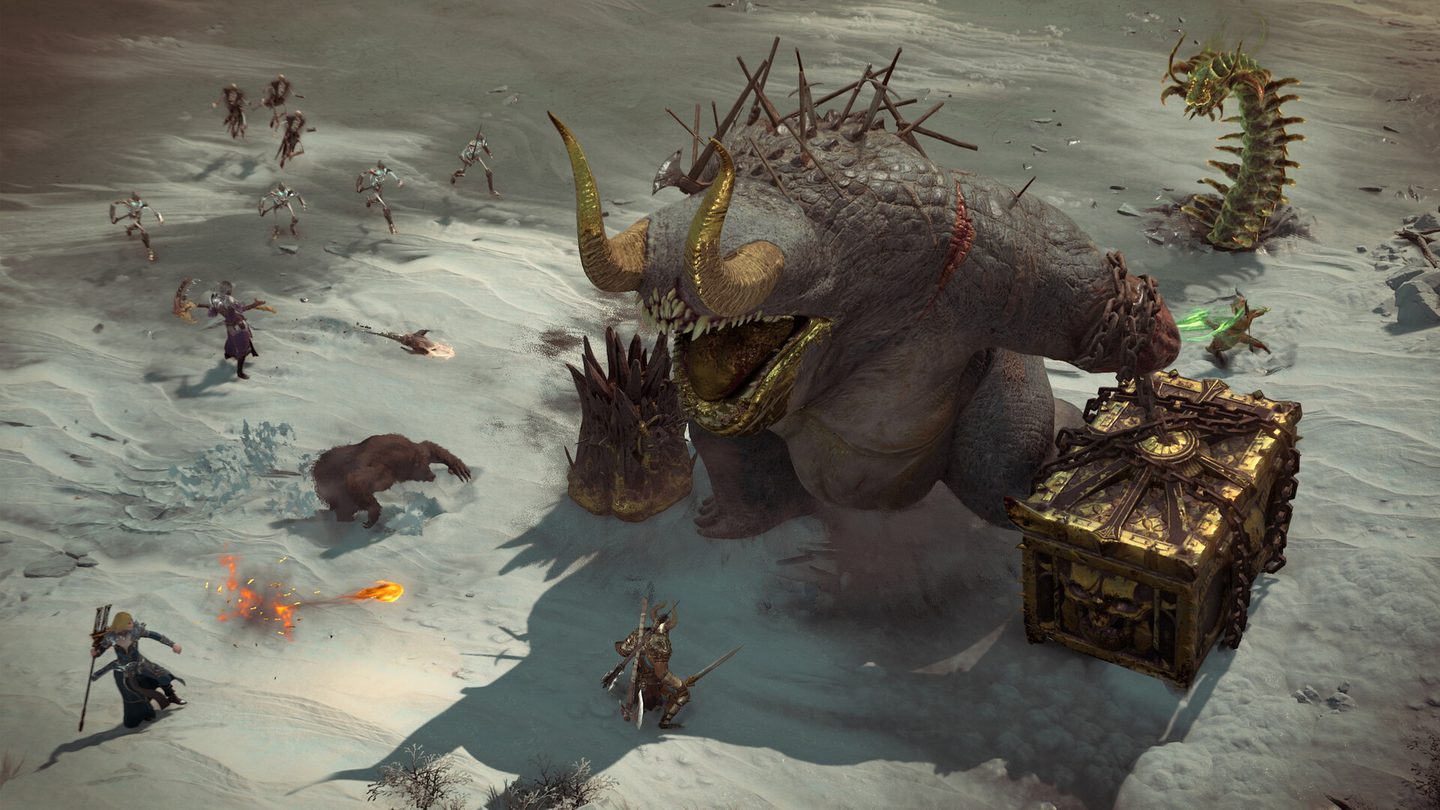
Open-world ports usually get discussed in terms of draw distance and texture resolution — how far you can see, how sharp the ground looks up close. Those matter here too, but Diablo 4’s real budget killer is mid-combat overdraw: dozens of enemies, each with their own particle and shader effects, stacked in the same screen space during a pack fight. On PC and current-gen consoles that’s handled with a GPU that can afford to brute-force a lot of overlapping transparency. Switch 2’s chip is a custom Nvidia Ampere-based part (codenamed T239) with an 8-core ARM CPU, 12GB of RAM — about 9GB of it usable by a game — and a GPU rated around 1.7 teraflops in handheld mode, roughly 3 in docked mode. That’s a genuine step up from the original Switch, and DLSS support is a big part of why a port like this is even on the table, but it’s still a fraction of a PS5’s or a gaming PC’s silicon. It cannot brute-force Diablo 4’s overdraw and hold a stable frame rate, docked or handheld.
So the studio doing this port (Blizzard hasn’t said who, if anyone, is doing the work) is looking at the same short list every team hits when a particle-heavy game goes to a hybrid console:
- Cap and cull effect density before it hits the GPU, not after — fewer simultaneous particle emitters per enemy, aggressive distance and screen-space culling on secondary effects, so a forty-monster pull reads as chaotic without every monster’s death nova actually rendering at once.
- Dynamic resolution scaling, probably paired with DLSS, since that’s the entire reason Switch 2’s Nvidia chip is a meaningfully different proposition than the original Switch’s — it can reconstruct a lower-rendered frame back up to something presentable, which is often the difference between “portable Diablo 4” and “no Diablo 4 at all.”
- Simplified skill-effect shaders for high-population fights specifically, not globally — keep the game looking like Diablo 4 during exploration and boss one-on-ones, where the budget exists, and spend the savings on the pack-fight moments where it doesn’t.
I haven’t seen this build and I’m not claiming inside knowledge of Blizzard’s pipeline — this is the standard playbook, the same one every particle-dense game reaches for on this class of hardware, not a confirmed account of what’s shipping. But the other Switch 2 ports out this year give a real sense of the range of outcomes. Cyberpunk 2077 landed around 1080p/30fps docked and 720p handheld, with a higher-framerate performance mode; Hogwarts Legacy runs 4K/30fps docked via DLSS upscaling and 1080p handheld, clearly cut back versus its PS5 build. Elden Ring’s “Tarnished Edition” is the cautionary tale worth knowing: its Gamescom 2025 demo ran at an infamous 15fps, and it took FromSoftware fixing a CPU bottleneck to get it to a stable-ish 30fps docked and 30-40fps handheld in time for its August 2026 launch. That’s the actual range a Diablo 4 port would be gambling inside — from “convincingly holds up” to “needs a public course correction before launch” — and nothing reported so far says which end this one lands on.
Bundling both expansions changes the shape of the problem too
Shipping Vessel of Hatred and Lord of Hatred in the same collection means the Switch 2 version has to hold this budget across three campaigns’ worth of biomes and boss encounters, not one. That’s more content that needs the same treatment, which is usually why a port like this trails the original release by a year or more rather than launching day-and-date — there’s no shortcut that lets you tune the effect budget once and have it hold for every fight in the game. Every dense encounter gets checked by hand against whatever the target frame time is.
Why I’m watching this instead of shrugging at “another port”
Because if it’s real, it’s a decent read on where the ceiling actually sits for what a hybrid-console chip can carry from a game that was never designed with one in mind. Switch 2 has already taken swings at demanding ports this year, and each one is a data point on the same question: how much of “current-gen AAA” survives the trip, and what gets cut first to get it there. For a loot-and-particle game like Diablo 4, the honest answer is probably “the noise” — and if Blizzard ships this well, the version of the port worth studying isn’t the resolution number on the box, it’s which pack-fight moments still feel like Diablo 4 once the effect budget gets cut down to size.
Release date, bundle contents and the BlizzCon-adjacent timing are from Eurogamer’s report, corroborated by VGC, Nintendo Life and others tracing back to the same leak — none of it confirmed by Blizzard, which has declined to comment. Switch 2’s hardware specs and the Cyberpunk 2077, Hogwarts Legacy and Elden Ring Tarnished Edition comparisons are drawn from public reporting on those ports. The technical breakdown of what a Diablo 4 port specifically would need to cut is my own reasoning about the standard approach to porting a particle-dense game to this hardware, not a description of a confirmed build.