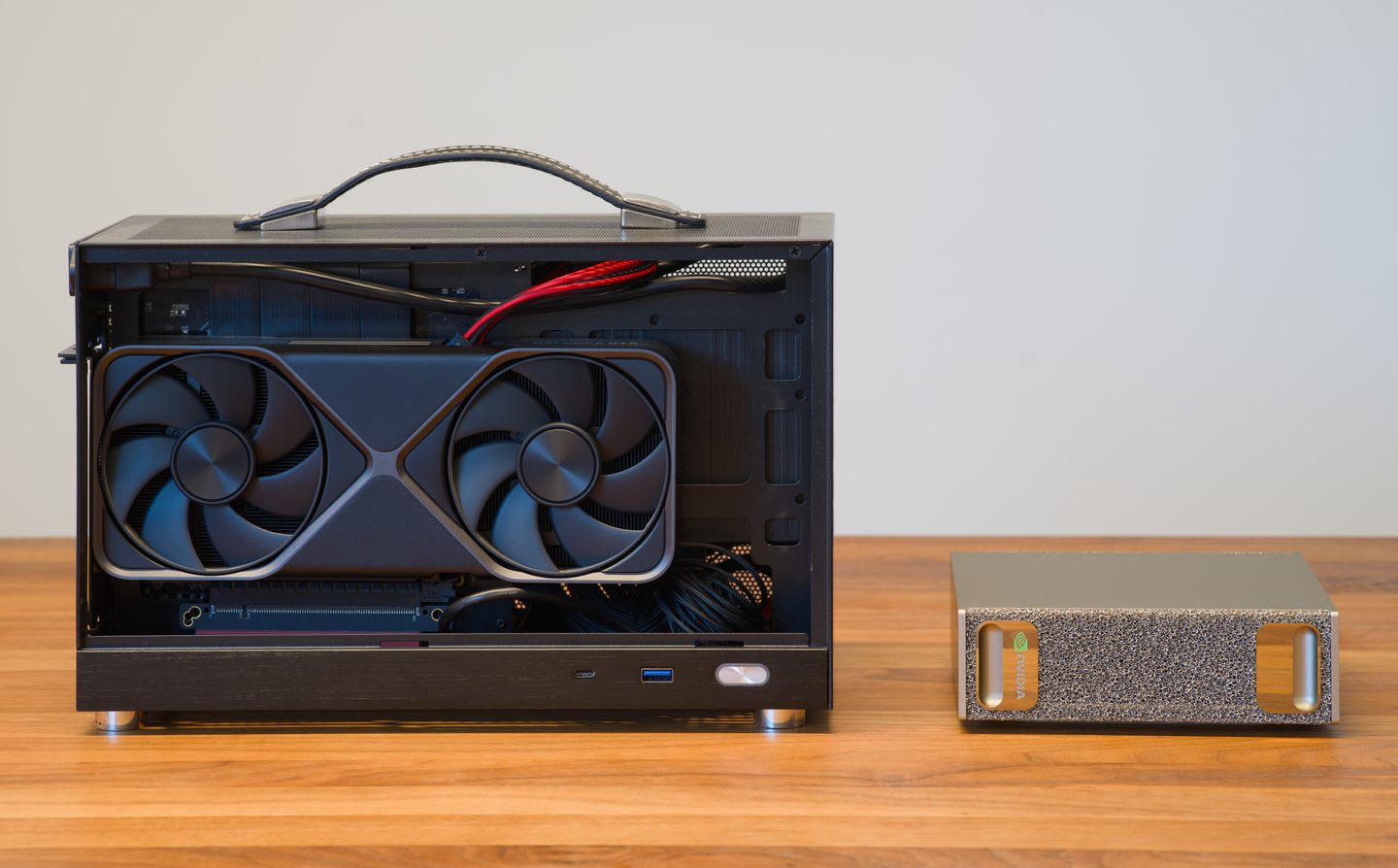
When the DGX Spark shipped, the specification that mattered to me had nothing to do with parameters or tokens a second. It was this: for about four thousand dollars, you got 128GB of memory that a GPU could address directly. At the time, as The Register points out, that made it the highest-capacity workstation GPU Nvidia sold — a claim about capacity and nothing else.
Anyone who has watched a Cycles render fall out of GPU memory and limp along out-of-core knows why that number is the interesting one.
On 2 October Nvidia put out a 64GB version at $4,999, on sale from 23 October through Acer, Asus, Dell, Gigabyte, HP and MSI. Same GB10 Grace Blackwell part, same DGX OS, same ConnectX-7 networking. Half the unified memory, and per The Register, half the storage too.
The same day, the 128GB model went to $6,950.
Do the subtraction
The 128GB Spark sold for around $4,000 when it launched last year. So the cheap one, the lifeline, the entry point, costs a thousand dollars more than the full-memory machine did twelve months ago — about 25% more for half the pool. The 128GB version is up nearly 75% in the same window.
Nvidia blames memory supply. Fair enough — it is true. Worth remembering all the same that the GB10 platform has been drifting upward since the day it was shown as Project Digits at CES last year, when the expected price was nearer $3,000 and nobody had yet watched DRAM contracts double.
Tom’s Hardware makes the fair case for the smaller box: dense models got good enough that you no longer need 128GB to run something clever locally. Qwen 3.8 27B fits inside 32GB, with a tight context window. If inference is the job, a permanently attached 128GB of LPDDR5X is an expensive thing to be carrying. The 64GB machine handles models up to around 100 billion parameters and is a poorer fit for fine-tuning, which is the trade being offered.
That argument holds for someone running a local agent. It falls apart for anyone who looked at this box and saw a render node, because a renderer does not care how clever your model is — it cares whether the scene fits in memory, and scenes have got bigger every single year that memory got more expensive.
Where the money went
Micron reported its fiscal Q4 on 30 September. Revenue $54.23 billion. A record 87% gross margin, and an 88% operating margin in the Mobile and Client unit — which was the only unit in the company that shipped less memory than the quarter before.
Eleven days earlier, Acer’s chief executive accused the three memory makers of holding for margins above 80% and said the warehouses were full. One of the three has now filed a number that sits just above his estimate, on the consumer business, while moving fewer bits. Make of the coincidence what you like.
Micron’s CEO Sanjay Mehrotra told investors the same week that demand will outrun supply for at least a couple more years. Worth noting what he was actually talking about: Micron does not sell consumer RAM any more, and his comments covered HBM and server DRAM. The consumer squeeze is a side effect. Capacity goes where the margin is, and DRAM revenue per square millimetre has already passed what TSMC gets for an N2 wafer. Nothing about that points at relief.
Meanwhile, the software caught up
The part of this week I enjoyed more. Reha Yağcıoğlu compiled Blender 5.3 Alpha natively on a DGX Spark — Linux on ARM64 — with the DLSS denoiser and OptiX working, and wrote the process up on Blender’s own developer forum on 1 October. There is a tutorial video, and a Raspberry Pi 5 running Blender tucked in at the end of it as a joke that also works.
Nobody hands you that build. You compile it, which is why a step-by-step writeup of the process is a genuinely useful thing to publish rather than a curiosity. And it arrives in the same fortnight that the hardware it runs on got worse value in both directions at once.
Grace Blackwell with a working OptiX path and 128GB of coherent memory would have been a strange, specific, rather wonderful box to build a lookdev station around. Grace Blackwell with 64GB at five thousand dollars is a harder sell against a tower with a used 4090 in it. And the tower runs software you can download.
The honest state of it
Confirmed: $4,999, 64GB unified memory, 23 October, six OEM partners, GB10 unchanged, 128GB now $6,950.
Not confirmed, or not by me: the exact storage capacities on the 64GB SKU — The Register says the drive is halved without giving the figures — and the original 128GB launch price, which sources put at “around $4,000” rather than a number Nvidia will stand behind today.
Pricing, launch date and partner list from Tom’s Hardware and The Register, both of 2 October 2026. Micron’s quarterly figures and Mehrotra’s remarks via Ars Technica. The Blender build is Reha Yağcıoğlu’s, documented on devtalk.blender.org and syndicated by BlenderNation on 1 October; I could not reach the forum thread directly from here and have relied on the syndicated summary and his own description of it.