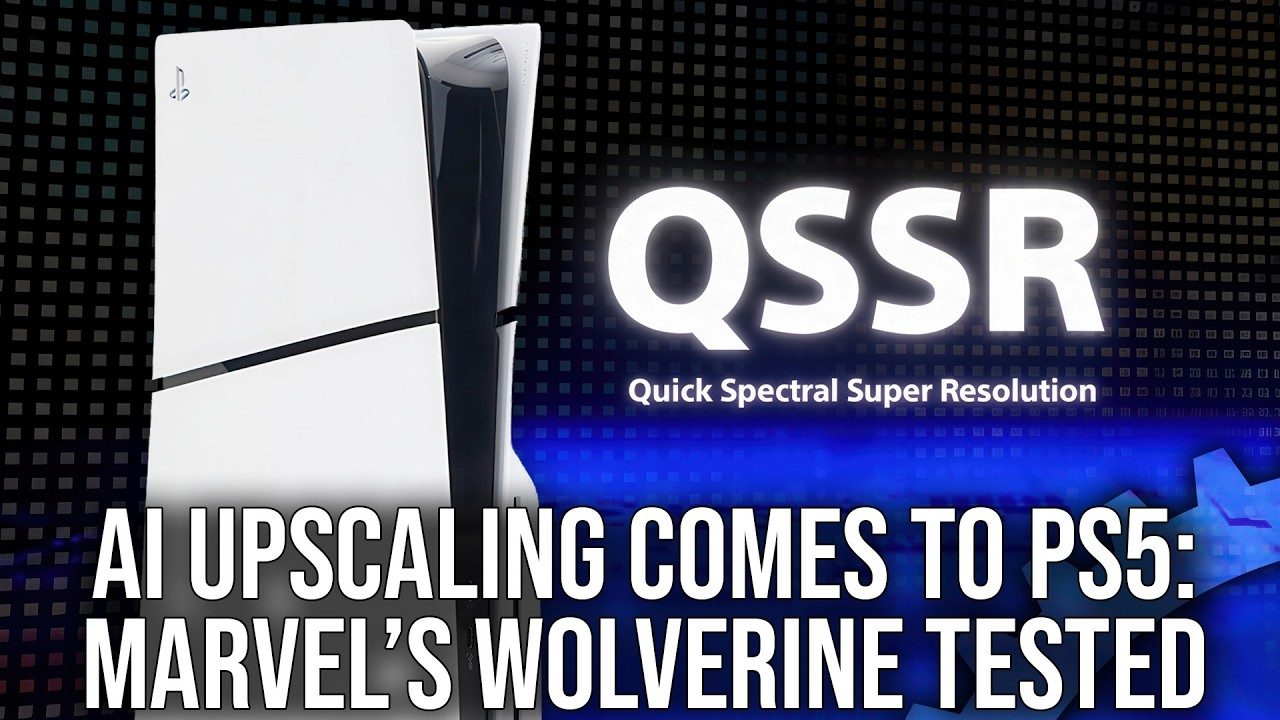
Digital Foundry put a number on Sony’s new upscaler this week: 1.5 to 1.8 milliseconds to reconstruct Marvel’s Wolverine from 864p to 1440p on a base PlayStation 5. A 60fps frame is 16.67ms end to end. So the upscaler is taking nine to eleven per cent of it.
That is the price. What it buys is harder to put in a number, and it lands on the people building the assets more than on the people reading the frame counter.
What Sony shipped
On 1 October Sony announced Quick Spectral Super Resolution — QSSR — and patched it into two games the same day: Marvel’s Wolverine and Ghost of Yōtei, in both cases as an extra graphics option rather than a replacement for what was there. It comes out of Project Amethyst, the machine-learning graphics programme Sony runs with AMD, the same programme that produced PSSR for the PS5 Pro. PSSR stays a Pro feature. QSSR is a lighter network with a hand-tuned PS5 implementation, and Sony says any PlayStation developer can call it.
There are two of these rather than one because of compute. A PS5 Pro carries 60 compute units against the base machine’s 36 and feeds them roughly 28 per cent more memory bandwidth. PSSR was built for that headroom and does not fit without it.
864p is the number to sit with
In the mode Digital Foundry measured, Wolverine draws 1.33 megapixels and presents 3.69. Nearly two thirds of what reaches the screen was invented. That arrangement is five years old on this hardware, with FSR or a hand-rolled temporal pass doing the inventing.
Those reconstructors fail in a specific place: fine, high-frequency detail in motion. A one-pixel leaf edge at 864p is a shimmering dot. Thin railings crawl. Sharp speculars sparkle into aliasing. Hair boils.
Artists have been compensating for that since 2020, in ways that stopped being decisions and turned into house style. You thicken the railing. You fatten the alpha on a foliage card so its edge is never a single pixel. You push roughness up so a highlight broadens instead of twinkling. You bias the normal map flatter at distance, add a little more fog, and ship a softer image than the one you authored. Each of those removes detail from the asset to keep the frame from boiling.
Which makes Digital Foundry’s finding the relevant one: sub-pixel integrity considerably better, temporal stability substantially improved, artifacts from moving foliage much reduced. Moving foliage is the worst case in the whole category. A temporal reconstructor works by guessing where each pixel was last frame, and on grass in wind that guess is wrong everywhere at once.
Jasmin Patry, lead rendering engineer at Sucker Punch, described it in Sony’s own announcement as a level of temporal stability that has not been possible on PS5 until now. Taking that at face value, the useful consequence lands on the next set of assets: detail you have been sanding off because it boiled can stay on the model.
Where the 1.8ms comes from
A console frame budget does not grow, so 1.5 to 1.8ms has to come out of something already in the frame. Shadow resolution, draw distance, a shading pass, or the internal resolution itself — and that last one has a pleasing circularity to it, since a team may well drop internal resolution further to afford the upscaler that makes low internal resolutions hold together. That trade is the ordinary shape of a reconstruction budget, and it is how 864p became the number in the first place.
Wolverine is a fair test because Insomniac had already spent that budget hard. Ray tracing at 60fps in the game’s default mode on a base PS5 was the thing worth noting back in August, and it fit because of a low internal resolution and a lot of careful cutting elsewhere. 4A Games made a similar claim for Metro 2039 and credited its corridors, which is the same accounting from another direction — you buy the expensive feature by narrowing what the renderer has to think about.
Why Ghost of Yōtei gained less
Yōtei improved, but less. Digital Foundry found it running at roughly the same frame rate as the game’s existing FSR 3 pass in the unlocked performance mode, with a smaller lift in image quality than Wolverine showed.
Read that as a statement about Sucker Punch. Their grass and wind work is among the most tuned of its kind on the platform, and they had already paid for stability — in custom temporal code, in authoring discipline, in art direction that leans on silhouette and large shapes where a thinner image survives. A better reconstructor is worth most to the team that had the worst one. Yōtei had little left to recover.
So the two launch titles are the games least able to demonstrate the point. Both were authored under the old constraint, with the fine detail thinned out before anyone wrote a patch note. Hand a studio a stable reconstructor at the start of a project instead of six years in and the assets come out different.
The timing
The base PS5 shipped in November 2020. Sony is handing it a new rendering library in October 2026, seven weeks before GTA 6 arrives on 19 November. A software upgrade that makes a five-year-old console hold detail better costs considerably less than persuading that install base to buy a Pro.