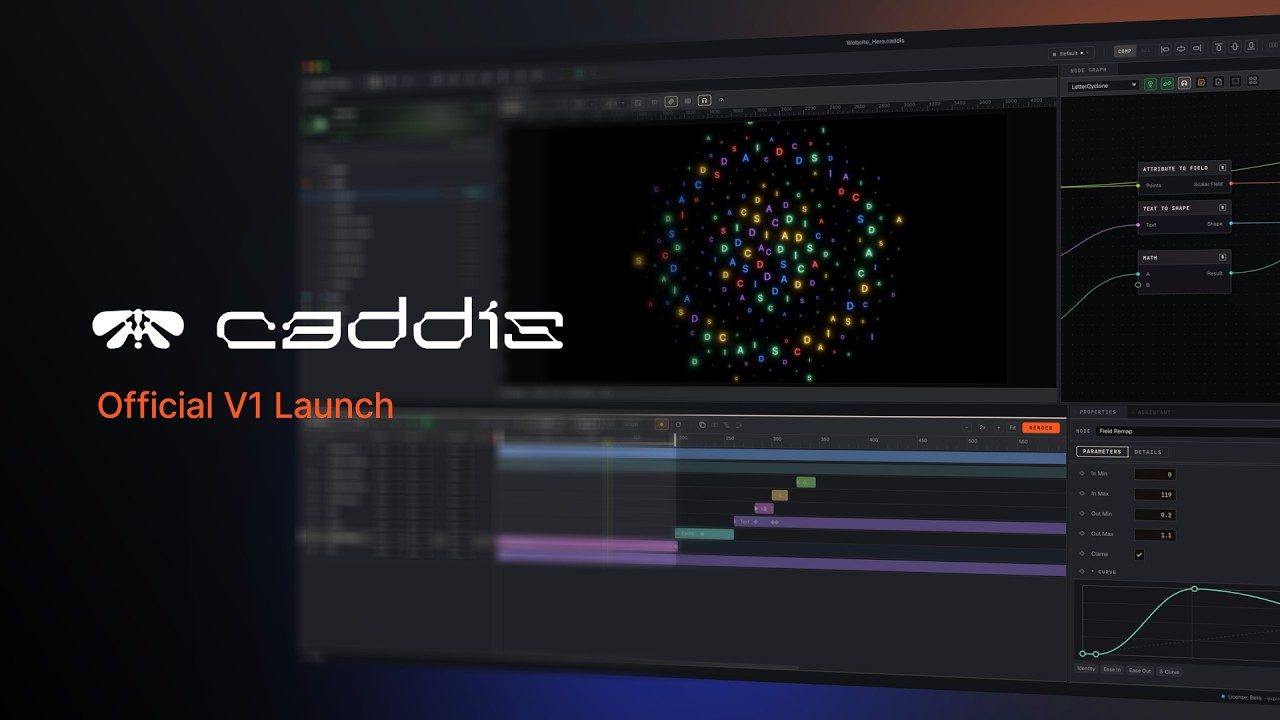
Select a layer in the Caddis timeline and a node graph opens next to the viewport. Not the composition’s graph. That layer’s graph, scoped to that layer, with everything you do to the image laid out as boxes and wires while the stack above and below it stays a stack.
That is the whole design, and it is a stranger decision than the press line makes it sound.
Two mental models that normally don’t share a room
Motion design has been layer-shaped since After Effects turned up in 1993. You stack things, you put keyframes on them, you read the composition top to bottom. Time is the primary axis and everything else hangs off it.
Compositing went the other way. Nuke, Fusion, Houdini’s image contexts — the unit is an operation on an image, and you wire operations together so the path from source to output is visible and re-orderable. Time is in there, but it is not what the interface is organised around.
Both models are load-bearing and neither one absorbs the other cleanly. Ask a compositor to keyframe forty title cards in Nuke and watch the enthusiasm drain. Ask a motion designer to branch a layer’s treatment three ways in After Effects and recombine it, and you get pre-comps — a second timeline hidden behind a thumbnail, holding state you cannot see from where you are working. Everyone who has opened a project six months later and had to spelunk through four nested comps to find where a blur came from knows the cost.
An effect stack on an AE layer is a list. Ordered, linear, one thing after another. You can reorder it. You cannot fan it out and bring it back together without leaving the layer.
So the pre-comp is where AE hides its graph. Caddis takes that hiding place and puts it on screen, in the panel next to the picture, still attached to the layer it belongs to.
What that buys, and what I’d check first
The appeal for anyone who has done both jobs is obvious enough. Composition order stays legible as a stack, which is how motion design work is actually discussed — this over that, this from frame 40. Per-layer image work gets to branch, which is how compositing work is actually built.
The question I would put to it in the first hour is whether a graph in one layer can reach another layer’s output. Cross-layer references are trivial in Nuke and they are most of what makes a node graph worth having: one degrain, read by six branches. If each layer’s graph is a sealed island, this is a very good effect stack rather than a compositor, and it should be judged as the former. I have not put hands on it, and none of the write-ups I can reach answer that directly.
Version 1.0 ships with more than 130 nodes, which is a real library rather than a demo, and the renderer is GPU-accelerated.
The line in the release notes that matters
Caddis runs on Linux.
After Effects never has, in thirty-three years, and that single absence has shaped more facility pipelines than most people notice. Nuke runs on Linux. Houdini, Maya, Katana, RV — Linux. A studio that standardised its workstations on Rocky or RHEL has one motion design answer, which is to do it in Nuke and be slightly miserable, or to keep a Windows island for the people doing titles and graphics, with its own licences, its own storage mounts and its own reason to break on a Thursday.
A GPU-accelerated motion tool that installs on the same boxes as the rest of the pipeline is a smaller thing than a node graph on paper and a bigger one in practice. It is also the kind of decision solo developers make and large vendors don’t, because the Linux motion design market is not large enough to justify a port to anyone with a shareholder.
Whether it holds up under a facility’s actual load — colour management, EXR throughput, a farm — is unknown, and a 1.0 from one person should be expected to have edges there.
Money, and the calendar
As listed on 2 September 2026: $129 for a perpetual licence, with a $99 launch price for early buyers. You can download it and keep using it for nothing; export is open for the first seven days, and the licence unlocks it permanently after that. No subscription. The current build is 1.0.5, on Windows 10 or later, macOS 12 or later, and Linux.
Pricing pages move, so that is the state of it today rather than a promise.
The beta opened in May and 1.0 landed in August — four months, one person, from public beta to a paid release with a three-figure node library. That pace is worth sitting with, whichever way you read it. It is either a story about how much a single motion designer can now build, or a reason to look carefully at the edges before a job depends on it. Probably both, and the trial is free long enough to find out which.
Node count, platform support, pricing and the beta timeline compiled from CG Channel’s and CGPress’s coverage of the beta in May 2026 and the 1.0 release, and from the product listing as reported. Caddis’s own site was unreachable from here at the time of writing, so nothing above is quoted from it directly. Cross-layer graph references are unconfirmed either way.