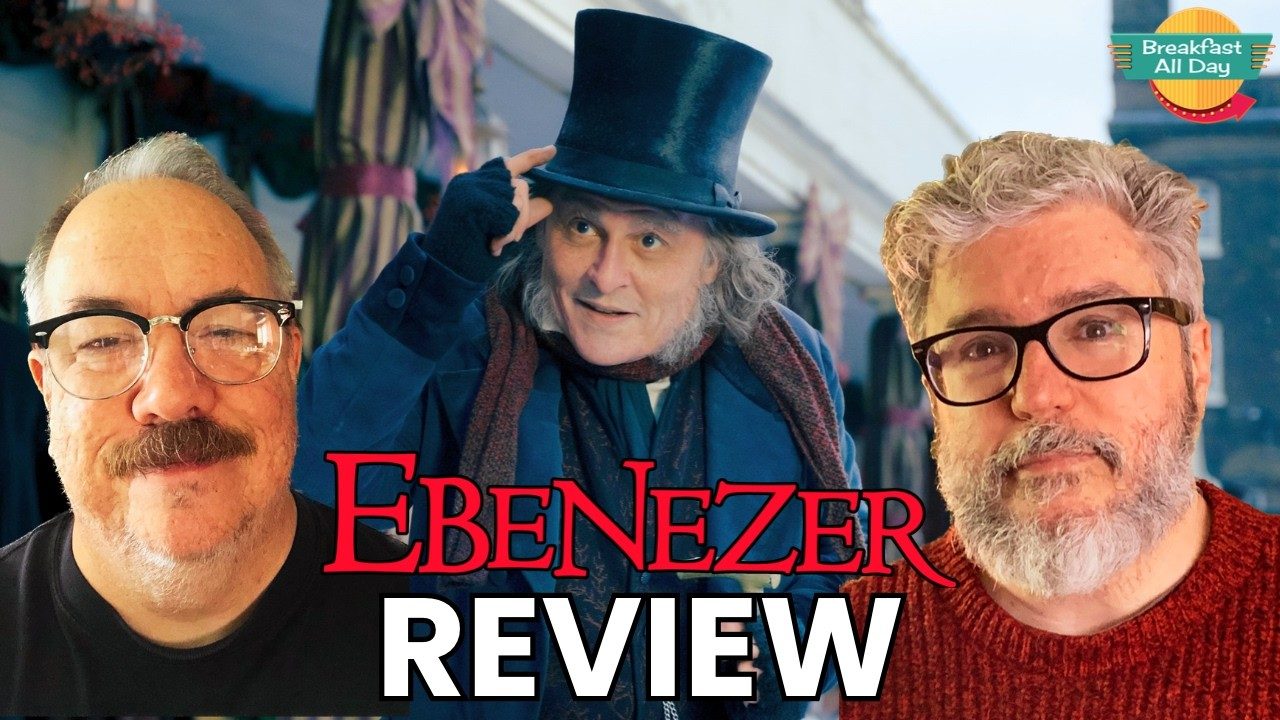
Ti West shot a Christmas Carol on 35mm and spent the film’s attention on the ghosts. The critics who disliked it say so too. That is the useful thing about a split this wide — everyone is arguing about the same half of the picture, and nobody is arguing about the other half at all.
Ebenezer: A Christmas Carol opened in the US and UK on 13 November 2026, after a premiere on the 1st. Johnny Depp plays Scrooge in his first studio lead in eight years. Nathaniel Halpern adapted Dickens, Checco Varese shot it, and cast listings have Ian McKellen as Jacob Marley.
The number, and what it is made of
Six verdicts carried a number I could read and check:
- But Why Tho? — 9
- The Telegraph — 8
- The Globe and Mail — 7
- Empire, Helen O’Hara — 3/5, so 6
- The Guardian, Peter Bradshaw — 3/5, so 6
- Screen Rant, Liz Declan — 5
Mean 6.83, which rounds to 7.0. The range runs 5 to 9. Four points on a ten-point scale is a wide spread, and it is wider than the number suggests, because the two figures at the top of that list are Metacritic’s conversions of reviews that print no score of their own.
One of those conversions is itself unstable. Metacritic’s listing shows The Telegraph at 80 in one place and 77 in another. Running the arithmetic with 7.7 instead of 8 gives 6.78, which rounds to the same 7.0, so the disagreement costs nothing — but it is worth knowing that a converted score is a judgement somebody made about a piece of prose.
And six is a small sample pulled in a particular direction. The outlets that publish a number liked this film more than the outlets that publish only prose. IndieWire’s C-, the Boston Globe, Vulture, Screen Daily, the New York Times and The Times are all somewhere between cool and hostile, and not one of them scores out of anything. The aggregates show what that costs. Rotten Tomatoes moved from 51 percent on 71 reviews on 12 November to 53 percent on 116 by the 14th, with a critic average of 5.4 out of 10 on the 83-review snapshot in between. Metacritic sat at 46 from 32 critics.
So read the 7.0 as what the scoring outlets said. The consensus is colder.
Everyone likes the ghosts
Empire’s Helen O’Hara describes West giving the spirits layers, a Ghost of Christmas Past with a distinct hint of corpse about it, and Ignorance and Want emerging from the ribcage the way Scrooged did it in 1988. RogerEbert.com’s headline — huzzah to Ti West, humbug to Depp — is the whole reception in five words.
There is a craft decision underneath the praise, and it is a frugal one. The default screen ghost is translucent: a soft falloff, a bit of displacement in the edges, light passing through. That is a compositing problem from beginning to end. Nobody on set can see it, the actor is reacting to a tennis ball, and the shot does not exist until a comp artist builds it, which means it can be re-noted forever and usually is.
A rotting ghost is a different proposition. Decay is texture, and texture is something you can build, put in front of a lens and light. The actor is there. The camera is reacting to a thing in the room. You still pay for cleanup, wire removal, maybe an eye replacement, but the shot is substantially finished when the camera stops. For a film whose budget plainly went somewhere other than a full spirit pipeline, that is the correct trade, and the reviews are the receipt.
The 35mm origination belongs to the same instinct. Film grain sits over fog and candlelight in a way that is annoying to fake and free to shoot, and the negative exists afterwards. We looked on Thursday at which elements of the 1977 Star Wars are left to scan, and the answer there was tangled by cuts, reprints and losses across fifty years. A film originated on negative in 2026 starts that clock with everything intact. Few people are thinking about 2076 while they are making a Christmas film. Someone in 2076 will be grateful.
The argument is about a face
Depp is where the reception comes apart, and it comes apart violently. The Hollywood Reporter called the film a creepily effective comeback vehicle. Deadline said he is having a blast. Variety found him perfectly solid and by-the-book. The Boston Globe called him, under all that makeup, the worst Scrooge they had ever seen. Vulture’s position is that the film is pretty good apart from its lead, which is an odd sentence to write about a film named after the character he plays.
What strikes me, reading across them, is how often the makeup arrives in the sentence before the performance does. That is a tell. Heavy prosthetic work on a lead is a bet that the audience will stop seeing it within ten minutes, and when critics are still describing the build in the back half of a review the bet has not paid. I have not seen the film and will not pretend otherwise. What the reviews describe is a problem with how the face was built and shot, which is the kind of problem a department gets asked to solve.
This is the second Film & TV review here in a week where the crafts hold up a picture the writing or the casting lets down. Warner Bros. Pictures Animation’s Seuss feature landed the same way on 9 November, where critics liked the looks more than the story and the score came out at 6. Two films, two sets of department heads delivering, two middles of the road. It is a familiar shape and it is not a flattering one for how these productions are being assembled.
Previews took $1.5 million on the Thursday and tracking put the opening weekend somewhere near $23 million, which for a Christmas release with eight years of curiosity behind the lead is neither a disaster nor a vindication. The ghost work will outlast the argument about the Scrooge. It usually does.
Scores collected on 14 November 2026 from the outlets’ own pages and Metacritic’s listings, converted to a 1-10 scale and averaged. Aggregate figures are Rotten Tomatoes’ and Metacritic’s own and were still moving when this was written.