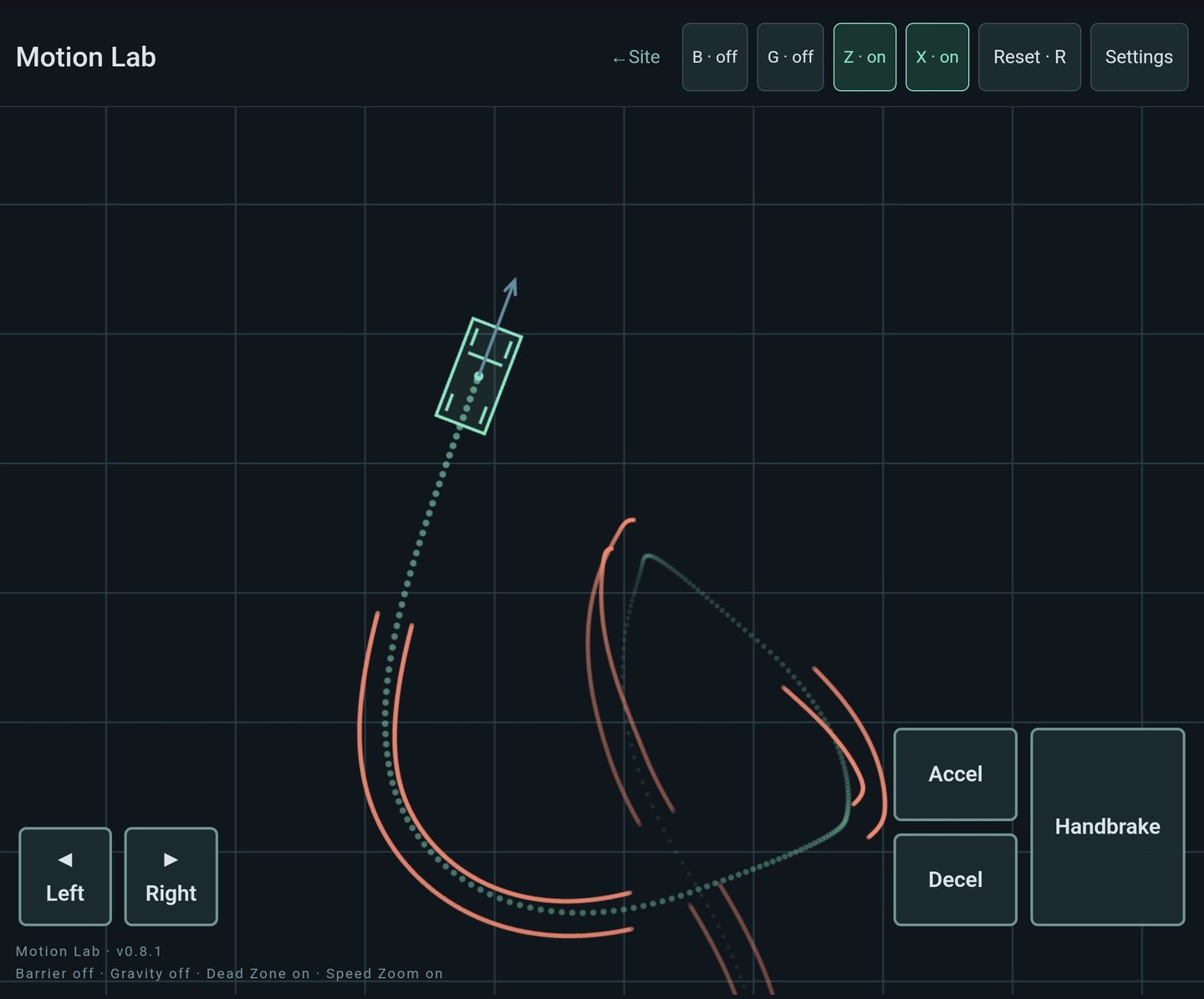
Press 3 and the car becomes a brick.
That is a real mode in Motion Lab, a browser toy that Pat Kerr put up this week. Kerr was a programmer at DMA Design — the studio that became Rockstar North — and the physics he is giving away is the physics that moved the cars in the original Grand Theft Auto. He has rebuilt it in JavaScript, thirty years after writing it, and the thing you drive in a browser tab is the same simulation that shipped.
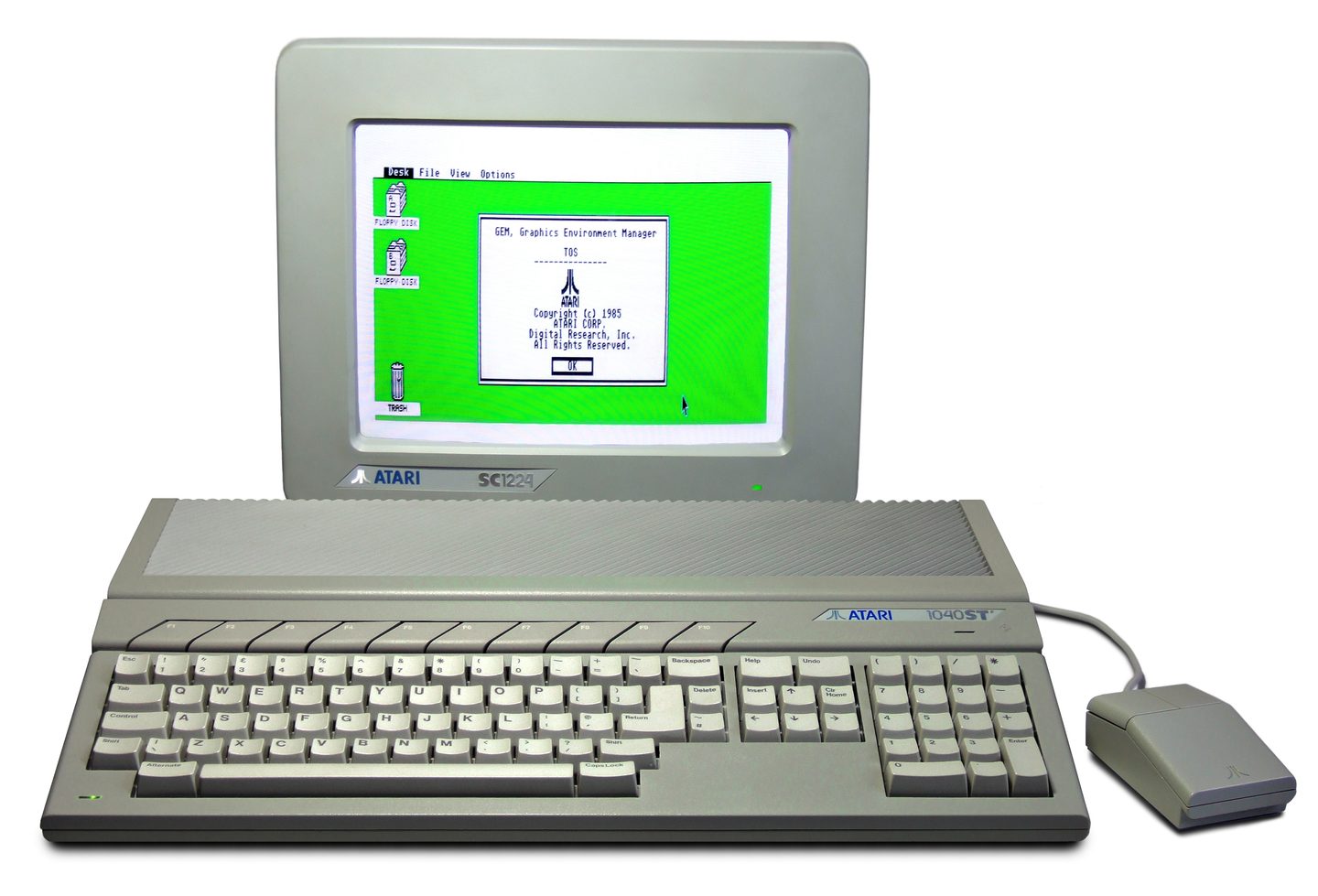
The origin story is smaller than the game it ended up in. One weekend in late August 1996, on an Atari ST at home, in GFA BASIC, as a wireframe demo. It was ported to C afterwards to go into the actual game.
What was unusual about it
Kerr’s own framing is the useful part. He describes what he built as a simple classical 2D rigid body dynamics simulation, and points out that most game vehicles of the period were done with basic high-school point physics — F = ma, a position, a velocity, a shove in the direction you are facing.
The difference between those two approaches is the difference between a car and a cursor. Point physics gives you something that accelerates and turns. A rigid body gives you a mass with a moment of inertia, which means it resists being rotated, carries that rotation once it has it, and can be pushed around its centre rather than through it. Oversteer falls out of that. So does the handbrake turn, and the way a GTA car keeps swinging after you have let go of the wheel.
Nobody playing in 1997 could have told you any of this. What they could tell you was that the cars felt heavy — the same information, arriving by a different route.
The part he guessed
The tyres are where it gets honest. Kerr calls his tyre behaviour simple, approximate and technically incorrect, and describes it as his fairly educated guess.
Tyre modelling is genuinely hard — the real thing is a slip-angle curve that rises, peaks and falls away, and getting it from measurements is somebody’s career. In 1996, on a machine with no floating-point unit worth the name and a frame budget measured in a handful of milliseconds, you were never going to evaluate that curve. So he approximated it, tuned it until the car did what a car does, and shipped.
This is the bit worth sitting with. The structure underneath was more rigorous than the competition’s, and the surface detail was a shrug. Both decisions were correct. A dynamics solver is the thing you cannot bolt on later; a friction curve is a number you can turn until it feels right. Vehicle handling still gets built in exactly that order, in studios with physics engineers and telemetry.
Dead zone, and zoom
Buried in Motion Lab’s controls are two camera toggles: Z for the camera’s dead zone, X for speed-based zoom. B switches the side barriers, G flips vertical gravity.
Those first two are a confession. A dead zone means the camera ignores small movements before it starts following, which keeps a twitchy car from making the whole screen twitch. Speed-based zoom pulls out as you go faster, so the road arrives at your eye quicker than the car is actually travelling. Neither is physics. Both are why the physics read as speed.
I have spent enough time next to a vehicle setup to know that the handling argument is usually half a camera argument, and that nobody enjoys being told so. Having the two toggles sitting beside the solver, as separate switches you can turn off, is a more candid piece of documentation than most engine manuals manage.
Thirty years of what, exactly
One correction, because the anniversary is being reported loosely. The thirtieth being marked is the prototype’s — that weekend in August 1996. Grand Theft Auto itself did not ship until late 1997, and the outlets do not even agree on the day: 21 October and 28 November 1997 both appear for the European MS-DOS release. The game’s own thirtieth is next year.
It keeps happening to these games. A modder path-traced GTA 2 by writing a new Direct3D 9 renderer to turn its tile world into geometry RTX Remix could actually light, and that was a stranger reaching into a closed binary from outside. This is the other direction: the person who wrote the code, opening it himself.
Both are worth more than nostalgia. When the GoldenEye decompilation rebuilt the 1997 ROM byte for byte, what came out of it was a readable account of how a 1990s console game was actually assembled — budgets, constraints, compromises. Kerr’s write-up does the same job for one subsystem, with the advantage that the author can tell you which parts he believed in.
Press 2 for Ship mode and the tyres come off entirely, leaving thrust and rotation in a frictionless plane. It handles like nothing you would want to drive. Which tells you precisely how much work that educated guess was doing.