Nvidia’s RTX Remix works by standing between a game and the graphics driver, catching fixed-function Direct3D 8 and 9 draw calls and re-lighting the scene it reconstructs from them. That is the whole premise, and it is why the Remix catalogue is full of early-2000s shooters. GTA 2 is from 1999. It talks to DirectDraw and an early build of Direct3D, neither of which Remix listens to.
So a developer going by gebdag wrote the missing renderer. GTA2 RTX Remix went up as v0.7.1 on 25 September 2026 and coverage followed over the next two days: path-traced lighting, a dynamic time of day, 16:9 support, and frame generation aimed at 60fps in a game that shipped when a Voodoo3 was a reasonable purchase.
Two DLLs and a rebuilt world
The project ships gta2dx9.dll, described in its own repository as a
Direct3D 9 renderer for GTA2, and gta2dx9_vid.dll, a shim for the video
device. The trade coverage has called this a wrapper, which undersells what is
in the source tree. Alongside the D3D9 renderer sit modules for map, style,
mesh and camera — GTA 2’s own level data and its own tile-and-sprite graphics
format, parsed and turned into meshes.
Read that again in pipeline terms. Remix is not intercepting GTA 2’s geometry. There is no GTA 2 geometry to intercept in any form Remix understands. The renderer reads the game’s data files, builds the city itself, and presents that as a modern draw call. What the path tracer lights is new work that happens to be positioned exactly where Anywhere City used to be.
That distinction decides everything about how the mod looks. A normal Remix project is an asset job: capture a scene, replace the textures with PBR versions, place lights, ship. Here the lights, the emissives and the surface properties have nowhere to come from, because the source files never had them. It is the same problem the team rebuilding PS1 pre-rendered backgrounds in Blender ran into from the other side: recovering three dimensions from data that was only ever asked to produce a picture.
Where the light comes from
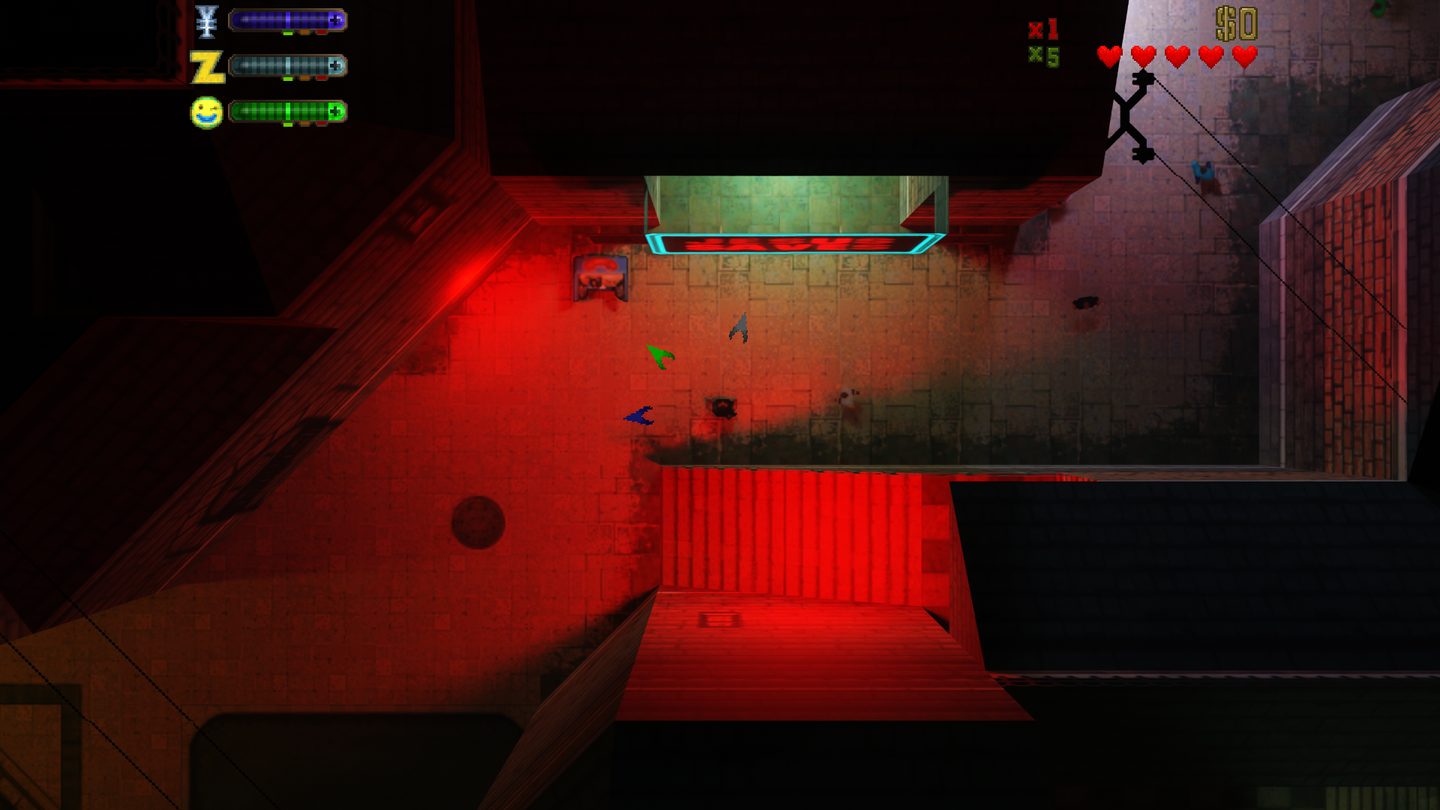
The repository is direct about it. The renderer does translation of the game’s lights, plus generation of lights from game events such as explosions, fires and gunfire, and it ships emissive maps for some of the game’s textures as a Remix mod. Version 0.7.0’s notes add flicker to car fires and extend emissives to all pickups so they stay visible in dark scenes.
Every one of those is an authoring choice. A car fire in 1999 was an animated sprite with no light attached; somebody decided it now throws a flickering point light, chose its colour, and chose how fast it flickers. Pickups glowing in the dark is not a restoration. It is a lighting artist solving a legibility problem that the mod itself created by making night actually dark.
Widescreen turned out to be a rendering problem too. The original ran 4:3 and culled at the edge of that window, so opening the view to 16:9 exposed characters popping into existence a few pixels from the frame edge. The project notes 16:9 support without that pop-in, which means the draw window had to be widened, not just the camera.
The cheapest path-traced city you will ever see
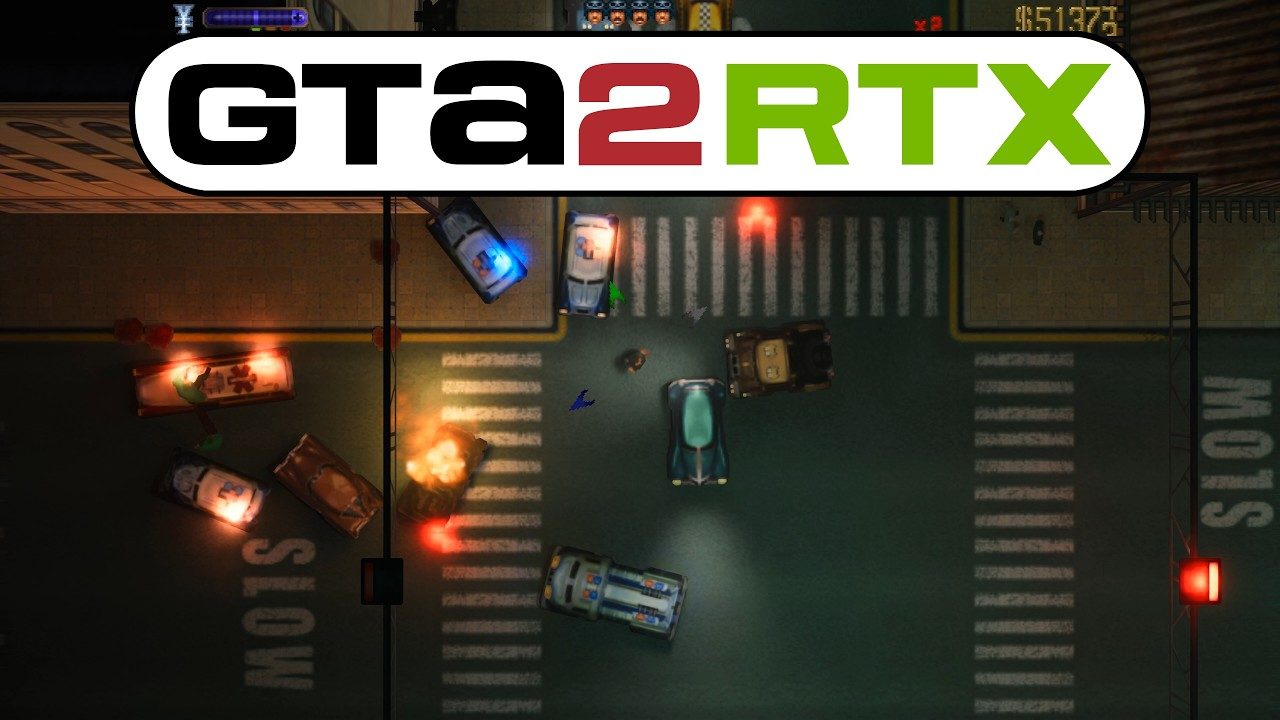
There is a nice irony in the timing. The expensive problem in path tracing right now is geometry — how to keep an acceleration structure for tens of gigabytes of mesh inside a consumer card’s memory, which is the whole subject of RTX Mega Geometry 2.0 streaming 31GB of mesh through 1.5GB of VRAM. GTA 2’s Anywhere City is a grid of textured blocks. The BVH for it would fit in a rounding error.
Which is why frame generation is doing the heavy lifting on the performance claim rather than the ray budget. The requirements list is short: the free v9.6 release of GTA 2 that Rockstar has distributed since 2004, the RTX Remix runtime, and 64-bit Windows 10 or 11. No minimum GPU is documented, which for a path tracer is a conspicuous silence — Remix’s own floor has always been an RTX card, and the 60fps figure quoted in coverage comes with no hardware attached to it. Treat it as unverified until somebody benchmarks it.
What this actually demonstrates
Remix was sold as a way to bring old games forward without their source code. The GTA 2 project shows the limit of that pitch and the way around it in the same repository: when a game is too old for the interception layer, you write the renderer the interception layer wants to see, and you accept that you are now the author of the scene rather than its restorer.
It is a lot of work for a 27-year-old top-down game, and the people doing it know more about GTA 2’s file formats than anyone at Rockstar has needed to in two decades. That knowledge is the real output. The lighting is what makes it shareable.