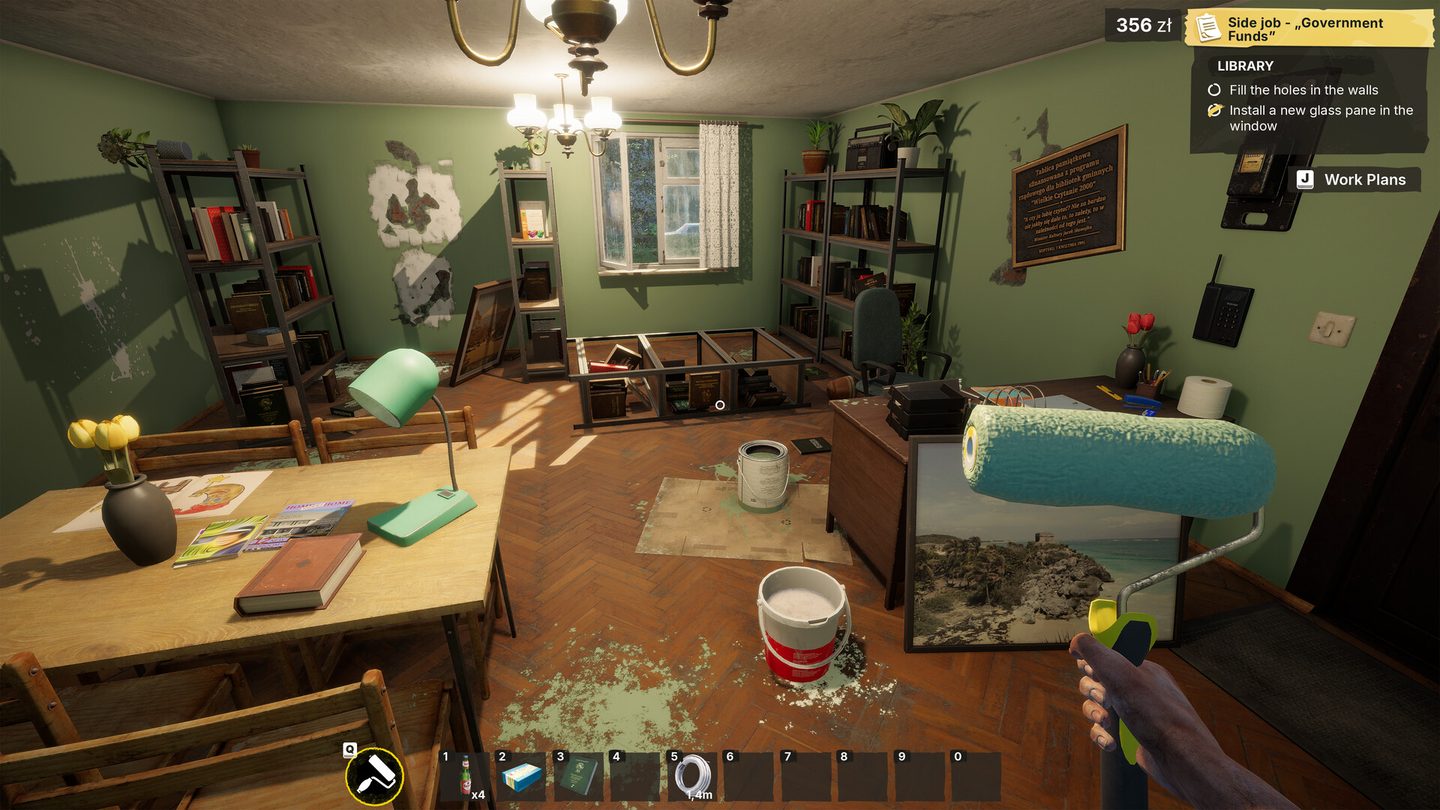
Low-Budget Repairs, by Polish studio Gray2RGB, left early access and hit full release on Steam on 13 August 2026. If you know House Flipper, you know the shape of it already — first-person renovation sim, walk into a wrecked flat, fix it up. The twist is the entire job description. You are not a craftsman. You are a scummy 1990s handyman running a one-man business on razor-thin margins, and the game rewards you for cutting every corner you can get away with: diluting paint with water so it goes further and looks worse, tiling without a level, patching drywall with the bare minimum of compound. There’s an achievement, Defenestration, for disposing of 500kg of old furniture and junk exclusively by throwing it out of the window rather than carrying it down the stairs like a person who cares.
It’s a funny premise, and it’s landing well — PC Gamer called it House Flipper for the scummiest handyman in ’90s Poland, which is about as good a one-line pitch as a Steam page gets. But the part I want to talk about is the one nobody’s reviewing it for: someone on that team had to build convincing bad craftsmanship, and that is a genuinely stranger art problem than building good craftsmanship.
Environment art almost never gets asked to look bad on purpose
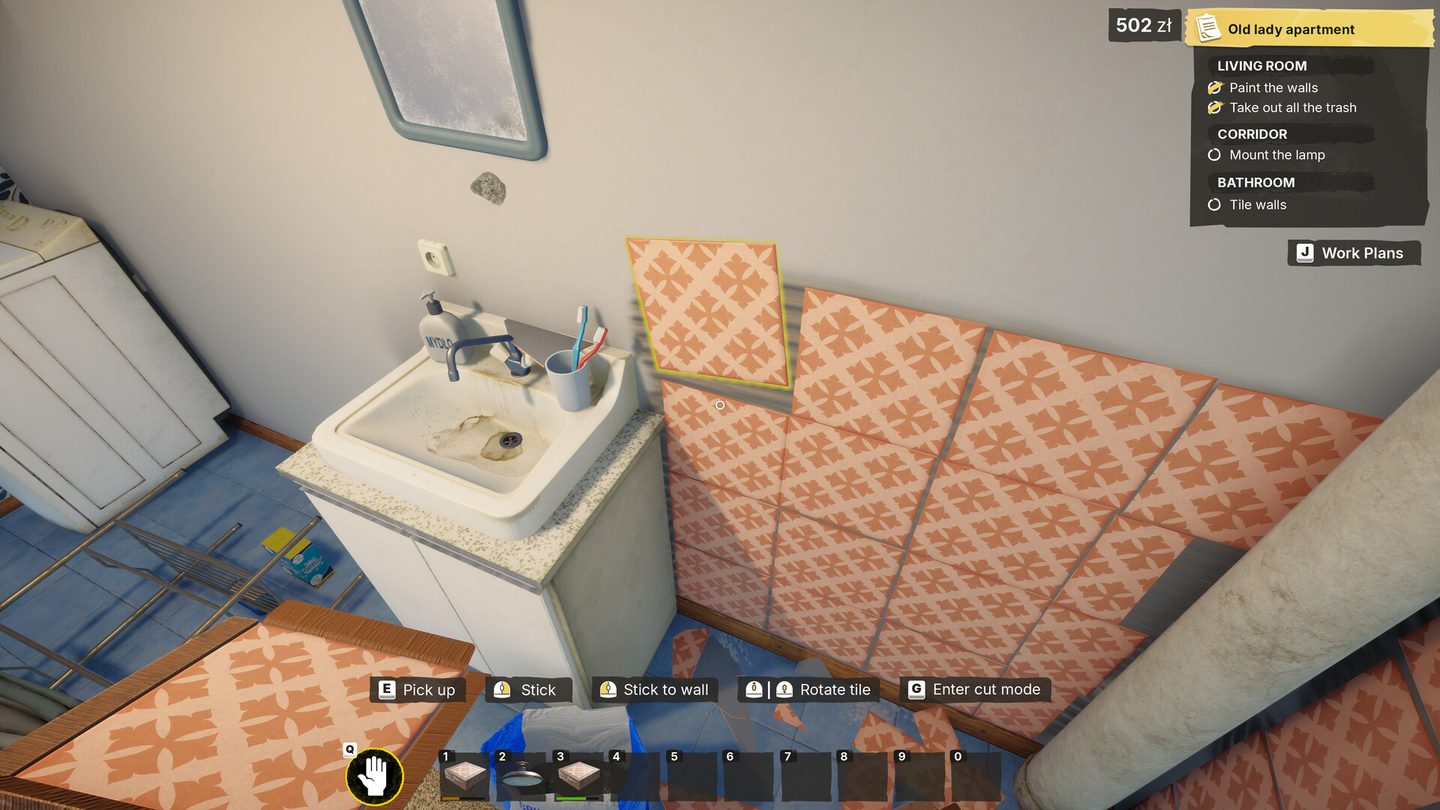
Nearly every renovation, building or interior-design game — House Flipper included — is solving the opposite problem: how do you make a “before” state read as neglected, then make the “after” state read as satisfying and correct? The bad state is a means to an end, a contrast that exists to make the good state land. Nobody has to believe in the bad state on its own terms.
Low-Budget Repairs can’t do that, because the bad state is the after state. The player’s own shoddy tiling, drippy paint job and crooked shelf has to sit there, finished, and still read as “a job that got done” rather than “a bug in the renovation system.” That’s the tightrope: make damage and sloppiness look intentional enough that the player believes their character chose to cut corners, not that the engine failed to snap something into place.
That means the underlying kit almost certainly needs a controlled badness system rather than a single “correct” state per object. A few ways I’d expect this got solved, in roughly increasing order of how much it costs to build:
- Procedural variance on placement, not just position. Tiles that are allowed to sit at a few degrees of rotation and a few centimetres of offset from a perfect grid, inside a tuned range — enough to read as “laid without a level,” not enough to read as physically falling apart.
- A grime and drip layer independent of the base material. Diluted paint needs patchy coverage and visible drip trails that behave differently from a normal weathered texture, because it’s not old and worn, it’s freshly badly applied. That’s a distinct look from the ambient dirt-and-decay masks most environment art actually trains on.
- Multiple valid “finished” states per fixable object, so the same wall or cabinet can end up looking acceptable, sloppy or actively wrong depending on what the player did to it, without any of those states looking broken. That’s real content multiplication — the kind of scope a small team like Gray2RGB has to be disciplined about, because every prop that can be “fixed” now needs a spread of outcomes instead of one.
Why this is worth filing away
The instinct in environment art is almost always toward legibility through polish — cleaner silhouettes, tighter material response, less noise. Low-Budget Repairs needed legibility through mess, which is a much less practiced muscle: noise that still reads as a choice. It’s the same underlying skill PowerWash Simulator needed for its dirt masks, just pointed in the opposite direction — instead of authoring grime that satisfyingly comes off, you’re authoring shoddiness that has to satisfyingly stay.
Worth a look if you do any kind of interior or prop kit work, even if a comedy renovation sim about 1990s Polish flats isn’t normally your genre. Convincing “bad on purpose” is a smaller body of craft knowledge than convincing “good,” and this is a shipped, full-release example of someone having actually solved it.
Mechanics and release details from PC Gamer’s and Game8’s coverage of the 13 August 2026 full release; I haven’t played it myself, so the art-pipeline breakdown above is informed reasoning about how I’d build this system, not confirmed detail from Gray2RGB.