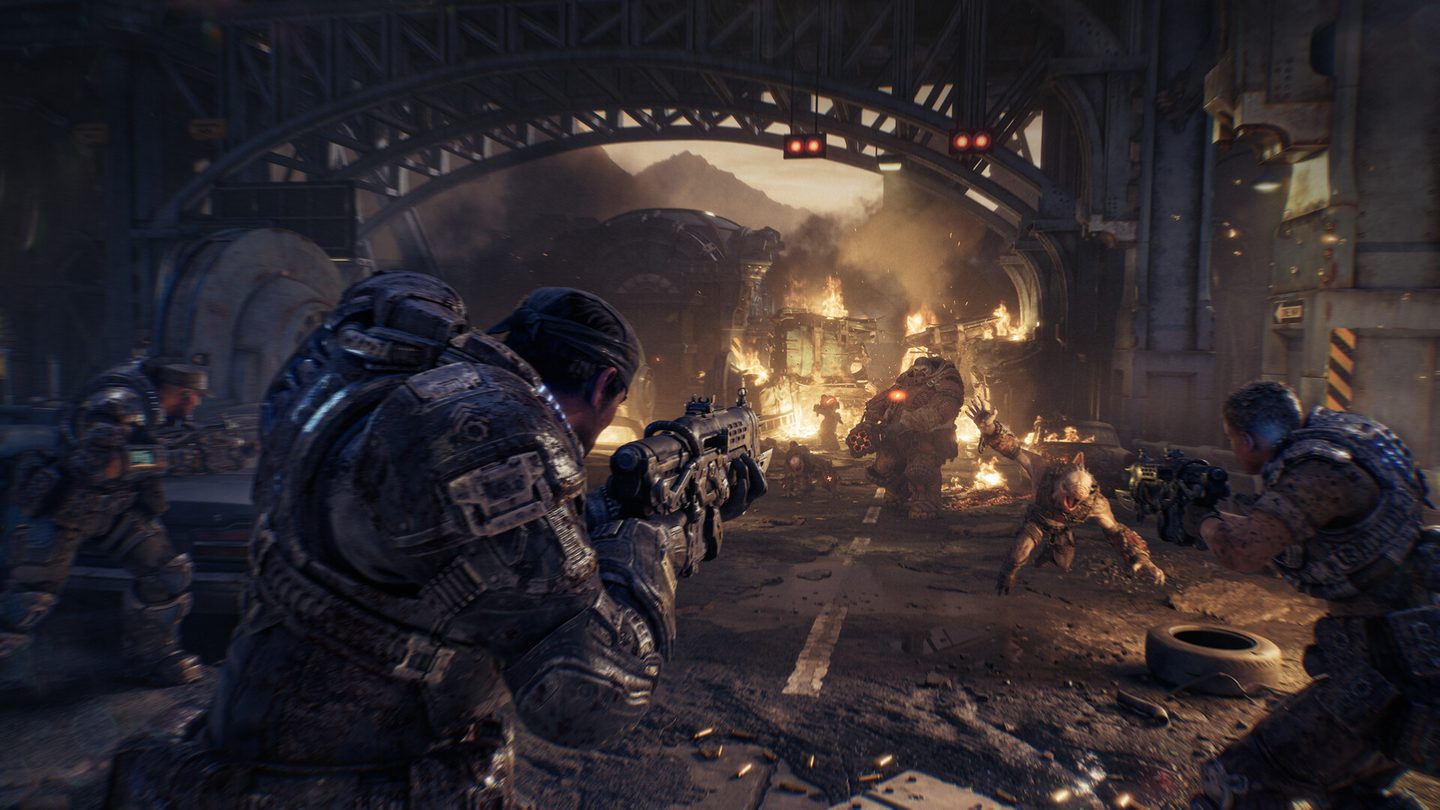
Reviews for Gears of War: E-Day went up on 1 October 2026. The game comes out on the 6th. That gap is unusual enough on its own, and it got stranger when the Guardian’s review went live a day early, scored it 3 out of 5, and vanished again — Notebookcheck and Power Up Gaming both caught it before it came down.
Across the five scored verdicts I could verify and convert, the average is 8. The range runs from 6 to 9.5.
Three and a half points. On Onimusha a few weeks ago the spread was two, and I said a tight spread usually means nobody is arguing about what the game was trying to do. The inverse holds here.
What nobody is arguing about
The shooting. Every outlet in the list, including the one that gave it a 6, says the moment-to-moment combat is the best the series has produced. The Guardian’s own line, in the version that briefly went live, was that E-Day has the best combat in twenty years of Gears.
So the 6 and the 9.5 are not disagreeing about whether the game is good at the thing it is for. They are disagreeing about everything wrapped around it.
The argument is about shape
PC Gamer filed under “good shooting, but the campaign’s a slog”. GameSpot’s Richard Wakeling called it a prequel with nothing new to say. GamesRadar reached for Halo 3: ODST as the comparison and meant it as a compliment. Eurogamer’s Dom Peppiatt said it evolves the best of the 2006–2011 trilogy and drops the worst. One review headline I found put it plainly: best Gears since 3, and brightest when it stays linear.
That last clause is the one worth sitting with from an art desk.
Gears of War built its identity on a very specific kind of space. A corridor that opens into a courtyard, chest-high cover placed where a designer wanted you to end up, a flank route that exists because somebody drew it. The cover geography is the level design. It is furniture arranged on a stage, and the arrangement is doing the work that a level-up system does in other games.
Widen that space and two things happen at once. The cover has to start looking incidental — rubble, barricades, wrecked vehicles that read as debris rather than as a designed fight — and the amount of authored detail you can afford per square metre falls, because the metres multiply. CD PROJEKT RED’s environment team talked about twice the texel density of The Witcher 3 in Night City, and were explicit that hand placement was what made it possible. Hand placement scales with hands.
I have not played E-Day and will not pretend otherwise. What I can read is a pattern: five outlets, no coordination, and the word that keeps surfacing for the open sections is repetitive while the word for the tight ones is superb. When independent reviewers converge on a complaint that maps that cleanly onto a structural decision, the decision is usually the cause.
Most of these reviews are incomplete
Worth saying loudly, because it changes what the number means. Reviewers describe a review build with versus multiplayer and the Horde siege mode switched off. That is why so many of these are filed as review-in-progress, including GamesRadar’s and PC Gamer’s. Windows Central was explicit that its 8 was for the campaign alone.
So: an average built from five campaign verdicts, five days before anyone can buy it, on a game whose multiplayer has historically been half the reason people keep it installed. Treat the 8 as a campaign score with a label on it.
The aggregates were moving while I collected this. Metacritic read 88 and then 89 inside roughly a day, with OpenCritic at 87. Different snapshots, different numbers — which is what an aggregate does when reviews are still landing.
The PC side
DSOGaming benchmarked an RTX 5090 at roughly 67fps average at 4K Ultra with DLSS 4.5 on Quality. Native 4K Ultra at 60 is, by their numbers, a 5090-only proposition. TweakTown found a graphics preset called Ludicrous that drags even that card down.
A “Ludicrous” setting is a studio being honest, and I would rather have it than an Ultra preset that quietly costs the same. It is a future-proofing slider, not a recommendation.
The CPU results are the more interesting half. E-Day scales visibly with core count and with 3D V-Cache, which points at a lot of work on the game thread — and on a UE5 title the usual suspects are shader compilation and streaming. We have been here before: Silent Hill: Townfall cleared 60fps at native 4K on a 5090 and still hitched, because average frame rate and frame delivery are different problems. Nothing in the benchmarks I read tells me which one E-Day has. Ask again on the 6th.
I could not confirm two things and would rather say so than guess: GameSpot published a review without a number I could verify, and a claim circulating about Series S memory paging traces back to secondhand write-ups of a Digital Foundry analysis I could not read directly.
The number
8, from five scores between 6 and 9.5, collected on 1 October 2026 and converted to a ten-point scale.
The mean is doing less work than usual here. A game that one outlet puts at 9.5 and another at 6, with both of them praising the same combat system, is a game where the thing you care about decides your score. If what you want is the Gears firefight, every review in the list says it is there. If you want a campaign that holds together for its full length — the longest in the series, which The Coalition has been advertising — the verdicts stop agreeing.
Scores collected on 1 October 2026 from the outlets’ own pages, converted to a 1-10 scale and averaged. Released 6 October 2026 on Xbox Series X|S and PC at €69.99, developed by The Coalition with People Can Fly for Xbox Game Studios.