Only CG Channel has filed on this so far, so the details below rest on one outlet’s reporting of the release plus the public reference code for the technique itself.
Stand a character next to a cliff face in almost any game and walk sideways. Somewhere around the fourth or fifth metre you will find the crack you already looked at. Then again. The tiling repeat is the most familiar failure in environment art, it has been solved a dozen different ways by a dozen different studios, and every one of those solutions lived in a shader someone on the tech art team wrote and maintained.
Foundry has put one in Mari.
What landed
Mari 8.0 has been in open beta since July. The update CG Channel wrote up on 24 September is Beta 2, and it brings a Hex Tile node, a Tri-Planar Tiled node, and a Compare node for A/B wipes between two branches of the graph. The whole 8.0 cycle adds over fifty nodes to the Node Graph, most of them small maths operations that should have been there years ago.
No stable date. CG Channel’s guess, based on how previous Mari cycles have run, is three to six months. Pricing at the time of the beta announcement: $86 a month or $689 a year for an individual, $1,289 a year per seat for teams.
The hexagons
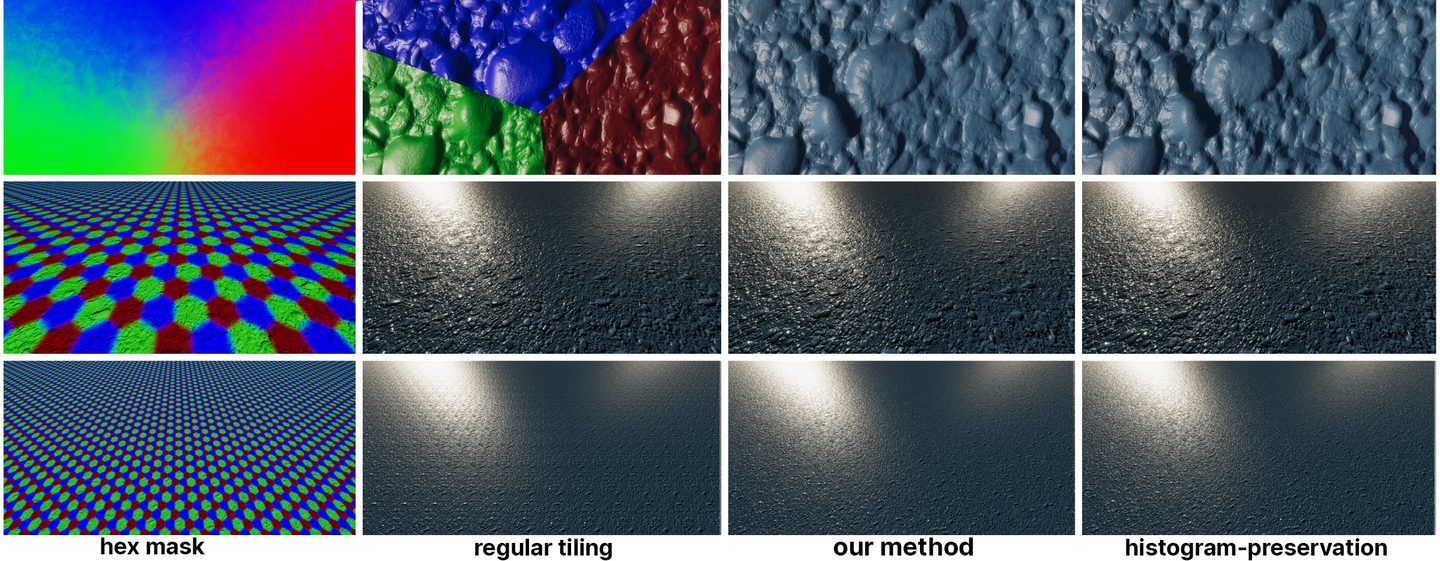
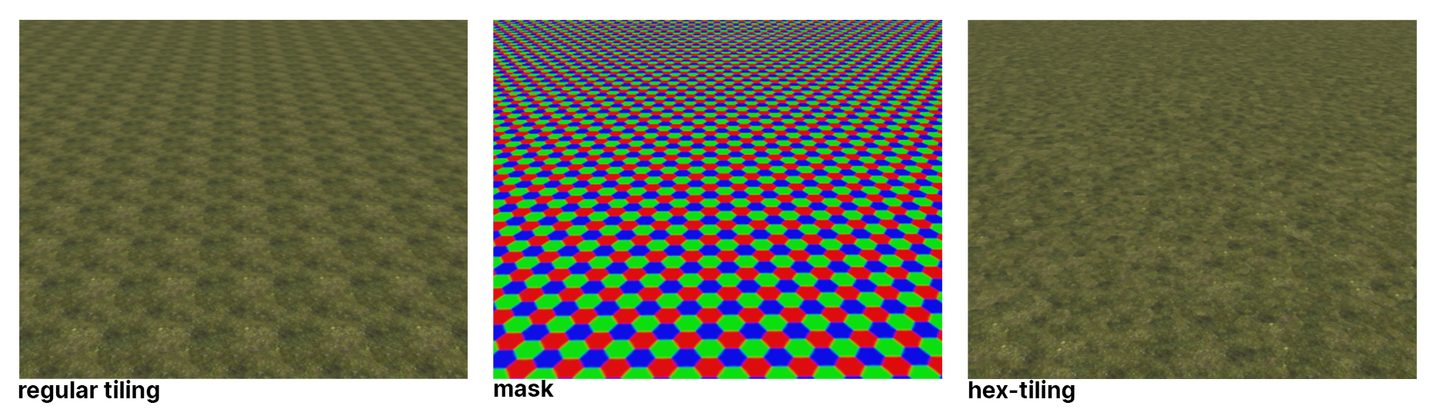
Tile a texture on a square grid and the eye finds the grid, because the same rectangle lands at the same orientation every time. Hex tiling breaks that by laying the texture down on a hexagonal lattice instead, with each cell getting its own random offset and rotation, then blending the three cells nearest to the shading point according to how far it sits from their edges.
Three cells means three texture fetches for every pixel that would otherwise have cost one. That is the price, and it is why this was a research problem rather than a default.
The lineage is worth knowing. Heitz and Neyret published the histogram-preserving version in 2018, which kept contrast intact through the blend but needed a precomputation pass turning your source texture into a transform and an inverse transform. Two extra textures per input, generated offline, invalidated every time an artist tweaked the albedo. Morten S. Mikkelsen’s 2022 adaptation threw out the histogram machinery and replaced it with a contrast ramp cheap enough to evaluate inline, which let the method sample the original texture directly. His demo code is on GitHub under MIT, and it is the version that has been spreading — into Houdini, into RenderMan, into Redshift 2026.6 back in May, and now into Mari.
Why the paint tool is the place it matters
A render-time hex tile node fixes the picture. A paint-time one fixes the feedback loop.
Every texture artist has shipped a surface that looked fine in the material preview and grew a visible grid the moment it went onto a two-hundred-metre terrain under a low sun. You find that out in review. Then you go back, add macro variation, re-export, re-import, wait for the light bake. Doing the de-repeating in the tool where the texture is authored means the thing on screen while you paint is the thing that ships, and the artist gets to judge whether the blend is eating detail they cared about.
That judgement is the part no node automates. Hex tiling works beautifully on gravel, rust, dirt, plaster, lichen, anything with no preferred direction. Feed it a brick wall and the rotations will cut the courses at angles bricks do not sit at. Wood grain the same. You learn quickly which of your library is hex-safe, and it is roughly the half of it that was already noise.
The other node
Tri-Planar Tiled is the less glamorous addition and might get more use. Mari already had a triplanar projection node, but it wanted up to three separate images, one per axis. The new one takes a single image and throws it down all three ways. For a scanned rock with garbage UVs, or a kitbashed hard-surface piece nobody ever unwrapped, that is the difference between texturing it and sending it back.
Triplanar has its own tax — three projections, blended by the world-space normal, and a smeared band wherever a surface sits at forty-five degrees to two axes. Artists have been eating that tax in Substance and in engine shaders forever. Having it in the paint graph mostly saves a round trip.
Where this sits
The interesting thing about a solved problem arriving as a button is how much of the craft it quietly relocates. Deciding how much unique texture a surface deserves is still the call that costs money — CD PROJEKT RED placed every building and advert in Night City by hand because a first-person camera walks right up to all of it, and no amount of clever tiling substitutes for that budget. Hex tiling does not buy you authored detail. It buys you permission to tile at a scale where you were previously forced to, and to stop apologising for it.
At the other end, a prop the camera holds at arm’s length still gets four hand-authored texture sets and wear painted where a hand would put it. Nothing in Mari 8 changes that maths. It just moves the line a bit, in the direction of the artist.
One practical note for anyone hoping to see it in motion: Foundry has asked people not to publish videos showing the beta UI until the features are out of beta, with demos available on its own site instead. So the node exists, the maths is public, and the screen recording is not.