Three models, two rack generations, and the company that built the chip doing the measuring.
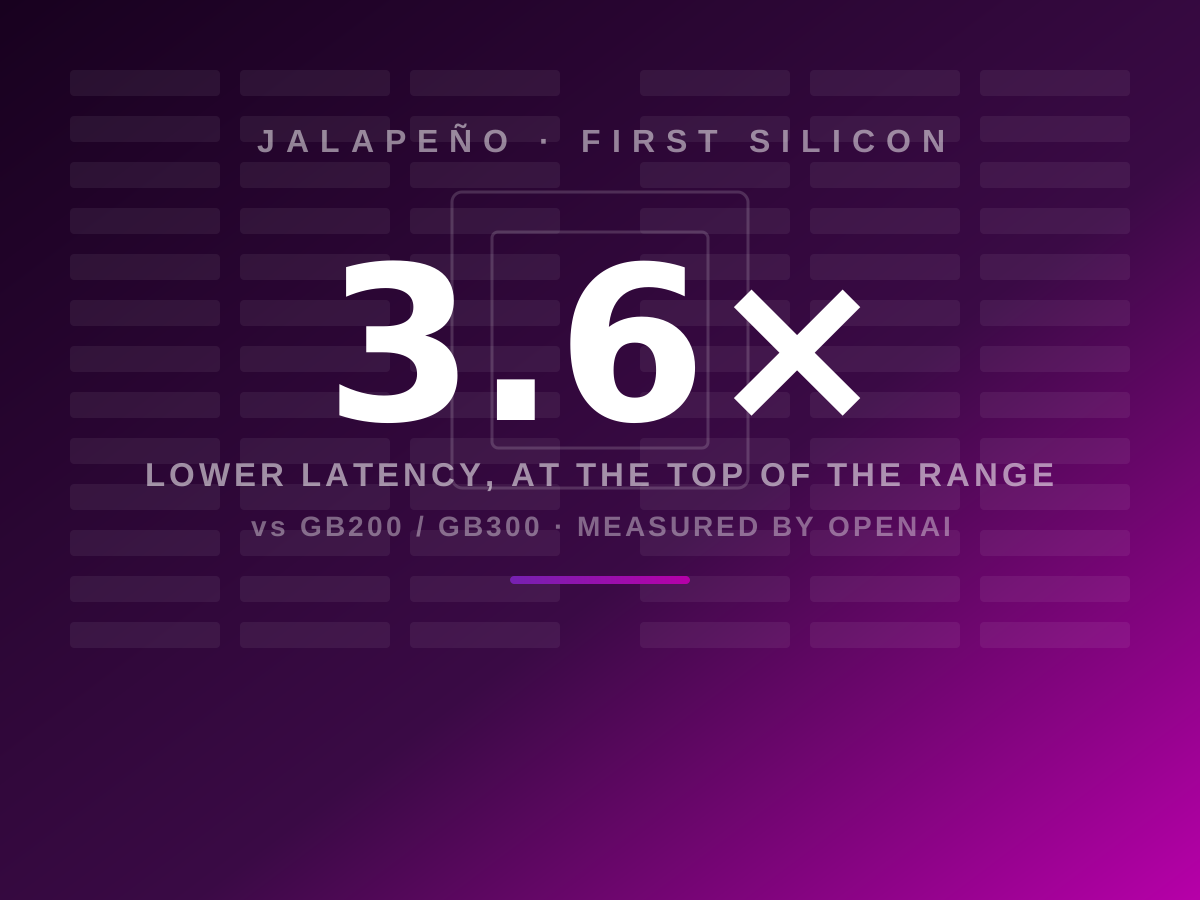
On 25 August OpenAI published the first numbers from working Jalapeño silicon. The tested models were GPT-OSS 120B, DeepSeek R1 and Kimi K2.5. Against Nvidia’s GB200 NVL72 and GB300 NVL72 racks, the claimed results were 1.5x to 1.9x more work at peak, 1.7x to 3.6x lower end-to-end latency, and 2.1x to 4.1x on the most interactive workloads — the ones where a person is sitting there waiting. All figures as published on that date.
The benchmark is not MLPerf
Jalapeño was measured on InferenceX, a public benchmarking platform from SemiAnalysis that times the whole business of serving a request rather than a single forward pass. That is a defensible choice — MLPerf’s inference suite has long been accused of measuring a shape of workload nobody actually ships, and “time to first token, then tokens per second, under real concurrency” is closer to what a serving stack does all day.
It is still not a neutral referee submitting a result. OpenAI picked the platform, picked the comparison racks, and published the run.
Two caveats came out alongside the numbers and both matter. Speculative decoding was excluded from the tests, which is a technique Nvidia’s stack leans on hard and which can move latency substantially. And the comparison racks are GB200 and GB300 — silicon from 2024 and 2025. Nvidia’s Vera Rubin platform is the thing Jalapeño will be sharing a datacentre floor with, and it isn’t in the chart.
One choice does read as fair. All three benchmarked models are open-weight, and two of them are somebody else’s. You cannot run GPT-5 on a Blackwell rack you don’t control, so if you want a cross-hardware comparison at all, open models are the only honest way to get one. Using DeepSeek R1 and Kimi K2.5 rather than three OpenAI checkpoints was the right call.
Per watt is doing a lot of work in that sentence
OpenAI’s own summary talks about getting more intelligence from every watt. Reporting around the release says system-level power was not disclosed, which would make the peak figure a throughput number rather than an efficiency one.
Those two things can both be true, and the gap between them is the whole question. Chip-level power and rack-level power are different measurements, and in an NVL72 the difference is enormous — the switch fabric, the HBM, the optics and the cooling all draw real current, and a rack-scale interconnect is precisely where Nvidia has spent its engineering. A part that wins on joules-per-token at the die and loses at the rack is a completely ordinary outcome in this industry.
Until someone publishes wall power for both configurations, treat the efficiency claim as unresolved. The latency claim is the sturdier one.
Nine months
The part I keep coming back to is the schedule. Jalapeño was announced on 24 June 2026, co-designed with Broadcom and fabricated by TSMC, and the reported gap from initial design to tape out was about nine months. Working silicon posting benchmarks two months after the announcement fits that timeline.
Nine months from design to tape out on a part this size is fast. Not unprecedented for a fixed-function accelerator built by a team that has done it before — which is exactly what Broadcom is, and why OpenAI went to them instead of building a silicon organisation from scratch. You buy the schedule.
The schedule is the competitive move here, more than any multiplier in the chart. Nvidia’s moat is CUDA, the interconnect, and the fact that everyone’s stack already runs on it. OpenAI is the rare customer with no exposure to any of that, because it only ever has to run one stack: its own.
It will not be in your machine
OpenAI says Jalapeño starts going into its own compute infrastructure by the end of 2026, and that it will keep deploying Nvidia and other accelerators alongside. No external sale has been announced. So for anyone building things for a living, this is a change to a rental price and a rental latency, not to what sits under the desk.
Worth being clear about what that does and doesn’t touch.
It could matter for the batch work a studio actually farms out to an API — tagging a decade of asset libraries, generating variant naming, first-pass descriptions for a store page, shader boilerplate. Those jobs are priced per token and run overnight, and cheaper inference is cheaper inference. Interactive latency matters too, in a narrower way: the assistant panel bolted into your DCC is unusable at two seconds and fine at four hundred milliseconds, and that difference is exactly what the 2.1x–4.1x figure is describing.
What it does not touch is everything that runs locally. The denoiser in your render, the upscaler, diffusion for texture and material work, mesh and segmentation tooling — all of that lives on the GPU in the box, on its VRAM, and none of it gets faster because a datacentre in Texas got a new part.
And even in a world where OpenAI sold this thing, it would not be your chip. A custom inference accelerator is shaped around transformer serving: enormous matrix multiplies, KV cache traffic, memory bandwidth tuned to autoregressive decode. Local creative AI is convolution-heavy, diffusion-shaped, latency- tolerant and VRAM-starved. Different problem, different silicon. The general GPU stays general for a reason, and it stays the thing artists buy.
What I’d watch for next is a price change. If custom silicon is doing what OpenAI says it is, the place it shows up for the rest of us is the per-token line on an invoice, some months from now. That is a number anybody can check.
Benchmark figures as published by OpenAI on 25 August 2026 and relayed by CNBC, TechCrunch and The New Stack; announcement date, Broadcom co-design and TSMC fabrication from the 24 June 2026 announcement and Broadcom’s own investor release. The InferenceX platform and the speculative-decoding and power caveats come via SemiAnalysis. OpenAI’s own post could not be read directly from here, so every figure above is as relayed by those outlets.