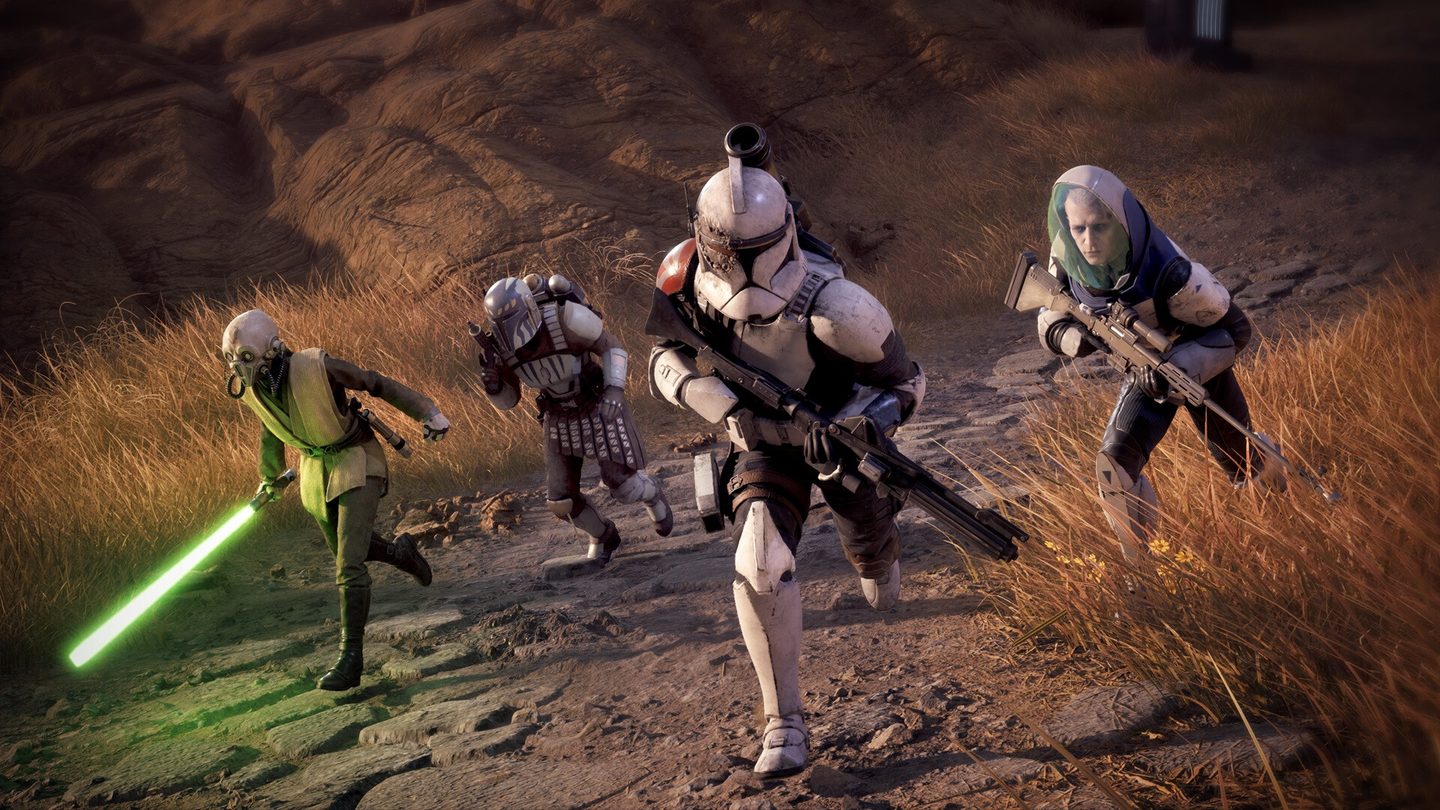
The camera sits about twenty metres up, angled down, far enough back that you can read a firing line across a whole courtyard. You commit a shot. It drops — fast, close, over the shoulder of a clone trooper — holds for the impact, and pulls back out to tactical height before you’ve finished exhaling.
That move is the entire art brief for STAR WARS Zero Company, out today on PC, PS5 and Xbox Series X/S. Bit Reactor built it with Respawn, published by EA and Lucasfilm Games, and it is a turn-based tactics game set in the closing stretch of the Clone Wars.
Where the scores landed
OpenCritic has it at 87 from nineteen critics as of 27 August, with 89% of them recommending it. Metacritic sits at 86. Six outlet scores I could verify individually:
| Outlet | Score |
|---|---|
| IGN | 9 |
| GameRant | 9 |
| TechRaptor | 9 |
| Game Informer | 8 |
| VGC | 8 (4/5) |
| Shacknews | 7 |
Mean of 8.33, which rounds to 8.5. Those six are a sample of nineteen, so treat the number as a temperature reading rather than a verdict — but the shape is consistent with the aggregate, and the spread is real rather than the flat identical-number pattern you get when a page is scraping rather than reporting.
The consensus is easy to summarise. The tactics are good. The presentation is better than a game seen from this distance has any business being. And a lot of reviewers, across the range from 7 to 9, mention texture pop-in.
Twenty metres up is a hard place to sell Star Wars
Respawn’s Jedi games get to art-direct a corridor. Third-person, over-shoulder, a known field of view and a known distance to the nearest wall. You know which side of a rock the player will see, so you spend your texel budget there and leave the back of it cheap. You know the light will hit the character from roughly camera-left in this beat, so you place a practical and let it read. That control is most of why those games look expensive.
A tactics map takes all of it away. The camera orbits. Players spin it constantly, because spinning it is how you check cover angles, so every rock is seen from every side within about four seconds of the map loading. There is no back of the rock.
At the same time you’re much further away, which means silhouette does the work that surface detail does in a third-person game. Small props stop existing. Material response flattens out — at that distance a beautifully layered metal shader and a decent flat one are separated by about three pixels of specular. The things that survive twenty metres of air are shape, contrast, and light.
So a game that wants to look like a Respawn Star Wars game from up there has to buy its impression back some other way, and the close-up cut is how Zero Company does it. Hold the wide shot for readability, cut in for the beat that carries the drama, get out. It’s a very old film-editing solution to a very specific rendering problem.
The cut is what costs you the textures
Here is why I think the praise and the complaint are the same finding.
Streaming systems work on prediction. In a third-person game the engine has a fairly good idea of where you’ll be in two seconds, because you’re walking, and walking has momentum. It pulls the high-resolution mips for that direction and lets everything behind you sit at low detail. When it guesses wrong you get a brief smear, and it usually guesses right.
Now give that same system a camera that can be anywhere on a large map on the next frame, controlled by a player who whips it around to check angles, and a cinematic cut that teleports it to point-blank range on an asset that was two hundred metres away and streamed at potato resolution a moment ago. There is no momentum to predict from. The cut is an instant, unsignalled demand for the highest mip on a specific object, and the request arrives at the same moment the shot is supposed to look its best.
You can mitigate it. You can pre-warm the target of a cinematic cut a frame or two ahead, because the game knows who’s shooting whom before the animation starts. You can bias residency toward anything inside a unit’s threat range. You can hold the cut a beat longer on a wide before pushing in. None of that is free, and on a game where the player might have thirty units and a dozen visible enemies, the set of things that might need to be sharp next is most of the level.
Whether Bit Reactor undershot the pre-warm or the console memory budget simply ran out, I can’t tell from reviews alone. The symptom is consistent enough across outlets that it isn’t one reviewer’s machine.
Clone armour is a readability problem before it’s a fashion one
XCOM-style play depends on telling your units apart at a glance, from a distance, mid-panic. Silhouette, colour, stance. That’s the whole reason those games ship with soldier customisation that goes well past cosmetic — it’s a legibility system pretending to be a wardrobe.
Then someone hands you the Clone Wars, whose entire visual premise is that the soldiers are identical. Identical is the point of them, narratively and thematically, and it’s also the worst possible starting condition for a game that needs six distinguishable pieces on a board.
Reviews describe a squad of non-Force-using misfits rather than a company of matching troopers, which reads like the design answering that question directly — build the roster out of species and silhouettes that differ, then let armour kit and paint separate whoever’s left. Several outlets flag the story and characters as competent without being remarkable, which may be the price of casting for shape.
The permadeath caveat
Multiple reviews mention crashes, and at least one report describes crashes interacting badly with permadeath — losing progress in a way that makes a permanent loss retroactively worse. I could not confirm the specifics against a primary source before writing this, so treat it as reported rather than established, and as the kind of thing a launch patch usually reaches first.
An 8.5 on a day-one tactics game with a free camera and a cinematic cut is a good result. The bug reports and the pop-in reports are landing on the same week, from the same reviewers, at scores between 7 and 9 — which is roughly what it looks like when a team gets the hard rendering idea right and runs out of runway on the plumbing underneath it.
Scores as of 27 August 2026, the day of release. Aggregate figures from OpenCritic and Metacritic; the six individual scores are converted to a 1-10 scale and averaged with no weighting. Release platforms and developer credits from EA’s own listings for the game.