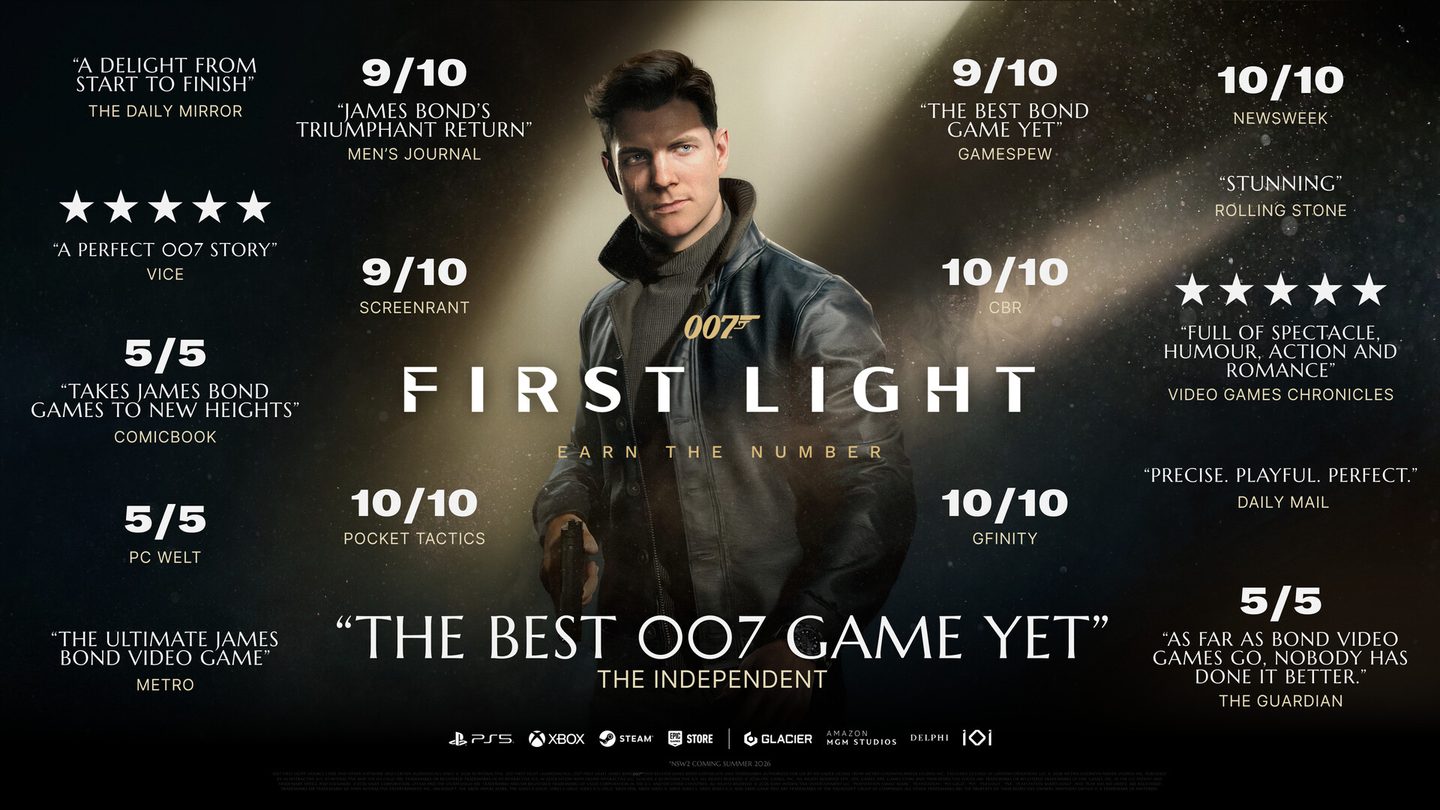
Territory Studio put out a making-of on the opening title sequence they built for 007 First Light, IO Interactive’s young-Bond origin story, and it is a good excuse to talk about something that has quietly become normal in game cinematics: title sequences that no longer shoot anything new.
What they made
The sequence was revealed back at the BAFTA Games Awards in April 2026, scored by “First Light”, performed by Lana Del Rey and co-written with David Arnold — his first return to Bond scoring in years. Andrew Popplestone, Territory’s global executive creative director, framed the brief plainly: “The creative hurdle on this sequence was honoring the weight of the Bond legacy while framing a fresh origin story that charts his journey from the Royal Navy to MI6.”
Visually it leans on a stark duality of light and shadow, gold accents standing in for the “First Light” of the title, pulling the viewer through an abstract dreamscape. It closes on refractive glass panels that rotate and resolve into the physical doors of MI6 — the cut point where the sequence hands off directly into gameplay. The centrepiece effect is a chandelier shattering in slow, highly refractive detail, built procedurally in Houdini and composited in Cinema 4D.
Territory has the pedigree for this kind of brief — they built the diegetic UI for Blade Runner 2049, embedded with Denis Villeneuve’s art department across fifteen sets, and have done cinematics work on Hitman World of Assassination and Marvel’s Spider-Man: Miles Morales. This isn’t a studio new to blurring film and game production.
The part I actually want to talk about
Here’s the detail buried in the making-of that matters more than the chandelier: the performance footage in the sequence isn’t a new shoot. It’s pulled from the game’s own in-engine animation assets — the same mocap captured for Patrick Gibson’s performance as Bond inside 007 First Light itself, not a separate cinematic capture session with its own lighting rig, its own camera department, its own take structure.
That is a real constraint, not just a budget line saved. Mocap captured for gameplay and in-engine cutscenes is authored to a completely different brief than a title sequence. It’s blocked for third-person camera coverage and readability at play-res, not for the kind of tight, symbolic, slow-push framing a Bond title sequence lives on. There’s no re-shooting a beat because the framing doesn’t quite land — the performance already happened, months earlier, for a different purpose. Whatever emotional beats Territory needed, they had to go find inside footage that was never staged for them, or build around it procedurally instead.
That’s presumably why the sequence leans so hard on abstraction and procedural FX rather than staged performance moments — shattering glass, refraction, light-through-glass compositing are things you can build around a mocap clip without needing the clip itself to carry the emotional weight of a title sequence. The procedural work isn’t just style, it’s cover for the fact that the performance layer is borrowed, not bespoke.
There’s also a shading gap to close that never gets mentioned in a making-of like this. In-engine mocap gets rendered through a real-time skin and cloth pipeline tuned for 30-60fps gameplay; a title sequence gets watched frame by frame on a cinema screen or a trailer loop, at a scrutiny level the original asset was never built for. Somebody had to decide how much of that gap gets closed with offline re-rendering versus how much gets hidden behind refractive glass and low-key lighting — because darkness and distortion are also just very good at not showing you a real-time shader doing its best.
The sequence is excellent, for the record. It’s a sign of where the budget actually goes on a licensed AAA game now: reuse the expensive asset (the actor’s captured performance) across as many deliverables as possible, including the ones that used to be an entirely separate production. The craft problem shifts from “how do we shoot this” to “how do we dress what we already have so nobody notices it wasn’t shot for this.”
Details on the sequence and quotes from Andrew Popplestone via Territory Studio’s own account and trade coverage of the reveal. Game release details (IO Interactive, published with Amazon MGM Studios, out 27 May 2026 on PC, Xbox Series X/S and PS5) are from the game’s own announcements; nothing here changes them.