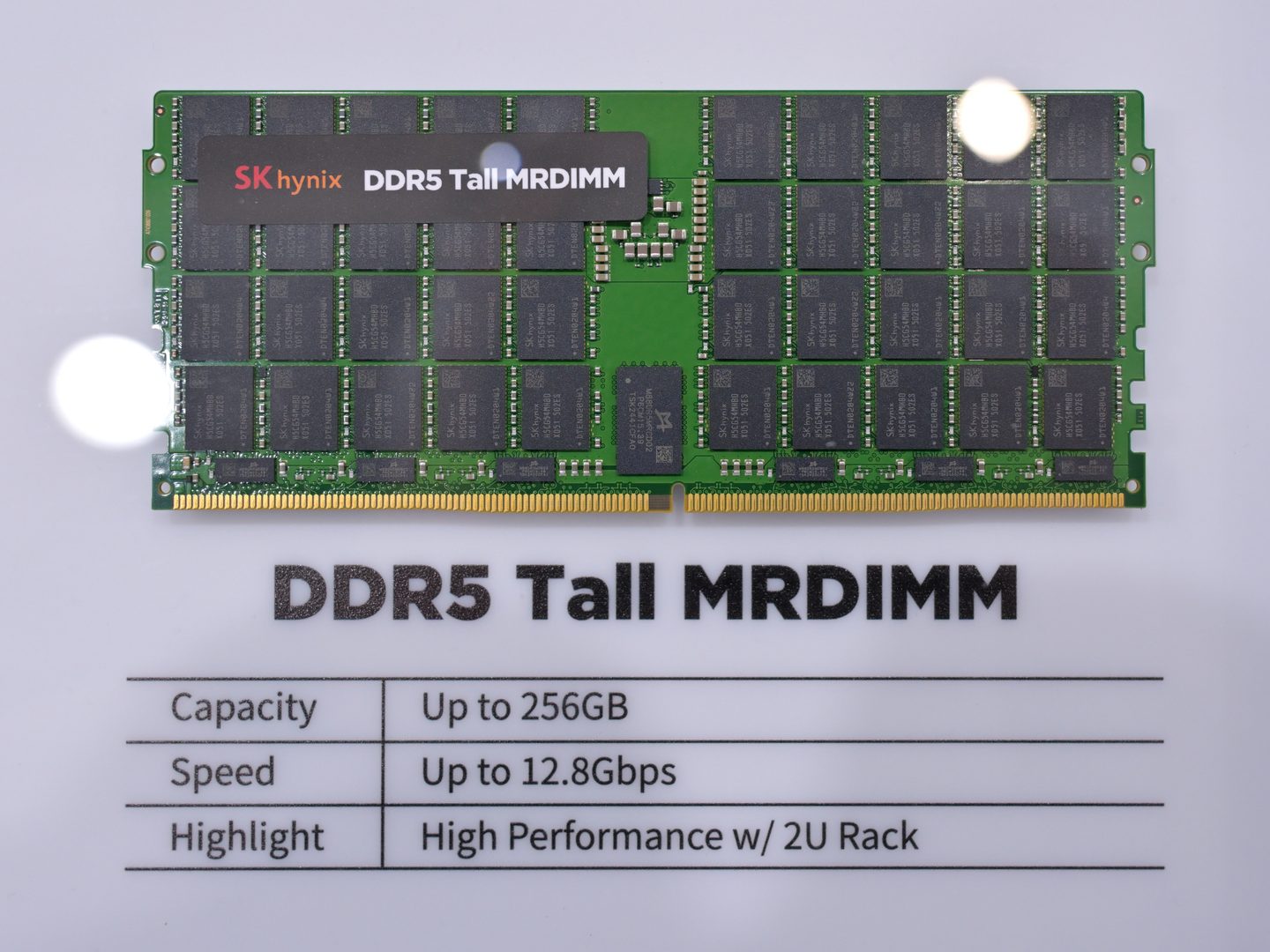
Sixty to ninety per cent. That, on AMD’s own telling, is how much of a large-memory server’s cost can sit in the memory alone — and it is the number that explains why the company spent money in June on a software startup instead of on more DIMMs.
AMD bought MEXT on 15 June 2026. On 11 November it explained what it intends to do with it, and the pitch is blunt: keep up to 99% of a full-DRAM machine’s performance while running as little as a quarter of the physical DIMMs.
The mechanism is a page file with a model attached. Cold memory pages get pushed out to NVMe flash; an AI engine watches the access pattern and tries to fly them back into DRAM before anything asks. To the operating system the missing memory still reads as installed. Gary Smerdon, who ran MEXT before the acquisition and is now a corporate vice president at AMD, puts the trade in three numbers: flash is about 50 times cheaper per bit than DRAM, about 30 times lower power per bit, and about 500 times slower.
That last figure is the entire product. Everything else is prediction quality.
The five-minute argument
Smerdon’s justification for why this works at all is a Meta research paper he cites, which found that between 50 and 80% of memory pages had gone untouched for five minutes, ten minutes, or longer. Even on a server reporting 95% memory utilisation, most of what is “in use” is not being used. “Five minutes to Epyc is an eternity,” he told The Register.
For a database holding a long tail of rarely-read rows, that is obviously true. Sit with it from an artist’s desk for a second, though, and five minutes stops meaning cold.
Five minutes is a coffee. It is the gap between a comp render finishing and you scrubbing back to frame one to check the roto. It is how long a Houdini sim cache sits idle before you drag the timeline and ask for ninety gigabytes of it at once, in order, immediately. The access pattern that makes MEXT look good is a large working set touched sparsely and predictably. The access pattern in a 3D pipeline is a large working set touched rarely and then all at once, which is the case a predictor cannot win — by the time it knows, you already needed everything.
What AMD actually measured
The headline figure comes from AMD’s own IT department running Synopsys PrimeTime at 95% of full-server performance on half the DRAM. PrimeTime is static timing analysis on chip designs. Huge dataset, overwhelmingly read-only, traversed in ways that repeat. If you were choosing a workload to flatter a page predictor you would choose something very like it.
It is a real measurement of a real tool AMD runs a lot of. It is also one workload, measured in-house, and nobody has yet published a MEXT result on something that thrashes.
The deployment is small and honest about being small: 145 internal servers today, a stated plan for 2,000 during 2027, and an HPE partnership to sell it to customers. Smerdon reckons those 145 machines have already avoided about $5 million in DRAM purchases. Phase one is 6th Gen EPYC “Venice” boxes carrying a MEXT Ready badge and a dedicated NVMe drive or bay for the offload. Phase two brings the licences and a monitoring app called RAM View. So this is a paid add-on to a server you buy, not a feature of a chip you own.
Nothing here is coming to your machine
There is no workstation story, and AMD does not claim one. This is EPYC, rack-mounted, wanting a spare NVMe bay, licensed per server.
Phoronix flagged the part that should bother anyone running a farm on Linux: there is a Linux driver, and it is not open-source. AMD has spent a decade making open drivers the thing it is good at. The exception they have chosen is the layer that sits underneath your memory map and decides what lives in RAM. If a render node starts stalling at 03:00, that is the one component you cannot read.
Which leaves the question of whether any of this helps the people who buy four sticks at a time. Indirectly, and slowly.
The reason a workstation DIMM costs what it does now is not that DIMMs got harder to make. It is that DRAM is running into atomic limits at the cell level, so supply cannot simply be scaled up to meet demand — and the demand is coming from data centres, which is the same squeeze that has left Sony unable to put a date on the PS6. Every RDIMM a hyperscaler does not buy is wafer capacity that can become something else. If MEXT does cut server DRAM demand by 20 to 75% across enough fleets, pressure comes off the fabs that make the modules in your tower.
Enough fleets is the load-bearing phrase. Two thousand servers in 2027, against global DRAM consumption, is a rounding error. The mechanism by which this reaches an artist is real and the timescale is years.
Worth watching anyway, for a reason that has nothing to do with price. If predictive paging to flash turns out to work on more than static timing analysis, somebody will eventually point it at a DCC application, and the first studio to run a 400GB scene on a 128GB box will find out quickly whether five minutes means cold.