
Paging memory out to disk is about as old as operating systems. Your desktop has been doing it the whole time, quietly and badly, and you only find out when something thrashes and the mouse turns to treacle.
A console has no such luxury. No swap file to fall back on, no spare bandwidth to be careless with, and a fixed frame budget that one bad page-in will blow straight through. So when The Coalition decided to use the Xbox Series S’s NVMe drive as a tier of memory for Gears of War: E-Day, they were taking on by hand what a kernel does by guesswork — and they had to be right every frame.
Tom’s Hardware went looking for the same system on PC this afternoon.
What is on the box
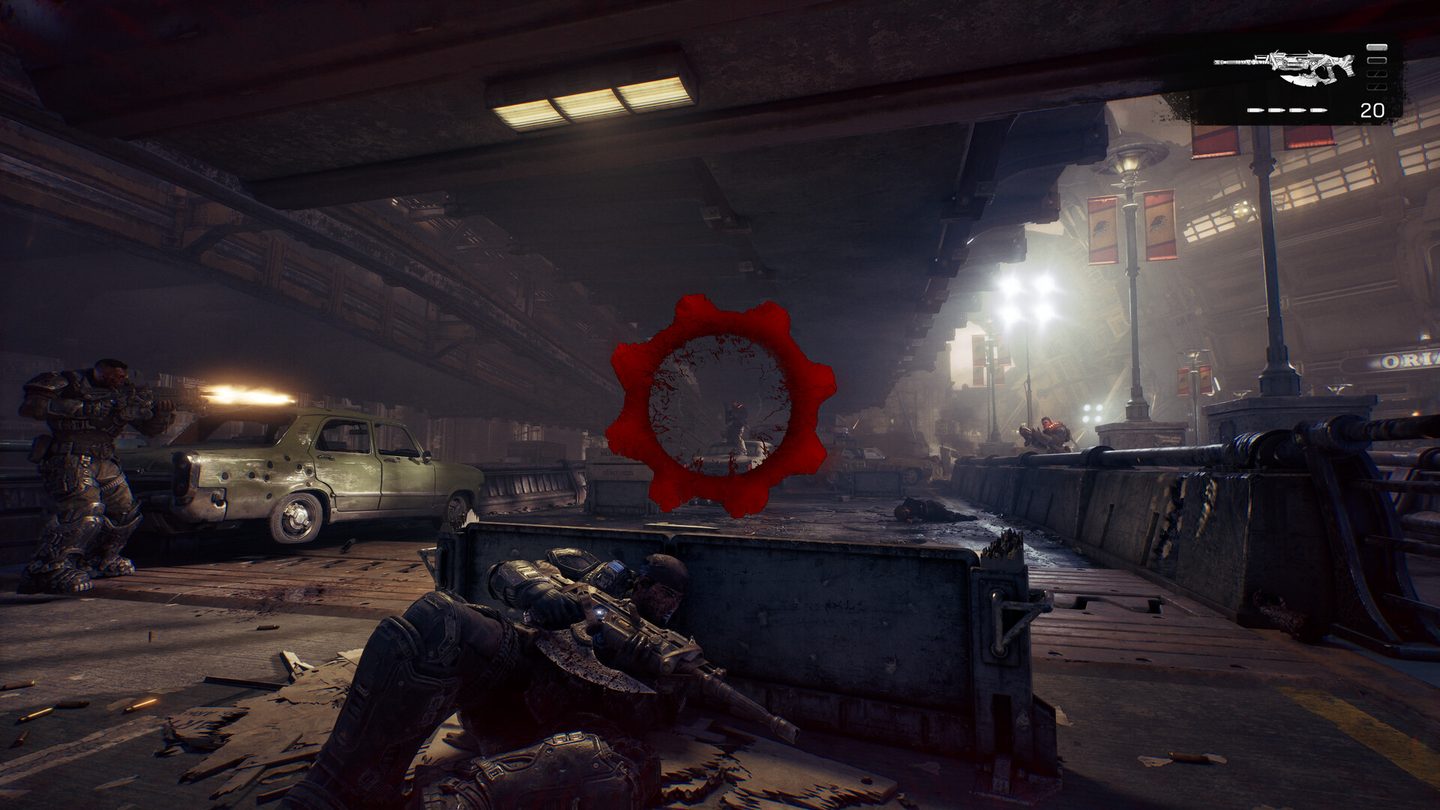
Series S ships with 10GB of GDDR6, of which games see roughly eight. Series X has 16. E-Day is a full Unreal Engine 5 title — Nanite, Lumen, MegaLights, and on PC RTX Mega Geometry driving ray-traced shadows and reflections — set in a dense city, and the Series S build keeps that city at its full size instead of shrinking it.
The Coalition explained how to Digital Foundry. They set aside a few gigabytes of the console’s SSD and treat it as a slower tier of memory, moving less-frequently-touched city data out to flash and pulling it back when the game needs it again, with access-pattern heuristics deciding what has gone cold. Write-ups of that interview put the net gain at roughly a gigabyte of effective extra RAM.
One gigabyte reads like a rounding error. Against an eight-gigabyte budget it is more than a tenth of everything you have, and on this class of machine a tenth is the difference between a district loading and a district getting cut.
Worth saying plainly: the Series S detail traces back to a single Digital Foundry interview, re-reported widely since. Neither Microsoft nor The Coalition has put the figure in their own words anywhere I can find, so treat the gigabyte as one outlet’s reporting of one conversation.
The PC numbers
Tom’s Hardware’s test went up today. Their headline figure is up to 3.7 GB/s of SSD streaming, which they say saves several gigabytes of system RAM, measured first on a high-end rig with resources to spare and then on a more modest configuration closer to what most people are running. I could not open the full test from where I am sitting, so I am working from the publication’s own summary rather than their charts. The shape of the result is the part that matters here, and the shape is that a trick built for the weakest console pays out on a mid-range PC.
Which is the sane way round, and rarer than it should be.
The bookkeeping is asset work
Digital Foundry’s reading was that the clever part sits in The Coalition’s data management rather than in the hardware. That is worth unpacking, because it is the bit that lands on the people making the content.
Eviction granularity is authored, not configured. If a building is one four-hundred-megabyte blob, you page four hundred megabytes or you page nothing. Split it along what is visible together and you page what the camera can see. Nobody writes that split in engine code. Somebody decides it while building the asset, usually without being told that is what they are deciding.
Locality on disk is the other half. Two things needed in the same frame want to sit next to each other in the package, or each one costs its own read. Chase that properly and you end up duplicating — the same prop across six districts, stored six times, so every district reads contiguously. It is one of the honest reasons modern installs are enormous, and where a 210GB install actually goes is mostly this plus audio.
Nanite has worked on the same principle since it shipped, streaming geometry clusters off disk as the camera asks for them. Extending that bet to the rest of the scene’s data is a logical next step rather than a leap.
Anyone who has cooked a build for a streaming engine has watched the package swell or the hitching appear because of how things were grouped, not because of how they were modelled. Nothing in that work shows up in a screenshot, which is why it tends to get discovered late.
Flash is not memory
Latency is the whole problem. A good NVMe drive answers in tens of microseconds. DRAM answers in tens of nanoseconds. Three orders of magnitude, and a frame sitting around waiting on a page-in is a frame you dropped. The Coalition said as much in that interview: move data too often and the gain goes back out as stutter.
The buffer buys nothing else, either. No GPU time, no CPU headroom. Series S still goes without Lumen reflections, and reviewers describe Series X dropping under 60 in crowded Horde scenes.
On PC an SSD is a hard requirement rather than a recommendation, which follows from all of the above. The install size I am less sure about — some outlets list 115GB and others 130GB, and I have not managed to reconcile them.
The same bet, in a server rack
AMD is running this play in the data centre, claiming 95% of server performance on half the DRAM by paging to flash, EPYC-only and closed-source. Different scale, identical reasoning, and the reasoning in both places is that DRAM has stopped getting cheaper and nobody expects it to start.
E-Day is the version of that idea you can buy. Series S is the machine that forced it, and the discipline it bought shows up on hardware nobody was worried about. That is usually how a weak target earns its keep, and it is a decent argument against dropping one.