The original Xbox turned 25 today. It went on sale in North America on 15 November 2001, and Europe had to wait until March 2002, which is why a lot of us met it secondhand and late.
Microsoft marked the anniversary three days early. On 12 November it added 21 original Xbox games to backward compatibility on PC, taking that library from four titles to 25 — twenty-five games for twenty-five years, which is the sort of symmetry a marketing calendar produces and I am not going to pretend it isn’t satisfying.
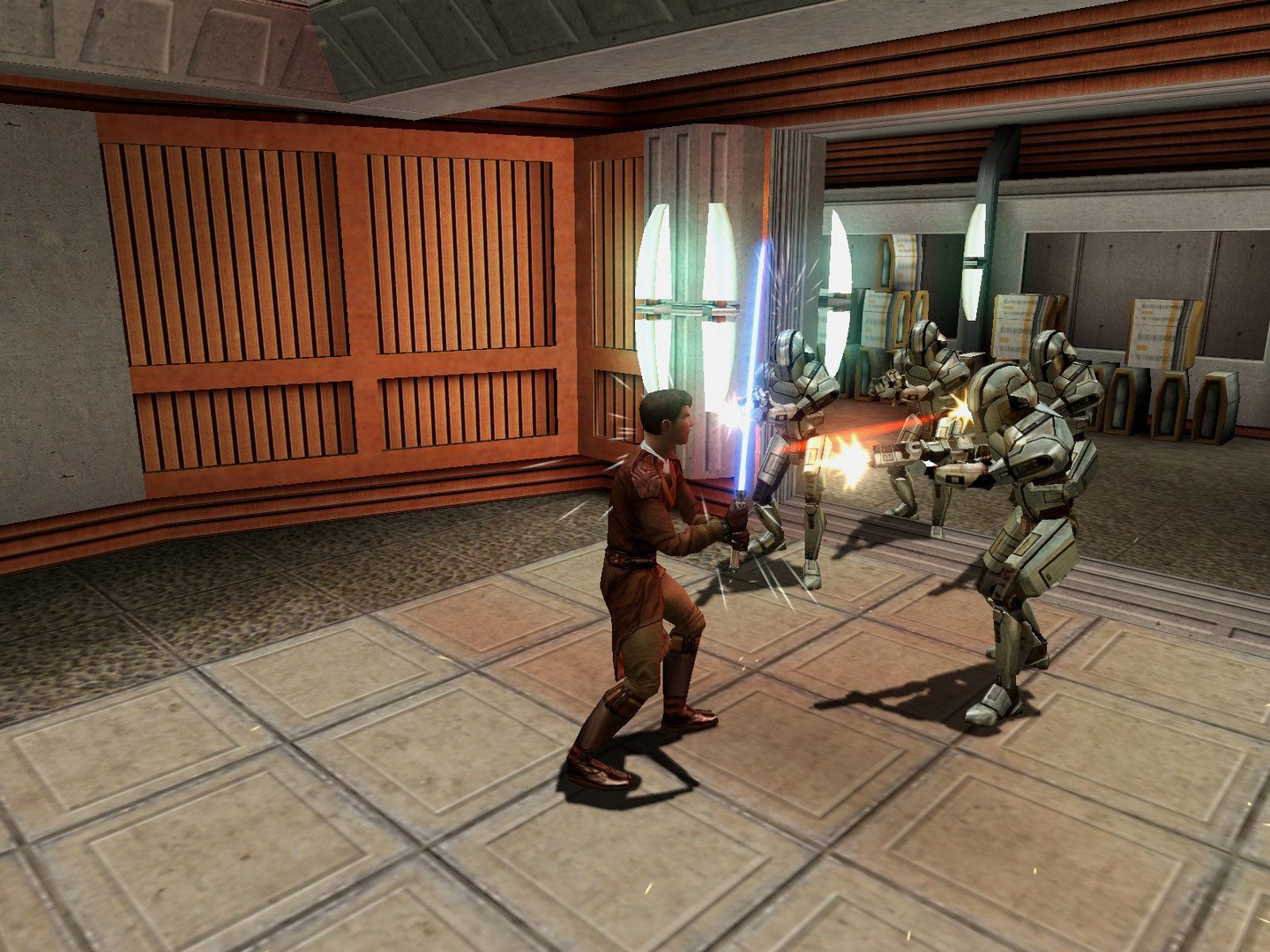
Eleven of the 21 are Star Wars games. Both Knights of the Old Republic games, both original Battlefront games, Republic Commando, Jedi Outcast, Jedi Academy, Jedi Starfighter, Revenge of the Sith. Outlets do not agree on the count — most say eleven, at least one says thirteen, and nobody has published the full list of 21 in a form I could check line by line. Call it somewhere between half and two thirds of the batch coming from a single licensor.
The list is a rights list
That Star Wars number is the most informative thing in the announcement.
Twenty-five games in four months, from a library of roughly a thousand, is a story about who holds what. One deal with one licensor delivered eleven titles in a single afternoon. The other ten came from everywhere else.
You can read the same shape in the achievements. Four of the 25 now have them: both Knights of the Old Republic games, plus BLiNX: The Time Sweeper and Conker: Live and Reloaded — two Microsoft-owned titles that were already in the programme’s launch batch in July, alongside Crimson Skies: High Road to Revenge and Fuzion Frenzy. Achievements did not exist until the 360, so there is no hook in a 2002 binary to hang them on. Somebody has to go find the state changes that mean “you finished the level” inside compiled code they did not write. That is per-title engineering, and it got spent on titles Microsoft owns outright or has a clean licence to.
So the bottleneck on backward compatibility is paperwork and headcount, which is the least interesting answer available and almost always the correct one.
The Xbox is the easy console to do this with
If you are going to run twenty-five-year-old console games on a Windows PC, the original Xbox is the one you want.
It was a PC wearing a green case. A 733MHz Intel CPU derived from the Pentium III, an NVIDIA GPU — the NV2A — sitting somewhere between a GeForce3 and a GeForce4, and a graphics API that was a modified Direct3D 8. x86 instructions in, D3D calls out. Nothing about that is alien to the machine you are reading this on.
Compare it to the PS3. The Cell processor’s SPEs were a genuinely unfamiliar architecture, and the games that got the most out of it were written hard against its specific shape — Metal Gear Solid 4 was designed around the limits of the PS3’s disc drive rather than despite them. A game fitted that tightly to one machine does not lift off it cleanly. The Xbox has no equivalent problem. Its hard parts are narrower: the NV2A’s register combiners, which did pixel work through a fixed-stage setup rather than the programmable shaders we think in now, and a unified memory model where the CPU and GPU shared one 64MB pool. Get the combiners wrong and water, glass and shadows come out subtly off — which is where accuracy work in original Xbox emulation has always concentrated.
And none of it needs source code. Backward compatibility runs the retail binary. That is a real advantage over the restoration route, where SNEG had to reverse-engineer a 2001 D&D game off its own retail discs before it would boot on a modern OS. Microsoft does not have to understand the game. It has to understand the hardware the game expects.
Sixty-four megabytes, and a television
Here is the part that matters if you make environments for a living.
Sixty-four megabytes was the budget for everything. Framebuffer, textures, geometry, audio, game code, all of it, in one pool. Artists working on these titles were not choosing between a 2K and a 4K texture; they were deciding whether a wall got a 256-pixel diffuse map at all, or whether it could be lit into its vertices and left flat. Lightmaps were baked and packed hard. Normal maps existed on the platform — Halo 2 used them — but sparingly, on hero surfaces.
And the target display was a 480-line television, usually interlaced, usually over composite. That signal was a free blur filter sitting between the art and the viewer. It smeared DXT1 compression blocks in sky gradients. It hid the seam where one lightmap chart met the next. It softened the LOD pop at twelve metres into something you felt rather than saw.
Put that same binary on a 1440p IPS panel and the filter is gone. The art is precisely what it always was; you are seeing it without the thing it was tuned against. I find this genuinely useful. A remaster repaints the evidence; backward compatibility leaves the fingerprints on it, and you can go and read how somebody solved a corridor in 2002 with four textures and no shadows.
The Morrowind joke
The Elder Scrolls III: Morrowind is in the 21.
Which means the version of Morrowind Microsoft is now shipping on PC is the Xbox port — a console build cut to fit that 64MB pool, with no mod support, of a game that came out on PC in 2002 and has had a modding community larger than most studios ever since. The uncompromised version has been one click away for twenty-four years.
That is what happens when the unit of preservation is the shipped console binary rather than the game. TimeSplitters 2 is in the list too, and for Free Radical’s shooter this is the closest thing to a proper PC release it has ever had, so the same rule cuts both ways on the same day.
The requirements, for anyone counting: Windows 11, supported markets only, and a digital licence or an eligible Game Pass subscription. You cannot put a disc in a PC. Microsoft says more titles and more achievement lists are coming.