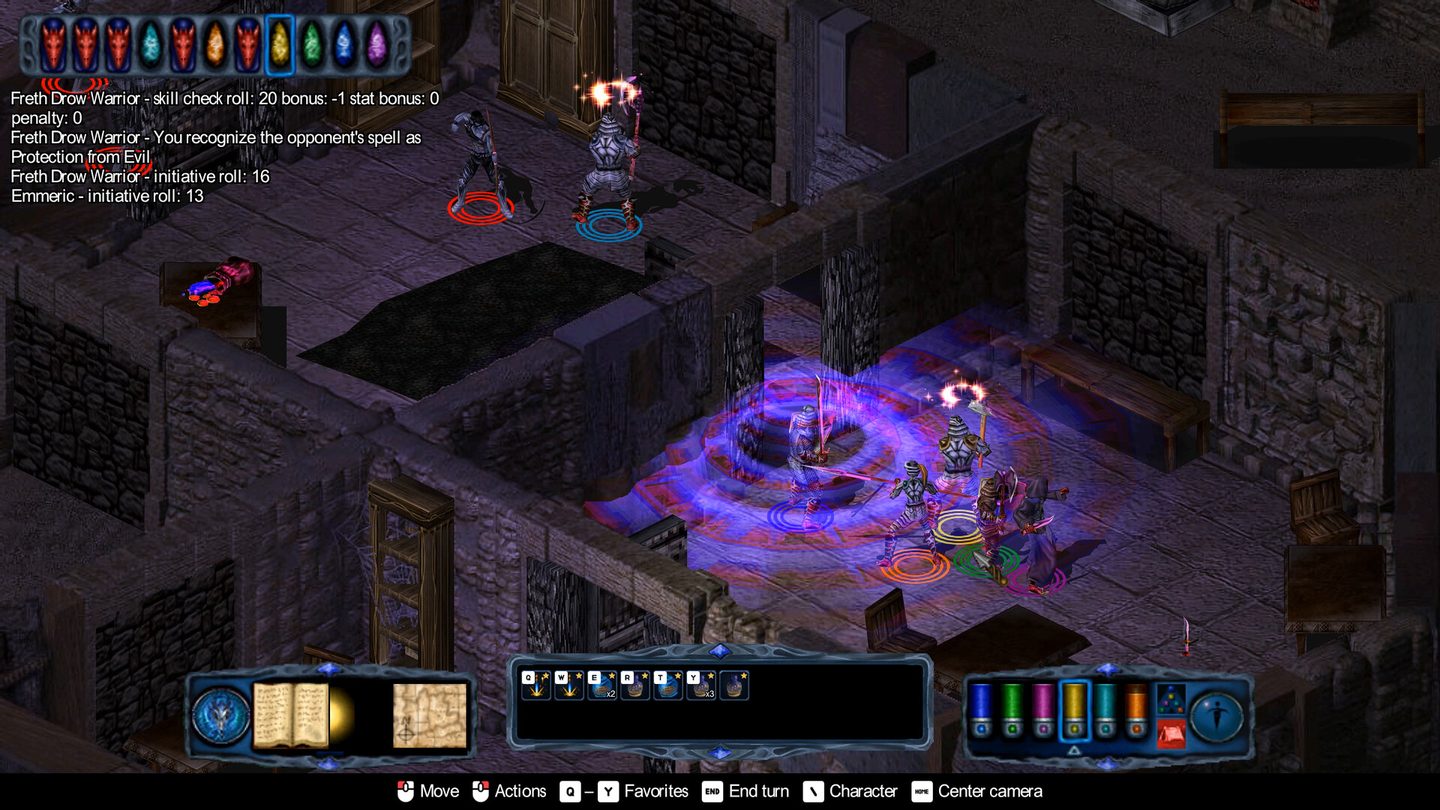
A 2001 Dungeons & Dragons RPG went up on Steam and GOG on 6 November, priced at 19.99 dollars. That part is ordinary. The way it got there is not: SNEG, which holds the rights to a long shelf of lapsed PC catalogue, had no source code for it. No build tools. No documentation. What it had was the retail discs.
The game is Pool of Radiance: Ruins of Myth Drannor, built by Stormfront Studios and published by Ubi Soft in 2001 — the first D&D game written to 3rd Edition rules, and a famously rough one. It has never been sold digitally before. Not on Steam, not on GOG, not anywhere.
Starting from the shipped product
Co-founder Artem Shchuiko has described SNEG’s working position before, and it is the position most of this catalogue is in: in the majority of cases the original source is simply gone, so parts of the game have to be reverse-engineered before it will run on a current operating system at all.
For Myth Drannor the team began with the international retail editions and whatever survived on those discs, and worked back from the binary until it knew enough to change the original engine from the inside.
Then came the decision that shapes everything you see in the trailer. Having done the reverse-engineering, they stayed on the 2001 engine — made the changes inside the legacy build instead of porting the game onto something modern. Shchuiko gives two reasons: speed, and keeping the look and feel of the thing intact.
Anyone who has inherited an undocumented asset pipeline will recognise the calculation. Porting means re-authoring every format you do not understand. The legacy build already understands all of them.
The hard part was getting at the data
Per 80.lv’s write-up, the single worst problem was not rendering or resolution. It was building an internal API to expose data buried deep in the original code.
That is worth sitting with, because it is the same wall you hit on any old project where the tools are missing. The data is all there — stats, inventory, party state, map information — but it is reachable only by the code that was compiled to reach it. Every structure is at an offset somebody chose in 1999 and wrote down nowhere. Before you can draw a new inventory panel you have to establish, by inspection, where an inventory lives in memory and what shape it is in, then wrap that in something stable enough that the rest of your work can depend on it.
Get that layer right and the modern features become tractable. Get it wrong and every new panel is a separate archaeology project.
On top of that API they put a new interface built with Dear ImGui — the immediate-mode library that gamedev uses for tool UI precisely because it draws whatever state you hand it, frame by frame, with no retained widget tree to synchronise against the game. For a team of roughly two people working inside someone else’s executable, that property is the whole appeal.
4K without repainting anything
The visual side is where the restraint shows. Widescreen resolutions up to 4K, a reworked camera, controller support, a faster interface, a long list of bug fixes, and an optional Legacy mode for people who want the 2001 behaviour. For sharpening, AMD FSR 1.0 applied over the output — and, deliberately, no changes to the original artwork.
FSR 1.0 is the spatial one. No motion vectors, no temporal accumulation, no machine learning: it takes a single rendered frame and reconstructs edges from it. By 2026 standards that is the oldest tool in the box, and it is also the only one of them that can be dropped into a renderer you did not write and do not fully understand. The modern upscalers need per-frame data from inside the engine — depth, velocity, jitter — which is exactly the kind of thing you cannot get out of a binary without the source.
So the choice follows from the constraint. And the result is more honest than a texture pass would have been. A 2001 D&D game authored for a 1024x768 monitor has a specific density of detail in it; upscale the frame and you get the original intent, larger. Repaint the assets and you get somebody in 2026 guessing what a Stormfront artist meant.
The team also set itself a rule: no changes to core game systems unless they were fixing a clear bug. Myth Drannor’s systems are the reason the game reviewed badly in 2001 — bugs, pacing, an interface that fought you. Leaving them standing is a defensible call for a restoration, and it does mean the thing on Steam this week is the 2001 game with its edges filed down, not a rescued classic.
Why this keeps happening
The missing source is not an accident of one studio. It is what the industry’s first three decades of asset management look like from here. When EA rebuilt Command & Conquer’s live-action cutscenes in 2020 it could not find the masters and worked from compressed archival copies; Wing Commander III was luckier, and its source tapes surfaced in EA’s own video archive years later. The GoldenEye 007 project reconstructed an N64 game out of its own binary because that binary was the only copy of the logic left. Shipped builds survive. The projects that made them do not, because nothing in a 1999 studio’s workflow treated a project directory as something to keep.
There is a rights layer under all of this too, and it is the part that stops most of these games coming back. SNEG has said it needed clearance from Wizards of the Coast for the licence, from Stormfront as the original developer, and from Ubisoft as the original publisher — three parties, for a game that sold badly 25 years ago. The engineering problem is solvable by two people with a debugger. The other one is not.