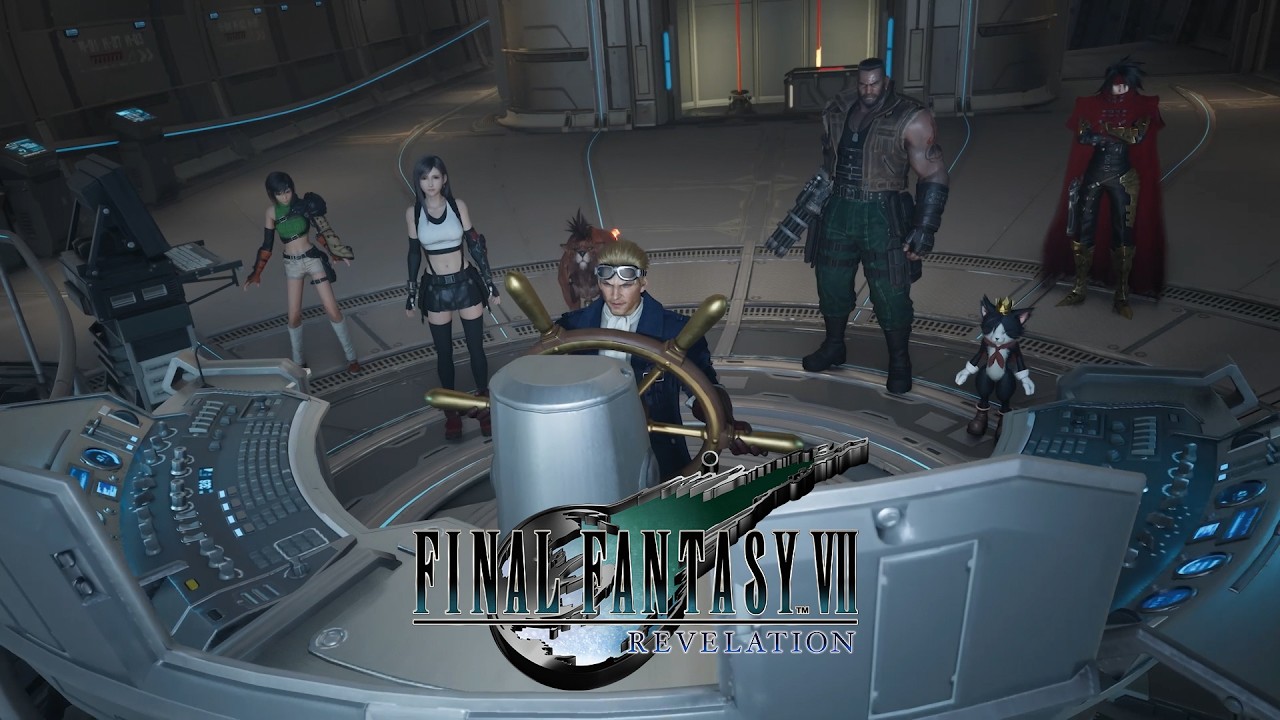
Square Enix brought the third and final part of the Final Fantasy VII remake trilogy to Opening Night Live last night, with director Naoki Hamaguchi presenting. Spring 2027, on PS5, Xbox Series X, Switch 2 and PC.
The trailer is called The Planet’s Crisis and it is doing a lot of work in three and a half minutes: the Weapons awake, Typhon as a new summon, Vincent Valentine and Cid Highwind finally playable, a costume system called FITS that hands characters abilities borrowed from the old job classes — Cloud as a Warrior, Tifa as a Black Mage.
Everyone is going to write about the Weapons. I want to talk about the parachute.
Three new verbs
Buried in the same trailer, next to the enormous monsters, are three additions to how you get around: a parachute, a grappling hook, and Chocobo mounts across open terrain.
Rebirth already had Chocobos, so that one is an extension. The other two are new, and they change the shape of the world in a way that lands almost entirely on the environment team.
A parachute puts the player above the level. Not on a flight path with the camera aimed where you want it — drifting, looking down and sideways at their own pace.
What players see from up there
An open world built for a person on the ground is, structurally, a set. Budget goes where eyes go, and eyes go forward and slightly down.
So rooftops get simplified, because you’re never on one. The far side of a ridge carries lower-resolution terrain. Buildings that are only ever seen from the street get their backs turned into flat planes. Vegetation is placed to read from eye level, which means the cards that make up a tree canopy are angled for someone underneath them.
Give that world a parachute and every one of those decisions is now on screen. The rooftops need to exist. The tree canopies need to work from above, where those angled cards go paper-thin. LOD transitions that were tuned for a horse now happen while the player is descending toward them, which is the worst possible case — you’re closing distance fast, in a straight line, with nothing else to look at.
A grappling hook does the same thing at a smaller scale and higher frequency. It puts players on ledges, on walls, on the tops of things, in places a designer did not choose for them.
It is the cost of the feature, and Square Enix has clearly decided to pay it. Which is the interesting signal: you don’t add aerial traversal late. That decision was made early enough for the world to be built around it.
The Weapons are an easier problem than they look
Everyone reads a colossal monster as a technical showpiece. Sometimes it is. But scale in a game world is mostly a compositional trick, not a rendering one.
You sell size by denying the player a clean look. You frame the thing against something whose size they already know, you keep the camera low, you let it break the horizon line, you never show it fully in one shot. Shadow does more work than polygon count — a shape that blocks the sky reads as vast whether it has ten million triangles or one.
The genuinely hard version of that problem is when the enormous thing has to share screen space with a world the player can walk through, at a distance where both need to be correct at once. Judging from the trailer, that’s what the Weapons are for. We’ll see how much of the encounter is arena and how much is the actual open world.
FITS, and the cost of outfits
The costume system is the sleeper item on the list.
An outfit that grants abilities is a design feature. An outfit is also, in production terms, a full character variant: its own mesh, its own materials, its own cloth simulation setup, its own weight painting, and its own set of interactions with every animation the character already has. Multiply by the party. Multiply again by however many FITS exist.
That is a real line in a budget, and studios do not spend it for a cosmetic. Which suggests FITS is closer to the centre of the combat system than a costume menu implies.
Trailer details from the Opening Night Live broadcast of 25 August 2026 and Square Enix’s own upload. Spring 2027 was reiterated as the window; no date was given.