
befores & afters flagged DNEG’s breakdown reel for For All Mankind season 5 this week, and it’s worth sitting with for longer than the runtime suggests. The season wrapped its run on Apple TV+ in May, VFX supervisor Mo Sobhy led the studio’s work, and the topline number is 338 shots across an expanded Happy Valley colony and the Kuznetsov Station explosion that gives the season its big mid-run gut-punch. The explosion is the shot that trends. The environment work underneath it is the one I’d put in front of a junior environment artist.
Season 5 doesn’t get to start from a blank Mars
Every season of this show adds years to its own timeline, and by season 5 Happy Valley is a colony of thousands rather than an outpost. That’s a writing convenience and an environment team’s headache in roughly equal measure, because the studio doesn’t get to redesign the base from scratch — it has to age the one it already built.
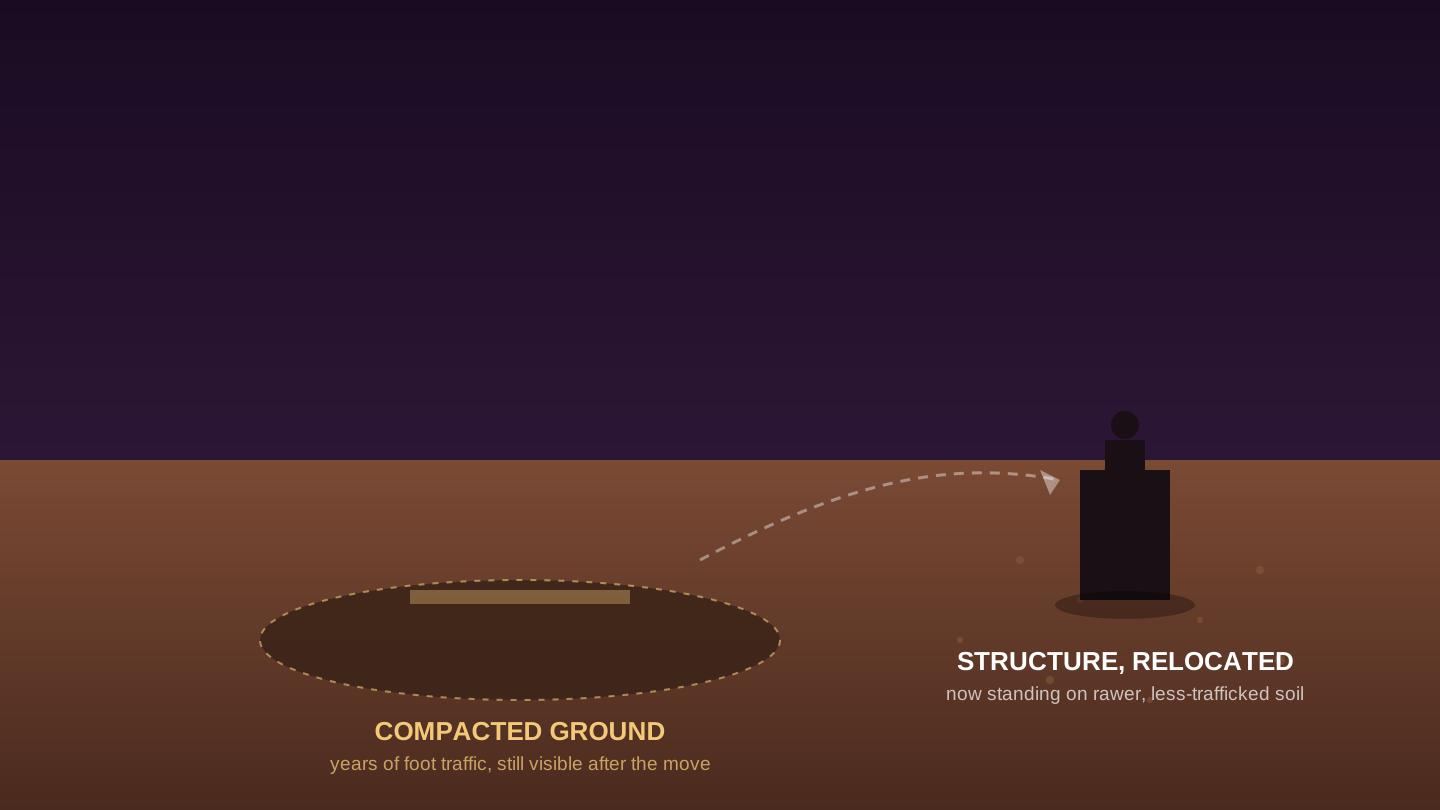
DNEG’s own account of the process is refreshingly boring in the way good pipeline work usually is: their starting point and main reference for the built Happy Valley environment was always their season 4 CG build, not a fresh concept pass. Everything season 5 adds gets reasoned outward from what already existed. If a building had stood somewhere in an earlier season and has since been relocated, the ground underneath it now reads as less raw than the soil around it — because in the story, and now in the asset, that patch of Mars was compacted and walked flat for years before anyone moved the structure off it. No audience consciously registers that. It is the kind of thing that makes a place feel inhabited rather than art-directed, and it only works because someone kept a continuity record precise enough to know which ground has history and which doesn’t.
Procedural first, painting last
The workflow DNEG has described keeps that continuity enforceable rather than hand-tuned per shot: Houdini carries as much of the process as possible procedurally, with resculpting or digital matte painting brought in only afterward, as a finishing pass rather than the primary tool. Most of what’s on screen is full CG geometry; DMP touches up specific elements rather than standing in for the environment wholesale. That ordering matters for exactly the reason the ground-wear detail matters — a procedural rule (“ground compacts under a structure, stays raw where nothing’s stood”) can be applied consistently across a colony of thousands of buildings and however many more seasons the show has left. A one-off painted fix can’t scale past the shot it was painted for.
Lighting got the same discipline. Reporting on the breakdown describes individual assets carrying their own light controllers, switched on per shot rather than lit generically, with the whole environment graded toward consistent, physically plausible sun behavior — and FX dust layered into exterior night shots specifically to sell scale, since a horizon with nothing moving through the air in front of it reads as a matte painting no matter how much geometry is behind it.
The explosion is the trailer. The base is the show.
The Kuznetsov Station sequence is excellent — a station breaking apart with characters still reacting to it is a harder shot to land than most environment work, and it’s clearly the reel’s centerpiece for a reason. But a hero explosion gets built once, for one episode, by a crew that can throw everything at it for a few weeks. An environment that has to represent a lived-in, aging colony has to survive being looked at from a hundred different angles across an entire season, and then get handed back to the same or a different vendor next year and still make sense. Apple has already confirmed For All Mankind for a sixth and final season in 2027, which means whatever ground-truth rules DNEG is keeping for Happy Valley now are the rules the next crew inherits too. The explosion is the shot people share. The continuity record is the thing that actually has to work.
Sources: befores & afters’ report on DNEG’s breakdown reel, Digital Media World’s writeup of DNEG’s Happy Valley process, and DNEG’s own project page. Quotes on procedural workflow and ground continuity are as reported by those outlets. The diagram on this page is an original sketch made for this article, not a production still.