Written on the afternoon of 25 August, before the show. Opening Night Live has since aired and Gamescom itself runs through 28 August. I have left the piece as it was published rather than quietly rewriting it after the fact — the things it says to watch for are the same things whether you are watching live or catching up on the trailers today.
There is a particular twenty minutes before a show like this where the chat fills up with people posting their predictions, and every year somebody is convinced Half-Life 3 is on the slate. It never is. The show starts, Geoff Keighley walks out, and the first trailer plays.
I watch these for a different reason than most people in that chat, and it took me an embarrassingly long time to admit it: I am not really there for the announcements. I am there to look at how the footage was made.
Where and when
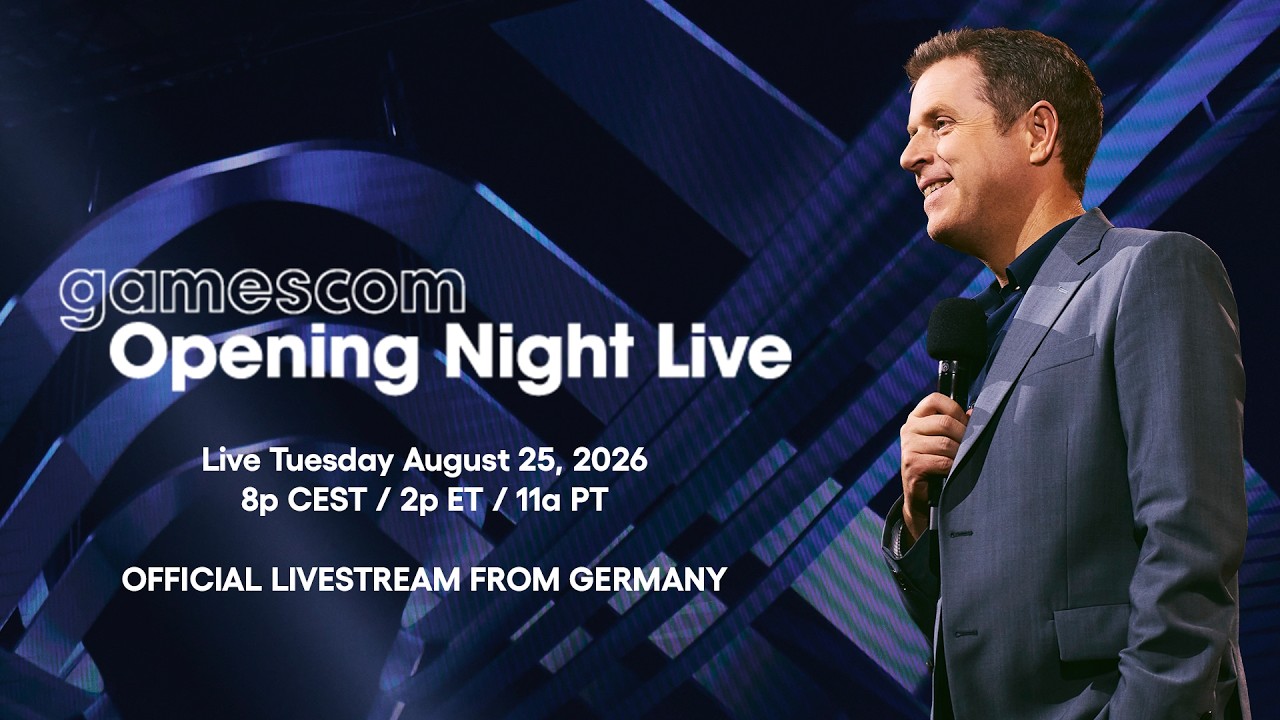
Opening Night Live runs tonight, Tuesday 25 August, at 20:00 CEST — 19:00 BST, 14:00 ET, 11:00 PT. There is a pre-show half an hour before, at 19:30 CEST, which historically carries one or two reveals that would have been perfectly at home in the main broadcast.
It streams on the gamescom and The Game Awards channels simultaneously. Here is the official one:
Confirmed for tonight: Final Fantasy 7 Revelation, Gears of War: E-Day, and a Witcher 3 expansion called Songs of the Past. Keighley has been trailing surprises, which is what he does every year, and roughly half the time there is one.
The fine print does most of the talking
Every trailer at a show like this carries a legal caption, usually bottom-left, usually on screen for about four seconds, usually in a typeface chosen to be technically present rather than readable. That caption is the most honest part of the whole segment.
“In-engine” means the renderer that ships the game produced these pixels. It does not mean a player could produce them — an in-engine cinematic can run at four seconds per frame on a workstation with nothing else in memory, and still be truthfully labelled in-engine.
“Captured on PlayStation 5” or “captured on PC” is a much stronger claim, because now there is hardware named. Watch for what comes after it. “Captured on PC” with no specification is doing a lot of work in the dark.
“Does not represent final gameplay” is the one to take seriously. It usually means the vertical slice you are watching was built by a strike team to be looked at, not played, and the thing that ships will be assembled differently.
Tells that are harder to fake than a caption
Captions can be honest and still leave you with the wrong impression, so I tend to watch the image itself.
Camera movement is the first thing. Real-time capture has a human on a controller or a camera rig with some imperfection in it — a slight overshoot when a pan stops, a correction. Offline renders move on splines. They are too smooth, and once you notice it you cannot stop noticing it.
Then lighting. A scene with no light leaks anywhere, perfect contact shadows in every crevice, and bounce light that reads correctly off every surface is usually not running in sixteen milliseconds. Real-time global illumination has gotten extraordinary, and it still has a look: slight temporal lag when a light moves fast, a softness in indirect shadow that offline rendering does not need.
Motion blur is a giveaway in the other direction. Per-object motion blur that holds up under a fast pan is expensive, and a lot of real-time footage either skips it or does a cheaper screen-space version that smears in a recognisable way at silhouette edges.
The last one is the least technical and the most reliable: what is the camera avoiding? If it never looks at the ground, never turns to face where the character came from, and cuts every two seconds, somebody is protecting something. Trailers get edited to hide pop-in the same way a property listing gets photographed to hide the neighbours.
None of this means a game is lying to you. Everyone builds vertical slices, including studios that go on to ship exactly what they showed. It means the footage is an argument, and arguments have authors.
Why I care, specifically
The gap between the trailer and the shipped game is not usually marketing dishonesty. It is production reality, and it lands on the environment team.
Somebody built that scene knowing it had to survive a camera move rather than a player, with a light rig placed for that one angle and a memory budget nobody was checking. Six months later the same scene has to open on a mid-range GPU with the player facing a direction the layout never anticipated. That is when the fog gets thicker, the draw distance comes in, the hero asset loses a texture set, and the internet decides the game was downgraded.
Some of it is. A lot of it is a scene meeting the constraints it always had.
So when I watch tonight, I am half looking at the reveals like everyone else, and half doing the thing I cannot switch off — counting light sources, watching where the camera refuses to go, and trying to guess what somebody had to cut to make that shot hold together for eleven seconds.
The show is at 20:00. I will probably be wrong about at least one of them.
Times confirmed against the official stream listing on 25 August 2026. The running order beyond the three announced titles is not public, because that is the entire business model of a Geoff Keighley show.