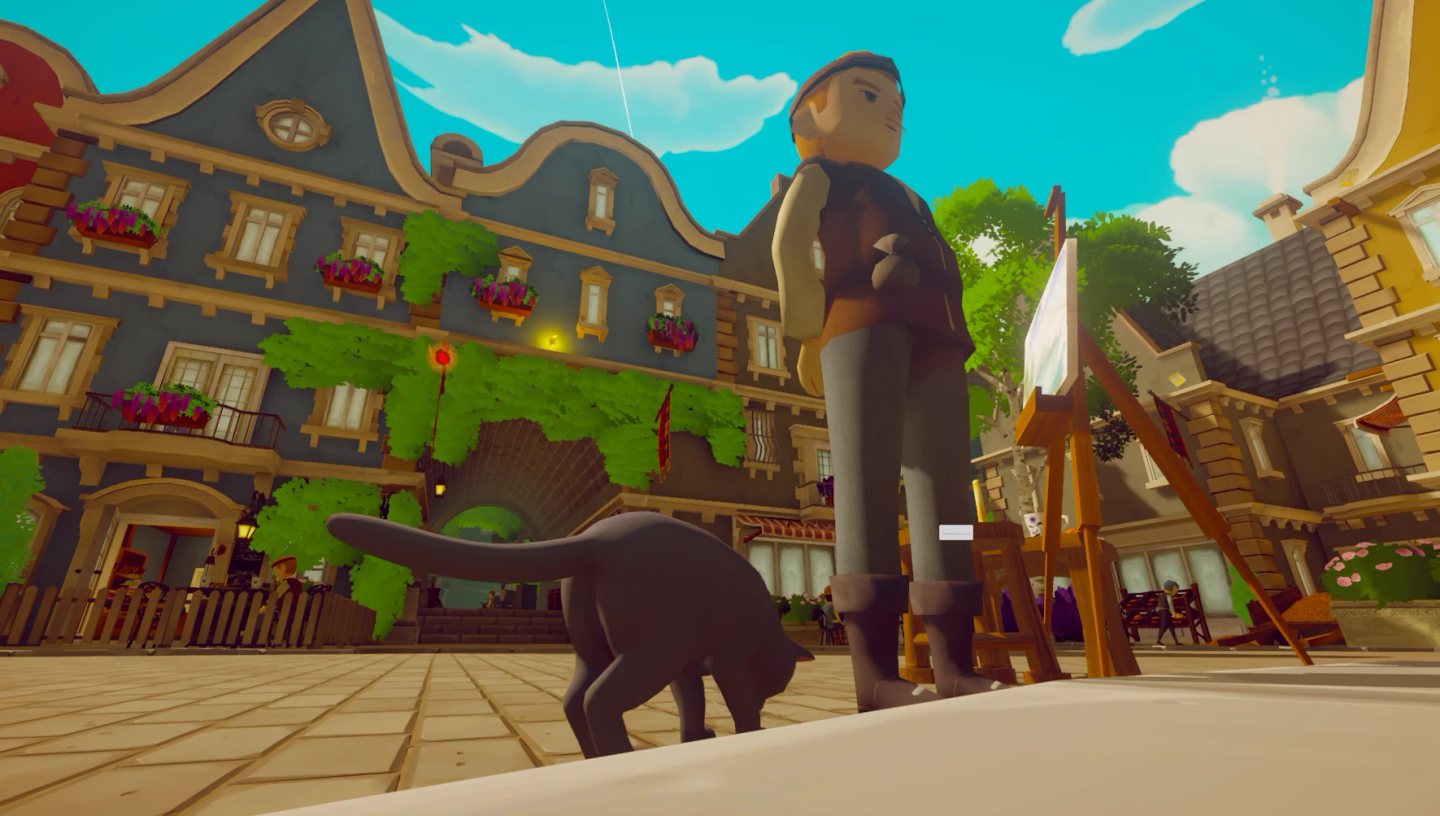
I’d hang Pawbay’s colour palette on my wall and send most of its population back to the modeller, and after my time in its town on PC I still can’t decide which of those two feelings should win the review.
Pawbay comes from Commando Panda, a small Polish studio that developed and published it. It launched on 15 May on PlayStation, Xbox, Switch and PC, and reached Steam as Pawbay: Cat Chaos on 21 August. I played the Steam version, from a code Commando Panda sent me. You’re a cat, the town is yours to wreck, and there’s local split-screen for two, which I didn’t try.
I ended up on a 6, and only just.
A room and a window
There is barely a story, and the game knows it. A kitten wakes up in a quiet room, a short tutorial teaches you to move, and you leave through the window. After that nobody asks anything of you. The story is a frame that holds the town together, and it never tries to push you through it.
For a cat, I think that’s the right amount. A cat has no motivation worth a cutscene, and every scripted scene a team this size writes is a week not spent on the town. What the thin frame can’t do is give the mischief a shape, so nothing builds and nothing pays off. You knock things over until you’ve knocked over most things.
Spacebar cat
The moments that work are the ones you’d hope for. Walking into someone’s lunch and ruining it. Nudging whatever sits on a ledge until it goes over. That’s the whole fantasy, and Pawbay delivers it with a straight face.
Getting there is harder than it should be. The controls aren’t as responsive as I’d hoped, and a cat game lives or dies on how the body answers your thumbs. Worse, jumps aren’t yours to make. You press the spacebar at points the game has already chosen, a small marker tells you where they are, and anywhere else the cat simply stays on the ground. I kept wanting to judge a gap by eye and commit, the way you’d expect an animal built for exactly that to move, and the game kept answering with a fixed route.
A cat is the most unconstrained animal you could put in a game, and this one keeps being told where it may go. Add a few tight corners where my cat simply got stuck, and the town I was supposed to own started to feel like a set of rails with fur on them.
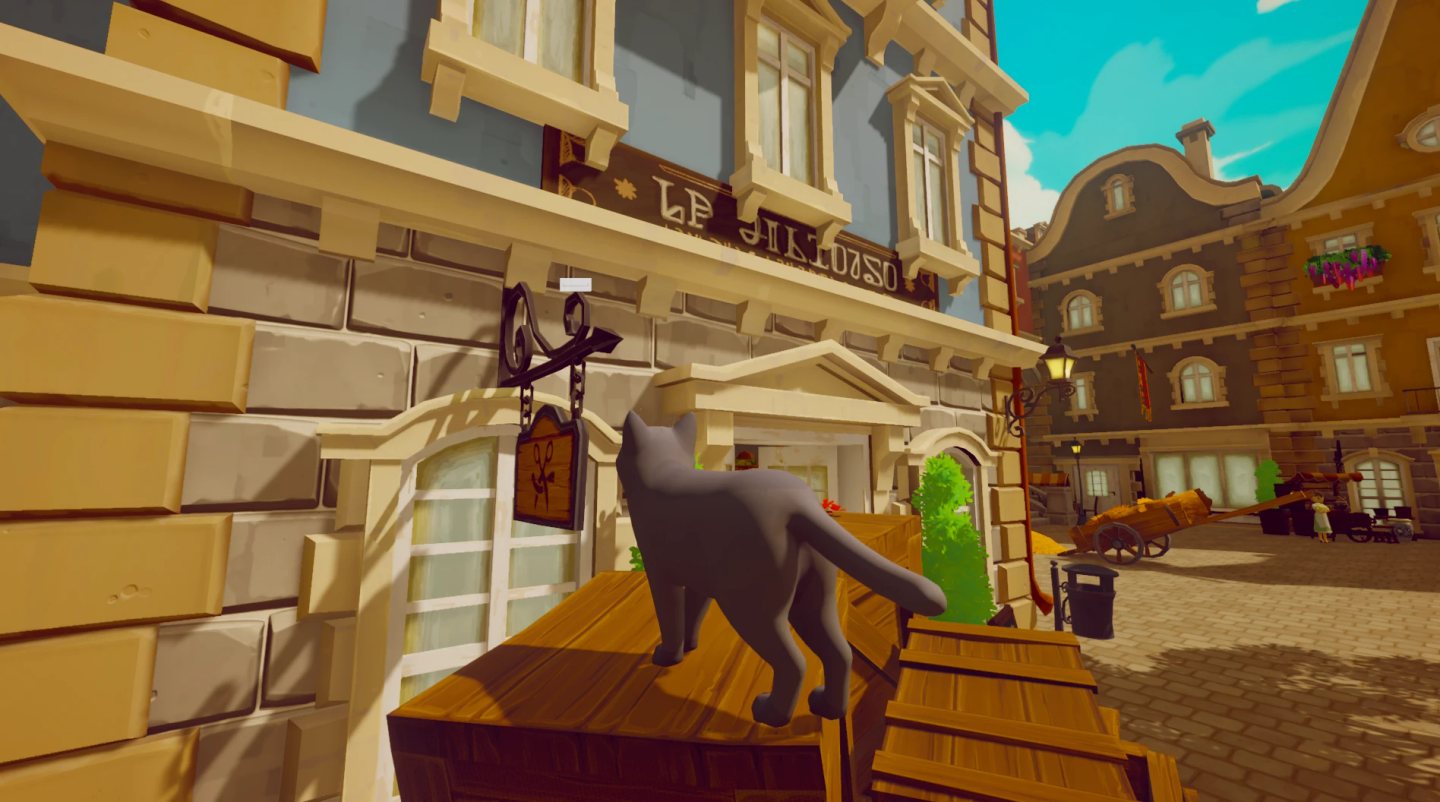
It’s also small. The city feels tiny once you’ve crossed it a couple of times, and a town you know by heart is a town with nothing left to knock over.
Colour does the work
This is the part Commando Panda got right, and it’s the part I’d study.
The palette is exactly where it should be. Blue-grey plaster, sandstone trim and purple flower boxes sit under a turquoise sky with clouds that look brushed on. It’s warm without getting sugary, and the mood holds everywhere I went. That consistency is harder than it looks. One careless material, one texture pulled from a different asset pack with a different idea of what green is, and a stylised town stops looking like one place.
The camera helps. At cat height, thirty centimetres off the cobbles, the bottom metre of every building is the foreground, so doorsteps, crates and stall awnings are what you spend the game looking at. The kit is simple, clearly modular, low in polygons, and it’s been built with that height in mind. Low poly is a direction here, and nothing about the architecture looks accidental.
People made of boxes
Then somebody walks into frame.
The townspeople look like automatons, parked on their spots only to trigger an event when you arrive. When the event comes, they barely move. Next to the care in the buildings behind them, they look like they belong to another game.
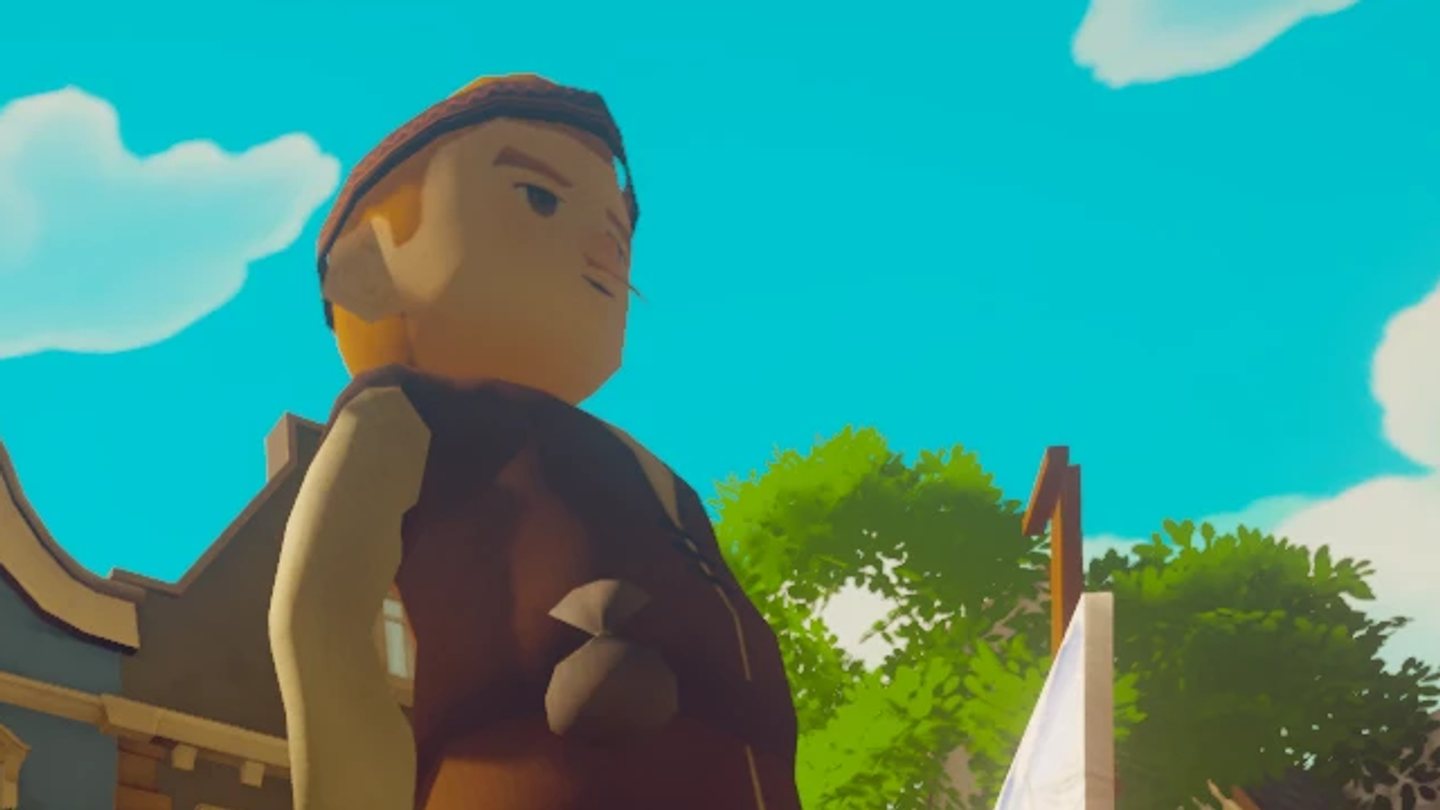
I understand how it happens. A crowd that reacts is animation work, state by state, and each state is a clip somebody has to key and blend into the next. A small team funds the hero first, and the hero here is the cat. But the entire game is about bothering these people, so they’re the one thing you watch closely every time something funny happens. When they don’t react, the joke lands on nobody.
Pop-in and silence
For something this low in polygons, I didn’t expect objects to pop in. They do, often enough to notice. My guess is that draw distances were tuned once for the weakest console it ships on and never loosened elsewhere. I can’t confirm that from outside.
The music is lovely and clearly written with care. Then a track ends and you get two or three minutes of nothing before the next one, which in a town this lively feels like the power has gone out.
A thin six
When a lunch goes flying across a square that looks this good, Pawbay is exactly the sweet little cat sandbox it wants to be. Those moments are real, and they’re the reason the score isn’t lower.
It’s an indie game from a small team, and I’d rather judge it as one than against Stray. Judged that way, the art direction is a real achievement and the characters are a real problem, and the controls sit between the two, pulling the whole thing down. It’s a 6 from me, and a thin one.
A beautiful town is set dressing until the people in it react to you, and in a game about causing trouble, the people are the point.