Thirty-five people. That is the number attached to Godzilla Minus One in almost every account of how it won the visual effects Oscar in March 2024 — a team of thirty-five working in one open room at Shirogumi’s Tokyo office, delivering somewhere between 610 and 620 effects shots, in Houdini and Maya with Nuke on the back end. The Academy’s own interview page says 610. Animation World Network credits 620 to supervisor Kiyoko Shibuya. Nobody seems to have reconciled the two, which tells you how the film was covered: the headline was the crew size and the money, and the money figure is itself unsteady — widely reported as under $15 million, never confirmed by Toho.
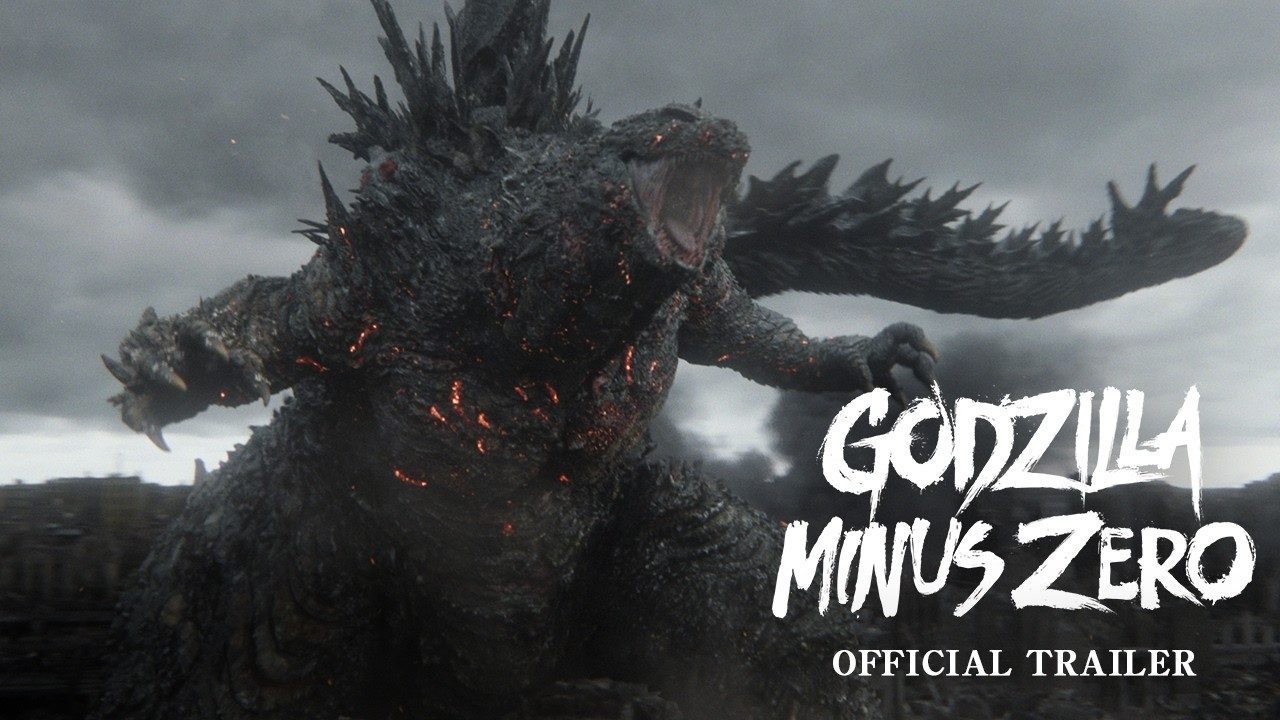
Godzilla Minus Zero opens in Japan on 3 November and in North America on 6 November, with first reactions out of its press screenings this week running hot. Takashi Yamazaki is back as director, writer and visual effects supervisor, and Shirogumi is back doing the effects. What has changed is the container.
The frame is nearly square
Minus Zero is being sold as the first Japanese production filmed for IMAX, and Yamazaki has said a high percentage of its shots are full-frame. IMAX’s full-frame ratio is 1.43:1. Set that beside the 2.39:1 most of this kind of film is finished in and the difference is not width. It is height.
A wide frame is forgiving in ways that only become obvious when you lose it. Crop top and bottom and a great deal of an environment never has to exist: ceilings, the upper floors of a building the camera tilts past, the ground immediately under a creature’s feet. Artists have been budgeting around that crop for as long as the crop has existed, and it is honest work — you build what is in frame. A 1.43 frame puts the sky and the pavement in the same shot as the monster. Every set extension grows upward, every digital building needs a roof, and the thing standing in the middle of it is lit from a sky that is now visible rather than implied.
Then there is what IMAX does downstream. Disney’s Infinity Vision certification earlier this month was a projection standard rather than a frame spec — brightness, screen size, sound, nothing about aspect ratio. Real IMAX runs the other way. It reaches back into production and finishing and dictates what shape and what resolution the work has to be carried at, which is the expensive end.
Resolution is not a slider on a simulation
Here is where a VFX supervisor’s pleasure at a bigger budget meets arithmetic.
Raise the delivery resolution and a render gets slower roughly in proportion to the pixels. Annoying, predictable, solvable with more machines. Simulation does not behave like that. A destruction setup or a water sim is solved on a grid, and holding fine detail at a 1.43 frame projected onto a screen several storeys tall means raising that grid’s resolution — at which point cost climbs with the cube of the increase, plus the storage for every cached frame. Double the detail in a volumetric sim and you have roughly eight times the work and eight times the disk.
Yamazaki’s own framing of the sequel, from his CinemaCon and Collider interviews in April, was that each shot requiring effects is more complex than Minus One’s, and that Toho gave him more money, which meant more people on the team. Both statements point the same way. Compute buys render farm. It does not buy iterations on a sim that takes a night to solve, and iterations are what a destruction shot is made of. People do.
This is precisely the bottleneck the research community has been poking at. A multi-layered rigid-body workflow presented at SIGGRAPH this year adds a second fracture to motion a director has already approved without resolving the whole thing — which is the IMAX problem stated as a technique. Detail goes up, the approved performance stays put, the overnight solve does not happen again.
What the reactions are and are not
Slant’s Eli Friedberg wrote that the mass-destruction sequences exceed Minus One’s in complexity, creativity and fidelity. Others have called the scale unmatched. Those are impressions from a screening, and they are worth exactly what impressions from a screening are worth — which is something, because the people writing them have seen the film and I have not.
What nobody has published is a number. No shot count, no crew size, no vendor breakdown. Minus One’s figures only reached the trade press once its Oscar campaign was under way, and the breakdowns that let anyone compare one show’s effects load with another’s exist because a vendor decided to publish them. Toho has decided nothing of the sort yet.
So the comparison everybody wants to make next week, thirty-five artists then against however many now, is not available. Worth remembering before someone makes it up.
Release dates, the IMAX framing and Yamazaki’s comments on crew size and per-shot complexity are from Toho and GKIDS announcements and the April interview coverage. Minus One’s shot count is given as 610 by the Academy’s own interview page and 620 by Animation World Network; its budget has never been confirmed by Toho. Reaction quotes are from the first-screening round-ups published this week.