Morgane Muller’s Spellbound Dormitory, covered by 80.lv this week, is a four-month final-year environment built at Artside from a concept by Gabriel Nagypal, under the supervision of Sacha Veyrier, Quentin Ferlay, Yoan Autin, Lionel Cregut and Clément Masset. The scene is a school dormitory, dressed almost entirely by hand.
What the coverage actually says
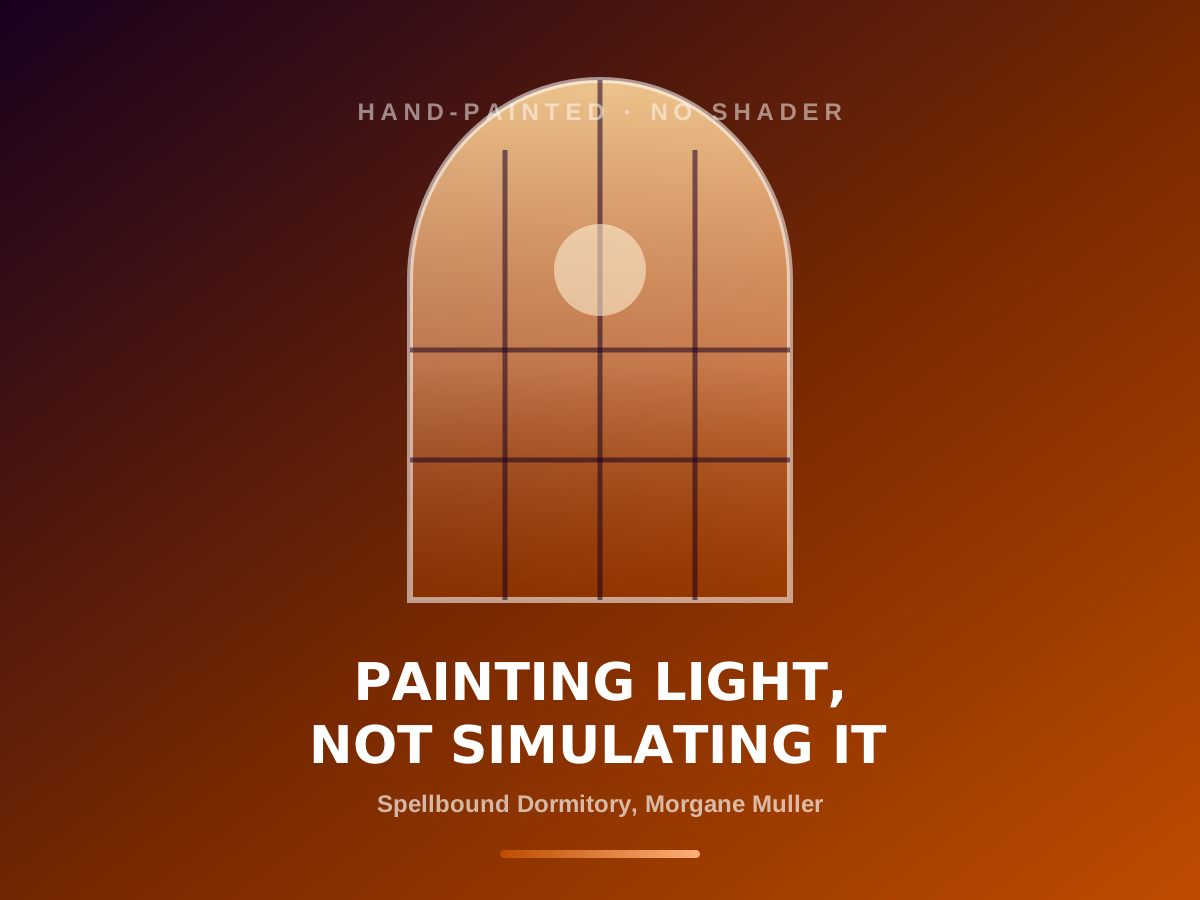
Two details from 80.lv’s write-up are worth pulling out on their own: Muller broke the scene down into individual hand-painted elements rather than leaning on a tiling PBR material set, and the stained-glass windows read as translucent without any actual light transmission behind them — the glow is painted, not simulated.
Why that second one is the interesting problem
Real translucency — light entering a surface, scattering, and leaving somewhere else — is one of the more expensive things a renderer can be asked to do. Subsurface scattering or a refraction pass through coloured glass means tracing what happens inside the material, not just how it reflects. In a real-time engine that is a budget line: a translucent shader with backscatter costs more per pixel than an opaque one, and a scene with a dozen stained-glass panels multiplies that cost by every light source hitting them.
Painting the illusion sidesteps the simulation entirely. You are not calculating how light passes through the glass — you are painting what a viewer’s eye expects that result to look like: a warm colour ramp near the light source, a cooler falloff further from it, a soft-edged bloom where the panes would be brightest. None of it is physically there. All of it reads as if it were, because the human visual system is doing the same shortcut we are — pattern-matching against what stained glass has looked like in every photo it has ever seen, not measuring photons.
This is the same reasoning that makes baked lighting work at all, just applied at the texture level instead of the lightmap level. A technical artist reaching for real-time translucency will still want it for anything the camera moves close to or that changes lit state — a painted glow does not react to a flickering torch. But for a fixed architectural read, in a scene that is being hand-painted throughout anyway, faking the physics is not a compromise, it is the consistent choice: the rest of the environment is already lying about light in exactly the same way, one brushstroke at a time.
Dividing the scene into individual pieces
The other detail — breaking the environment into separate hand-painted elements rather than tiling a shared material library — is the more time-consuming decision and the one that makes the trick above possible in the first place. A tiling PBR set has to look correct under arbitrary lighting because it does not know in advance what light will hit it. A hand-painted, non-repeating element can bake in exactly the lighting the artist wants, because it is only ever going to sit in this one spot in this one scene. That is the trade a hand-painted pipeline makes across the board: slower to build, no reuse, but every surface gets to lie in a specific, art-directed way instead of a generic one.
Based on 80.lv’s coverage of the project and Muller’s own credits for it — I have not seen a full texture or lighting breakdown of the stained-glass work itself, so treat the technical reasoning above as informed extrapolation from the published summary, not a confirmed step-by-step of how the panels were actually painted.