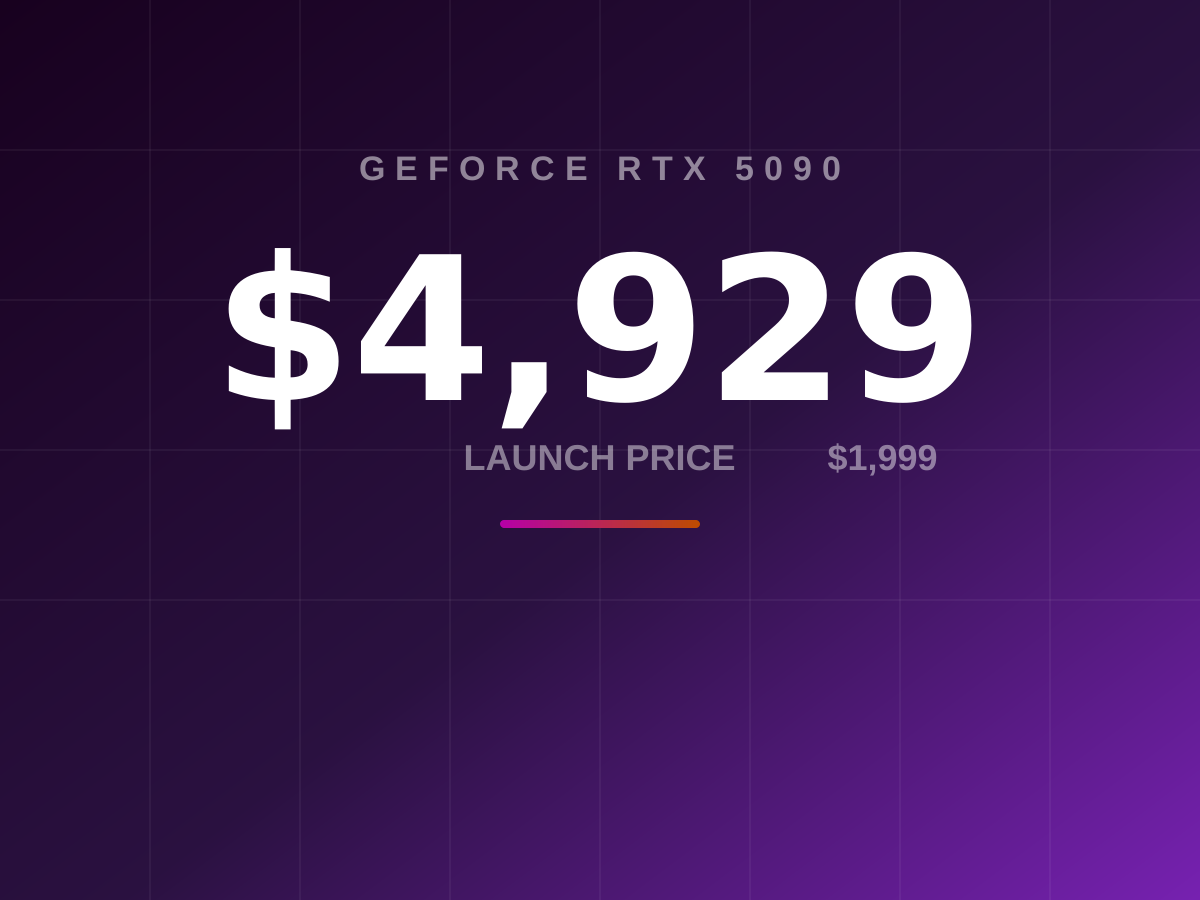
Let me get the number out of the way first, because it is genuinely absurd. The RTX 5090 launched at 1,999 dollars. On 5 August it was listed at 4,929 dollars on Nvidia’s own store. Not a scalper. Not eBay. The manufacturer.
If you have been putting off a workstation upgrade and quietly hoping prices would settle, I have bad news, and it is worth understanding why — because the reason changes what you should actually do about it.
The memory glued to the GPU is what costs
Here is the part most people miss. The chip is not what got expensive. The memory did.
AI data centres are on track to swallow roughly 70% of the world’s memory output in 2026. In 2022 that figure was somewhere between 20 and 30%. Samsung, SK Hynix and Micron have pointed their wafer capacity at high-bandwidth memory for AI accelerators, because that is where the money is, and consumer GDDR6 and GDDR7 are fighting over what is left.
The result is brutal. Sixteen gigabytes of GDDR7 cost somewhere around 65 to 80 dollars in mid-2025. By the end of that year, once the long-term supply contracts ran out, the same sixteen gigabytes cost over 200 dollars.
On some high-end cards, VRAM is now more than 80% of the entire bill of materials. You are not really buying a graphics processor any more. You are buying memory, with a processor attached.
This is a plateau, not a spike
I know the instinct. Wait a few months, let it cool off, buy at a sane price. That is what usually happens.
That correction is not coming. MSI has told investors to expect gaming hardware prices to climb 15 to 30% across 2026, pointing at a roughly 20% GPU supply shortfall from Nvidia on top of the memory shortage. Analysts at TrendForce, IDC and Intel are all landing on 2027 or 2028 before memory supply meaningfully normalises.
So the honest read is: this is the price for a while.
What I would actually do
Nothing here is clever, but it is the reality.
Buy for the VRAM you need, not the tier you want. If your scenes fit comfortably in 16GB, the 24GB card is a luxury purchase right now, not an investment. The premium you are paying is almost entirely for memory you are not filling.
Look hard at the previous generation. The used market is the one place where the memory crunch has not fully priced itself in yet. A last-gen card with generous VRAM is a far better deal today than it was a year ago, relatively speaking.
Rent for the spikes. If you need serious horsepower for one heavy render or one training run a month, cloud instances have suddenly become the cheap option. That felt backwards two years ago. It does not now.
Do not panic-buy. Prices are not going to double again. They are going to sit where they are. That means you can take your time and buy properly, rather than grabbing whatever is in stock.
The frustrating truth is that we are downstream of a spending war we are not part of. Our GPUs got expensive because someone else wanted the memory more. That is not satisfying, but knowing it is what stops you waiting for a crash that is not coming.