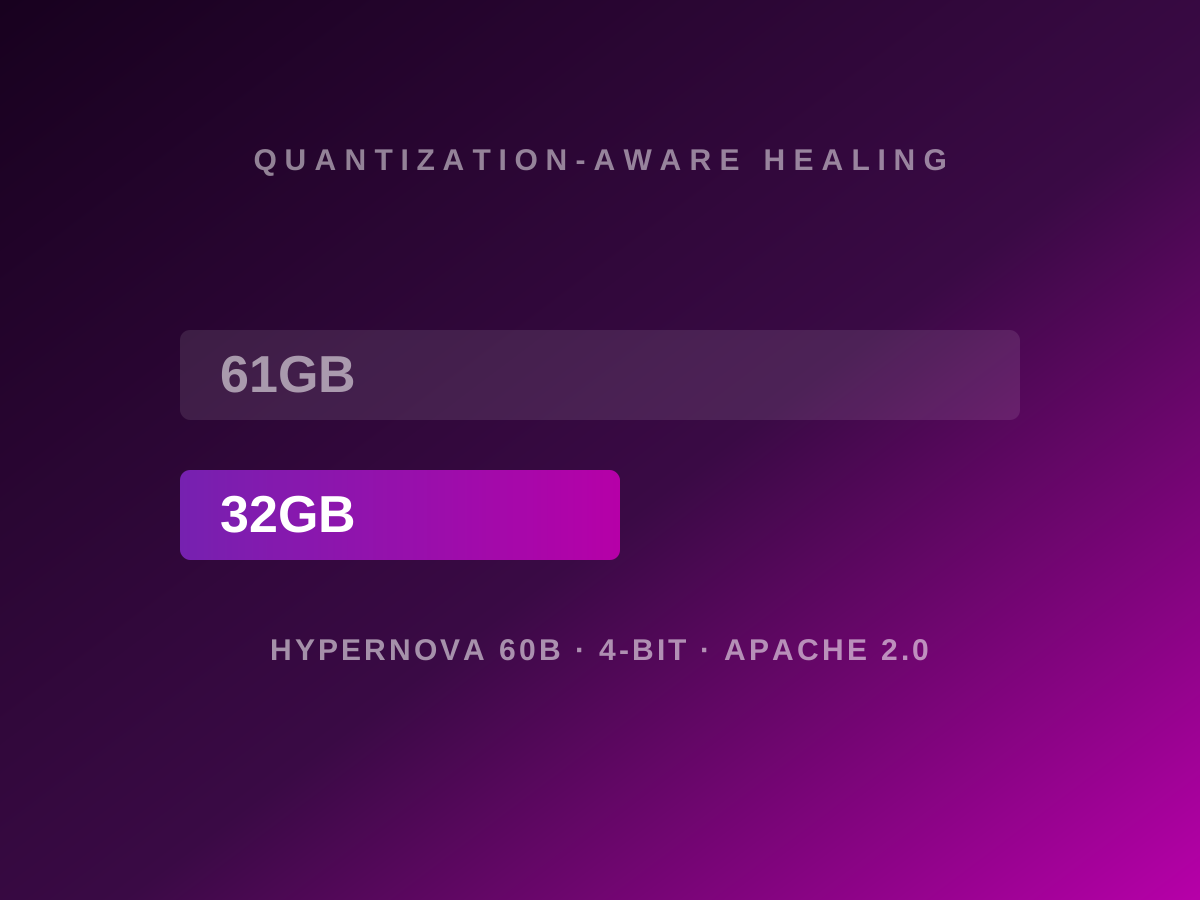
61GB of weights, quantized down to 32GB, and the benchmark scores did not fall off a cliff. That is the whole pitch behind a technique Multiverse Computing is calling Quantization-Aware Healing, published this week alongside a new 4-bit release of its HyperNova 60B model.
Quantizing a model has always meant a trade. You halve the memory, you eat a quality hit, and you decide afterward whether the hit was worth it. Every GGUF file on Hugging Face is a monument to that negotiation — Q4 for the card you actually own, Q8 for the one you wish you had. QAH is Multiverse’s attempt to make that negotiation less lopsided: instead of quantizing and hoping, they quantize and then retrain the compressed model against its own uncompressed self, using knowledge distillation combined with what they call fake-quantized training — running the forward pass at low precision while the gradients update at full precision, so the model learns to be good at being compressed rather than just surviving it after the fact.
Where HyperNova sits
HyperNova 60B itself isn’t new — it’s Multiverse’s earlier compression of OpenAI’s gpt-oss-120b, a mixture-of-experts model, down to 58.7 billion total parameters with only 4.8 billion active per token. What shipped this week is a further pass: taking that already-compressed 60B checkpoint from roughly 61GB down to about 32GB with 4-bit quantization, healed rather than just truncated. Multiverse’s own numbers put the healed version within a few points of the model it was distilled from, on the evals they chose to report. Take that “within a few points” claim as the company’s own measurement, not an independent one — nobody outside Multiverse has reproduced it yet, and vendor benchmark slides have a long history of picking the evals that flatter them.
32GB is the interesting number regardless of how the last percentage point shakes out. That’s a single high-end consumer or prosumer card — a 5090, a workstation Ada card, the kind of GPU that shows up on a render farm rather than a data centre rack. A model with a 120B-parameter parent, running local, on hardware someone in this industry might already own.
I don’t fully trust “near-parity” on a vendor’s own slide until someone else has run the same eval independently. But the direction of travel is the part worth paying attention to, regardless of whether this specific number holds up: compression is stopping being something you just accept and turning into something you can train for.
That matters for anyone who has tried to fit a local model into a texture pipeline, a batch-tagging tool, or an offline assistant and hit the same wall every time — the model that’s actually good enough doesn’t fit in the VRAM you have left after the renderer, the DCC and the OS have taken their share. A 4-bit model built to hold its quality is a different proposition from a 4-bit model that just happens to still boot.
The weights are on Hugging Face under Apache 2.0, same as the earlier HyperNova releases. Whether the healing holds up outside Multiverse’s own eval suite is the question worth watching next.