The most useful thing Rockstar published this week was a table. On 18 November 2026, a day before Grand Theft Auto VI went on sale, the studio’s technical team handed over the resolution and upscaling breakdown for every console it ships on. Four SKUs, three different reconstruction techniques, one frame rate target.
PlayStation 5: native 1440p, upscaled to 4K, using Rockstar’s own temporal anti-aliasing. Xbox Series X: the same. PlayStation 5 Pro: also native 1440p to 4K, but reconstructed with Sony’s second-generation PSSR instead. Series S renders at 720p and upscales to 1080p with AMD’s FSR 4. On all four the final image gets a 4K interface composited on top.
Read that list twice and the frame rate stops being a mystery.
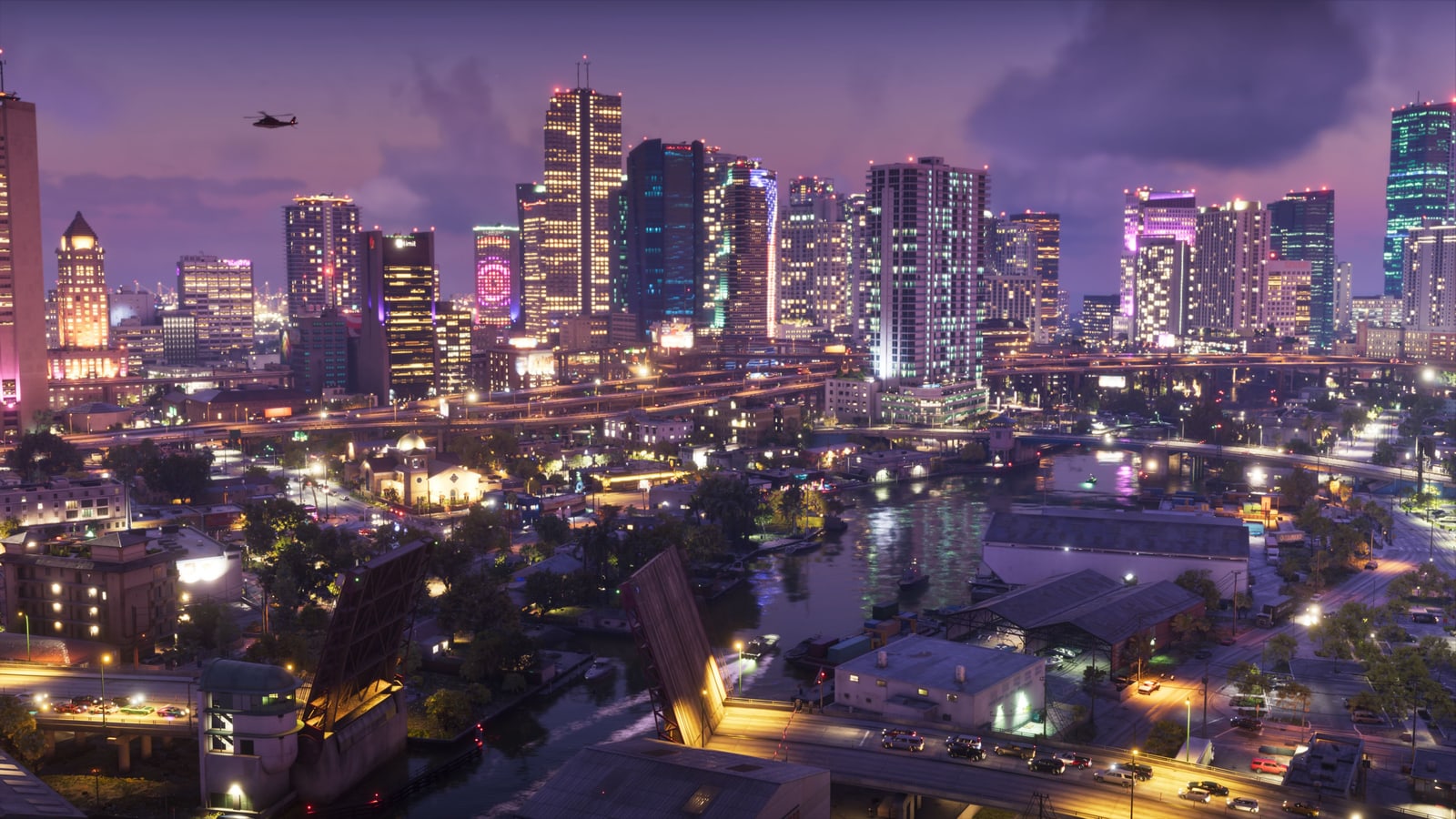
The Pro did not buy more pixels either
A mid-generation console with a substantially bigger GPU normally announces itself in the resolution column. That is what the extra compute is for. Give a game more GPU and it renders the same frame at a higher base resolution, or holds the same resolution at a higher frame rate, and either way the number on the spec sheet moves.
Here it does not move at all. The Pro renders the identical 1440p as the machine it is meant to outclass. Every bit of that additional GPU went into PSSR2 doing a better job of reconstructing those 1440p into 4K, and into ray-traced shadows that Rockstar says are a Pro exclusive.
Which tells you where the frame time is going. If the GPU had been the thing setting the budget, a base PS5 would have landed below 1440p and the Pro above it. They are the same because neither one is waiting on the GPU. They are both waiting on the same thing, and it is a thing the Pro barely touched.
Rockstar said it out loud
The studio’s position, given to press on 18 November, is that the Pro is not powerful enough to run the game at 60fps or at 40fps, because its CPU is only marginally quicker than the base console’s and the simulation is what needs the headroom. Digital Foundry has put that CPU gap at roughly seven per cent. The part is the same Zen 2 silicon, clocked a little higher.
Seven per cent more CPU does not buy you a hundred per cent more frames.
The sharper half of the statement is that this covers future patches. No 60fps mode is coming to current-generation consoles, which breaks a habit — GTA V and Red Dead Redemption 2 both got their higher frame rate options eventually, on later hardware. Ruling it out now says the tick rate is structural rather than a setting somebody could unlock later.
That argument has been running since the summer — why a bigger GPU cannot make the simulation tick faster was the whole of it — and the receipts are finally attached.
What the thirty-three milliseconds are buying
A 30fps lock gives you about 33ms a frame. On a game like this the renderer is not the tenant taking up most of that.
Traffic routes itself. Pedestrians have destinations. Physics runs on every vehicle in range. Police coordinate. Both protagonists are live simultaneously, so the one you are not driving is doing perception and target selection beside you every frame. Reviewers who went long on detail kept landing on the audio — Rockstar says convenience store refrigerators have individual sounds, which means emitters being managed, mixed and culled in numbers nobody would have attempted a generation ago.
Then there is the weather, which the studio rebuilt so that storms are localised and persistent rather than global. A single global weather state is cheap. Separate systems moving across a map this size, leaving wet surfaces behind them, is bookkeeping that runs whether or not you are looking at it.
Add it up and 30 is the number the design chose, years ago. Everything above was bought with it.

Three upscalers is a real cost
The bit that interests me most as someone who ships assets is the reconstruction spread. Rockstar built a physically-based material library for this game, and a cinematic imaging pipeline on top of it. That library now has to survive being resolved three separate ways.
TAA, PSSR2 and FSR 4 fail differently. Thin geometry, foliage, fine specular detail, anything with high-frequency normal data — each technique smears or shimmers its own way, and the fixes do not transfer. Tune a fence or a wet-asphalt material until it stops crawling under one and you have learned nothing about the other two. Four consoles, three validation passes, and one of them starts from 720p.
Digital Foundry’s launch testing, published 18 November, has the Pro holding its 30 almost without deviation and the base PS5 taking minor but sustained dips. That split is the most predictable thing in this whole story: same resolution, same target, and the console with the marginally faster CPU is the one that keeps the lock.
PC remains unmentioned. No port has been confirmed, and for anyone who wants this world at 60 frames a second it is now the only place it could happen.