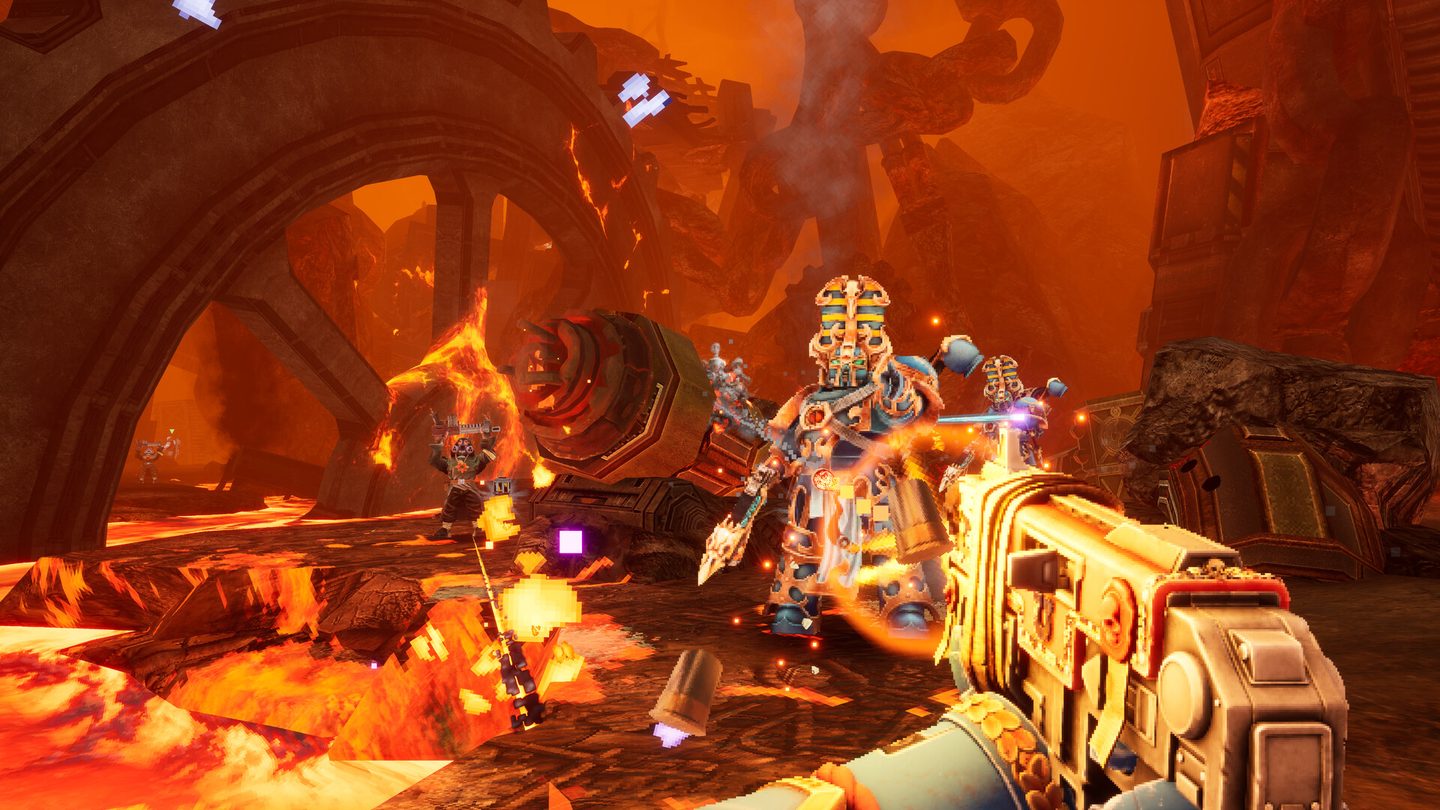
Every cultist you shoot in Boltgun 2 is a 3D model that was photographed to death.
Auroch Digital’s lead artist, Mark Chambers, walked Creative Bloq through it. The team models the character in 3D first. Then comes a pixelisation step: a custom rig captures the asset from eight camera directions, a script packs the output into a compressed sprite sheet, and the finished frames get projected onto a billboarding plane that swivels to face the player. You are firing at a flat photograph of something that was never flat.
The game has been out since 14 October 2026 on PC, PS5 and Xbox Series X|S, with a Switch 2 version following on 19 November. That second date is why the verdicts are being read again this week, and a good moment to look at where they disagree.
Eight directions, and the frames nobody sees
Eight is the number worth sitting with. A sprite that rotates to face you only needs to be correct from the angles a player will ever hold it at, and Chambers says the team deliberately reduced the frame count to the most important angles. Down a gun barrel, in a corridor, at speed, nobody is studying a Chaos marine in three-quarter profile.
That restraint is a labour decision before it is an aesthetic one. Every angle of every animation of every enemy is a frame somebody has to look at and sign off, and the count multiplies in a way polygon budgets do not — which is the same arithmetic that made GTA 6’s 600,000 NPC animations a headcount problem rather than a disk-space one. Drop the diagonals and the bill halves. Keep them and you are paying for frames that exist for a sixth of a second each.
The first game hit the wall earlier than you would expect. Auroch has said that Unreal Engine 4’s own sprite tooling could not draw the sheer number of objects and enemies fast enough, so they wrote their own renderer, able to run on either the GPU or the CPU. A studio writing a bespoke renderer to make flat squares appear is a funny sentence until you count the squares. Boltgun 2 is listed as running on Unreal Engine 5, and Auroch has not made much noise about the jump — which tracks, since a version bump tends to bill you somewhere specific rather than everywhere, the way Phasmophobia’s move to Unity 6 sent the cost straight into lighting.
The number
8, from thirteen scored verdicts I could verify, running from 5 to 9.5.
That is a plain mean of what was published, converted to a ten-point scale and rounded to the nearest half. The aggregates agree with it and disagree with each other about the detail: as of 24 November 2026 Metacritic sits in the low 80s depending on which platform page you open, and OpenCritic’s figure moves between 81 across all critics and the low 80s for top critics alone. All of which is a long way of saying low eights.
A four-and-a-half point spread is the interesting part. TechRaptor’s 9.5 and ComicBook’s 2.5 out of 5 — “a mediocre boomer shooter doomed by repetition” — weight the same two facts differently. Both name those facts in their opening paragraphs: the look is terrific, the fighting runs out of ideas.

Why the repetition is a pipeline problem
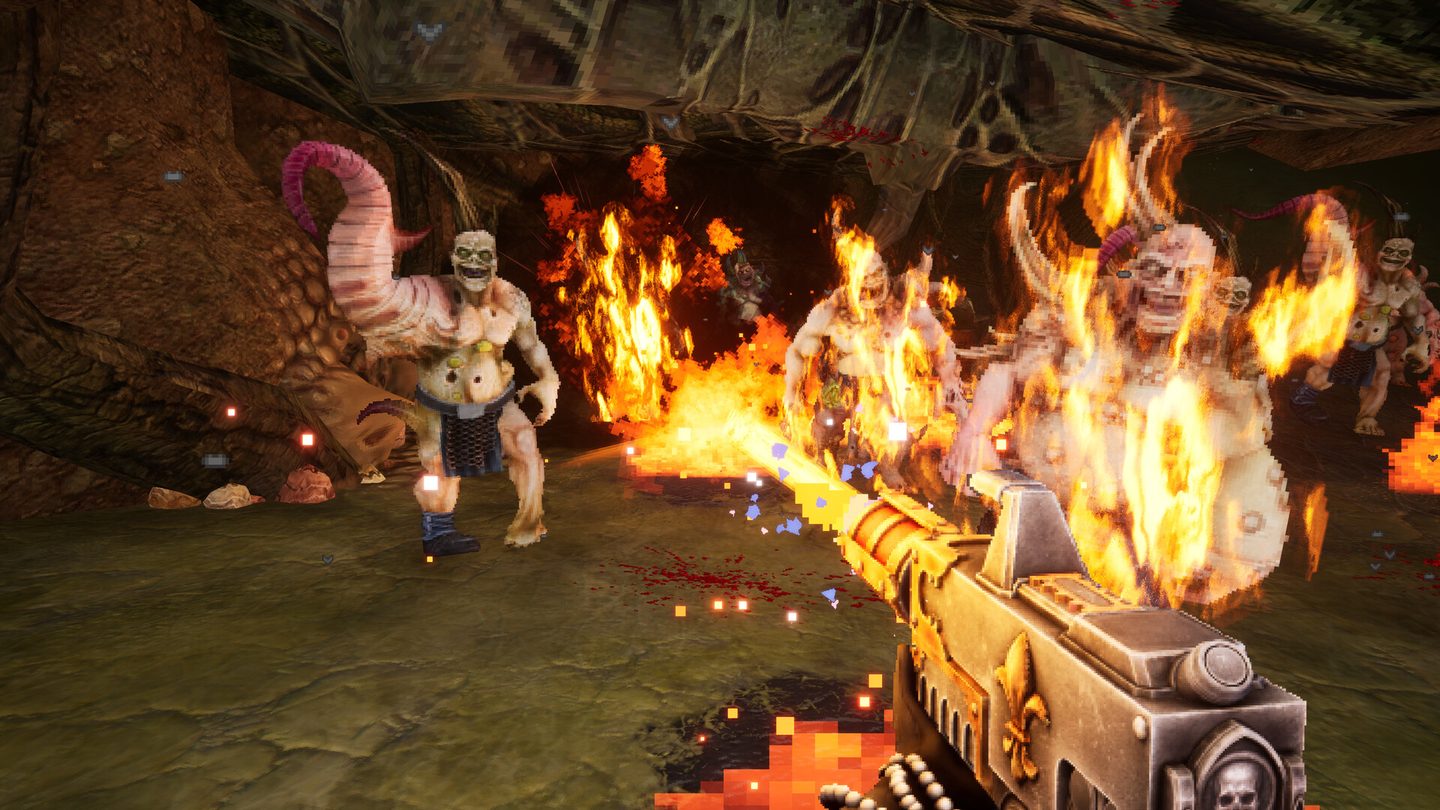
Read the complaints together and they land almost entirely on variety: three bolters that feel like one, four heat weapons that feel like two, enemies that snag on geometry, ambushes that start to telegraph, and two playable characters who — ComicBook’s words — feel too similar.
Now put that next to the sprite pipeline. A polygonal enemy is cheap to vary: reskin it, swap a head, scale it, give it a different animation set, and the engine renders the difference for free. A sprite enemy costs its own full capture — model, pixelise, eight directions, every frame of every animation, packed and hand-checked. Variety stops being a modelling task and becomes a multiplication table. The cheapest way to fill an arena is therefore more of what you already captured, and more of what you already captured is the exact sensation reviewers are describing when they say level six feels like level three.
That excuses nothing. A player who paid for the game is entitled to find the fifth identical ambush boring, and the technique that produced it is not their problem. But it does explain why the complaint survived a sequel that otherwise improved nearly everything — the branching campaign, the second character, the level geometry, Mick Gordon on part of the soundtrack. Auroch fixed what was fixable without touching the constraint underneath, because the constraint underneath is the reason the game looks the way it does, and the way it looks is the reason anybody wanted a sequel.
Which is a fair trade, and a real ceiling. Boltgun 3, if it happens, runs into the same wall on the same day it starts.
Scores collected on 24 November 2026 from the outlets’ own pages and published round-ups, converted to a 1-10 scale and averaged. Aggregate figures are the aggregators’ own.