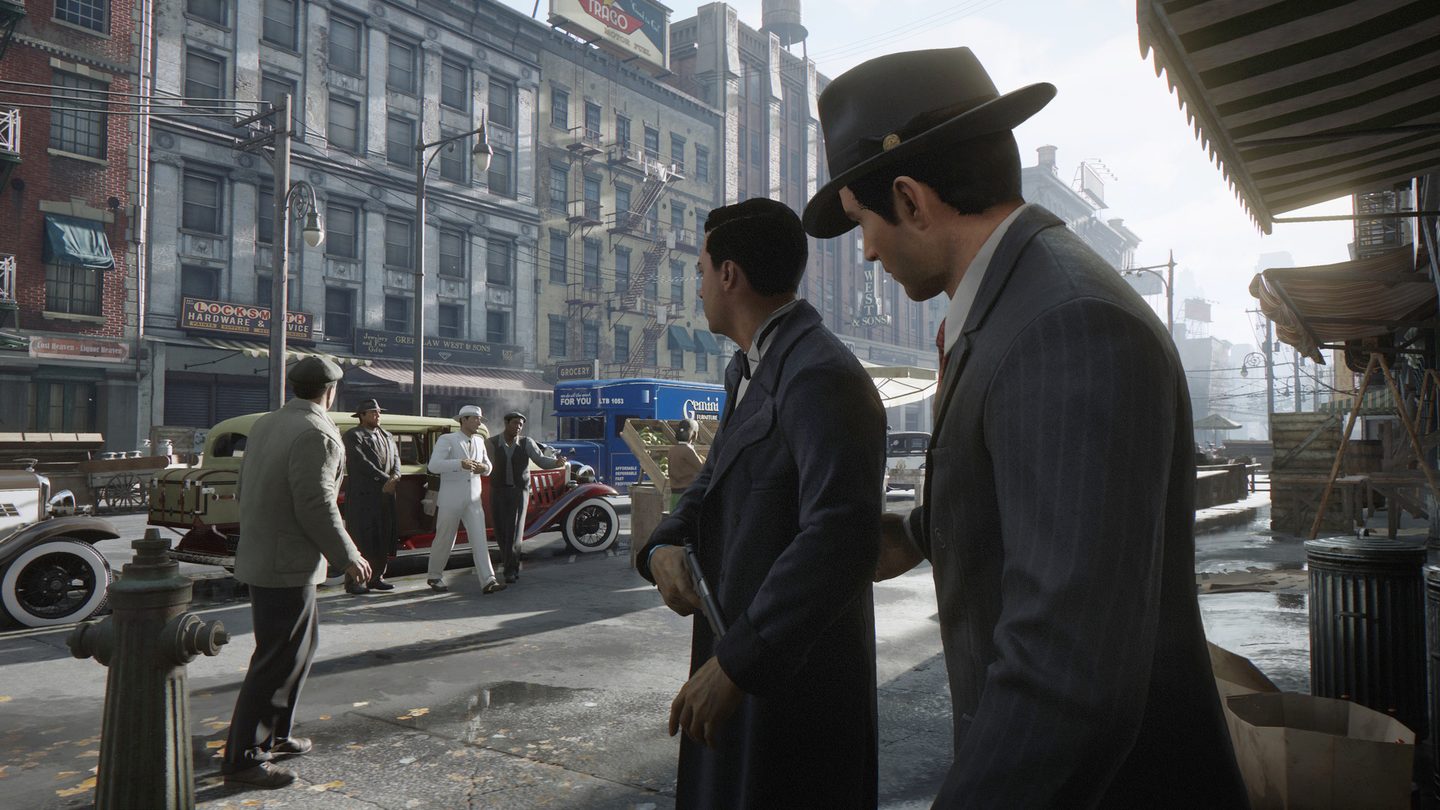
2K shipped Mafia: The Omertà Collection on 14th August, bundling all three Definitive Editions of the original trilogy alongside Mafia: The Old Country and its Man of Honor DLC. Buried in the launch was a quieter piece of news: Mafia: Definitive Edition — the 2020 remake of the 2002 original — got a free native PS5 and Xbox Series X/S patch, unlocking a stable 60fps and picking up unspecified “technical improvements” along the way, as reported by Push Square. Anyone who already owned it gets the upgrade for nothing.
Mafia II and Mafia III Definitive Edition, sitting in the same collection, did not get the same treatment. They’re the same PS4-era builds running in backward compatibility, same as before. That asymmetry is the more interesting story here, and it’s an engine story before it’s a frame-rate one.
Backward compatible isn’t the same as native
Before this patch, Mafia: Definitive Edition on PS5 ran the way most PS4 games still do on current-gen consoles — through backward compatibility, which mostly means the console clocks its CPU and GPU higher and lets the original build run faster, capped wherever the game itself capped it. That’s why it sat locked at 30fps despite years of spare GPU headroom sitting on the table: the engine loop, the streaming system, the systems that decide how much geometry and texture data to pull in before the next frame, were all still ticking to a budget authored for PS4 hardware in 2020. Backward compatibility raises the ceiling. It doesn’t retune the room.
A native patch is a different job. It means going back into the build and re-authoring the systems that were tuned around a 30fps frame budget so they hold up at half the time per frame. Streaming has to pull geometry and textures in twice as fast to stay ahead of the camera before pop-in becomes visible. Shadow cascades and LOD transition distances, both tuned against how much frame time is available to spend on them, need re-balancing. Dynamic resolution scaling — the system that trades pixel count for frame time when a scene gets heavy — needs a wider range to lean on, because there’s a lot less time to fall back into. That is ordinary technical-art work that still eats real weeks. It is the unglamorous half of what “next-gen patch” means whenever a studio actually does it properly instead of just relaxing the frame cap and hoping.
Why only one of the three games got it
Here’s the detail that makes this worth a longer look: Mafia: Definitive Edition does not run on Unreal Engine. It runs on a proprietary Hangar 13 engine, one built out of the cinematic tech the studio developed for Mafia III. That’s the studio’s own, decades-deep in-house technology — not an industry-standard engine with a scalability system built by someone else. Mafia: The Old Country, by contrast, is the first Hangar 13 game built on Unreal Engine 5, a genuine break from over twenty years of proprietary tooling, according to Hangar 13’s own comments to Unreal Engine.
That means this collection quietly contains two completely different rendering stacks under one banner. Old Country was scoped for current-gen from day one, on an engine that ships with mature scalability groups and platform-target profiles out of the box — hitting a 60fps mode there is largely a tuning exercise inside tools built for exactly that. Retargeting Definitive Edition’s frame rate meant going back into bespoke, in-house systems with no outside engine team’s scalability work to lean on, on a nearly six-year-old codebase, with whatever internal team still maintains it. That’s a heavier lift for a smaller studio, and it’s a reasonable guess — though 2K hasn’t confirmed this directly — for why Mafia II and III’s Definitive Editions, built on still older, likely different tooling from their 2010 and 2016 originals, didn’t get pulled along for the ride. Full engine parity across a trilogy remaster was apparently never the goal; getting the flagship of the three onto current hardware properly was.
The part worth remembering
The marketing copy skips all of it and says “60FPS, Visual Upgrades” and moves on. But it’s a decent, concrete example of something I keep running into from the technical-art side: a frame-rate number in a patch note is never really about the frame rate. It’s a proxy for how much of a game’s underlying systems got touched to get there, and whether the team doing it was working with tools built for the job or fighting a decades-old proprietary stack to make it happen. Rebel Wolves ran the same equation in public a few weeks later, skipping 60fps entirely on Blood of Dawnwalker and then finding the mode three days after the backlash — a number that was always about what the renderer could be asked to give up.
Judged on that basis, Mafia’s free 60fps patch is a bigger piece of work than the one line in the changelog suggests — and the fact that Mafia II and III didn’t get the same treatment tells you almost as much as the patch itself does.
Sourced from Push Square’s coverage of the Omertà Collection launch and Hangar 13’s own comments on Mafia: The Old Country’s move to Unreal Engine 5, published via Unreal Engine’s developer interview series. 2K has not published detailed patch notes for the Definitive Edition update beyond confirming 60fps support and unspecified technical improvements.