Two Sony stories landed in the same week and I don’t think they’re being read together enough.
Back in July, Sony confirmed it will stop producing physical discs for new PlayStation games starting January 2028. Nothing already released is affected, and the justification is just arithmetic: in Sony’s own FY2025 Q4 numbers, digital already accounted for 85% of full-game software sales against 15% physical. Discs were already a minority format being kept alive mostly for collectors and people without reliable broadband.
Then, this week, PS5 owners got an unprompted email reminding them of the terms they already agreed to: “The Software is licensed to you, not sold. You are granted a limited, non-exclusive, non-transferable, and personal license.” The timing wasn’t subtle — it landed right before #PSBlackout, a week-long protest (23–30 August) organised by the preservation community DoesItPlay, calling on players to log out of PSN and stop buying anything on the platform.
Commentators have mostly focused on whether the boycott will actually move a number Sony cares about — it’s an ordinary week, no major PS5 exclusive is launching, and a chunk of the hardcore audience is at Gamescom anyway. Fair. But that argument is about the protest’s leverage, not about the thing it’s protesting, and the thing underneath is worth sitting with regardless of how loud this particular week gets.
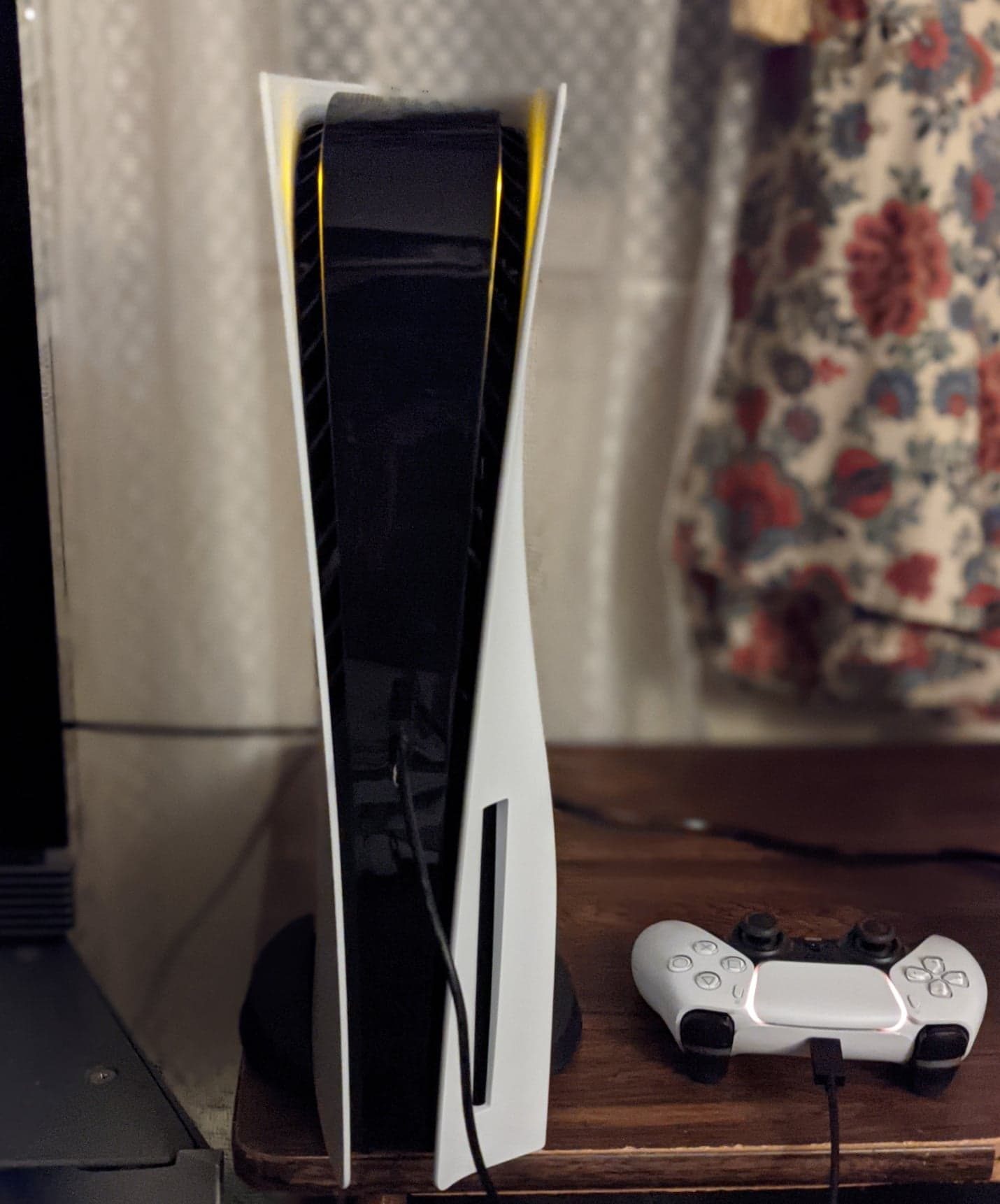
A disc was never really about the plastic
I don’t care about the disc as an object. I care about what a disc does, which is carry the finished thing with it, with no dependency on anything staying switched on somewhere else. Pop a fifteen-year-old PS3 disc into a working console today and the environment is exactly as it was on release day — same geometry, same lightmaps, same draw distance — because nothing about playing it required asking anyone’s permission first.
A digital purchase has always been a step removed from that, even before this policy shift. What changes in 2028 is that the removed version becomes the only version for every new PS5 release. And the license-check reminder that arrived this week is a statement of exactly what that entitlement actually is: not a copy you hold, but a permission Sony can define, redefine, and in the right circumstances, revoke.
Sony has been quick to say the online validation it rolled out in March only runs once, right after purchase, and doesn’t need to repeat. I believe that’s true today. It’s also not the part that matters. The part that matters is that the check exists at all — that somewhere, a server has to say yes before the software you paid for will run — and that “somewhere” is infrastructure a company maintains only as long as it’s commercially worth maintaining.
This has already happened, at smaller scale
This isn’t hypothetical. Ubisoft shut down the servers behind The Crew in 2024 and the game stopped being playable for everyone who owned it, disc or download, because the title required a permanent online activation check that Ubisoft simply switched off. The geometry, the open-world map, the physics tuning — none of it was damaged. It was all still sitting on people’s drives. It just couldn’t be unlocked anymore, because the key lived with a company that had decided to stop issuing it.
That’s the exact mechanism a digital-only, license-checked PlayStation is building toward at a much bigger scale. Not every game will get shut off — most won’t, because most storefronts have no commercial reason to. But “most won’t” is a different guarantee than “none will,” and a disc-based library never needed the first kind of promise at all.
Why I read this as an artist, not a consumer

An environment isn’t the code around it. It’s the specific arrangement of geometry, materials and lighting a team spent months, sometimes years, tuning to read a particular way — a corridor’s proportions, a sky’s colour temperature at a given time of day, the exact density of foliage that makes a forest feel inhabited instead of sparse. That’s the actual deliverable of the job. The disc or the download is just the container it ships in.
What a license-gated, disc-free platform does is quietly change what kind of container that is. A shipped environment used to be closer to a painting: once it’s out, it’s out, durable on its own terms regardless of what the studio or publisher does afterward. Under a permanent licensing model, it’s closer to a lease — the work is complete and correct the day it ships, and its continued existence depends on a business relationship that has nothing to do with the quality of the work itself.
I already write about how memory and GPU shortages are squeezing what an environment artist can build within a budget. This is a different kind of squeeze: not on what gets made, but on how long what gets made is guaranteed to keep existing for the people who paid for it. Sony isn’t doing anything as blunt as shutting games off today. But it just told everyone, in writing, exactly what it’s not promising — and phased out the format that never needed the promise in the first place.
What I’m actually watching for
Not whether #PSBlackout dents a quarterly metric — it almost certainly won’t, and that was never really the point of naming a boycott week. What I want to see is whether Sony (or anyone else moving the same direction) ever publishes a real commitment about license-server longevity for delisted or discontinued titles, the way some platforms have started shipping DRM-free fallbacks or offline-activation patches when a service gets sunset. Until that exists, “licensed, not sold” is a true sentence, and everyone building for the platform — including the people building the worlds — is making something whose permanence is someone else’s decision, not theirs.
Sources: PlayStation Blog’s own announcement of the January 2028 disc phase-out, digital-vs-physical software split from Sony’s FY2025 Q4 results as reported by outlets covering the announcement, Push Square on this week’s licensing reminder, and GameDeveloper on Sony’s March 2026 clarification of the one-time license check. The Crew’s 2024 shutdown is well documented across the trade press at the time. #PSBlackout’s actual measurable impact hadn’t landed as of this writing.