Going gold used to be the end of the conversation. The build is final, it goes off for certification, the discs get pressed, and the team stops touching it. On 14 September Ubisoft’s Rayman team posted that Rayman Legends Retold had gone gold — and in the same message moved it from 1 October to 3 December.
Two months, on a game that was already done.
The stated reason was that “while the game has officially gone gold, we have decided to take extra time to make sure every detail gets the care it deserves.” That is the whole of it. Ubisoft has not said what the extra time is for, and everything below is reading the shape of the project rather than anything the publisher confirmed.
This is a rebuild, in a different engine
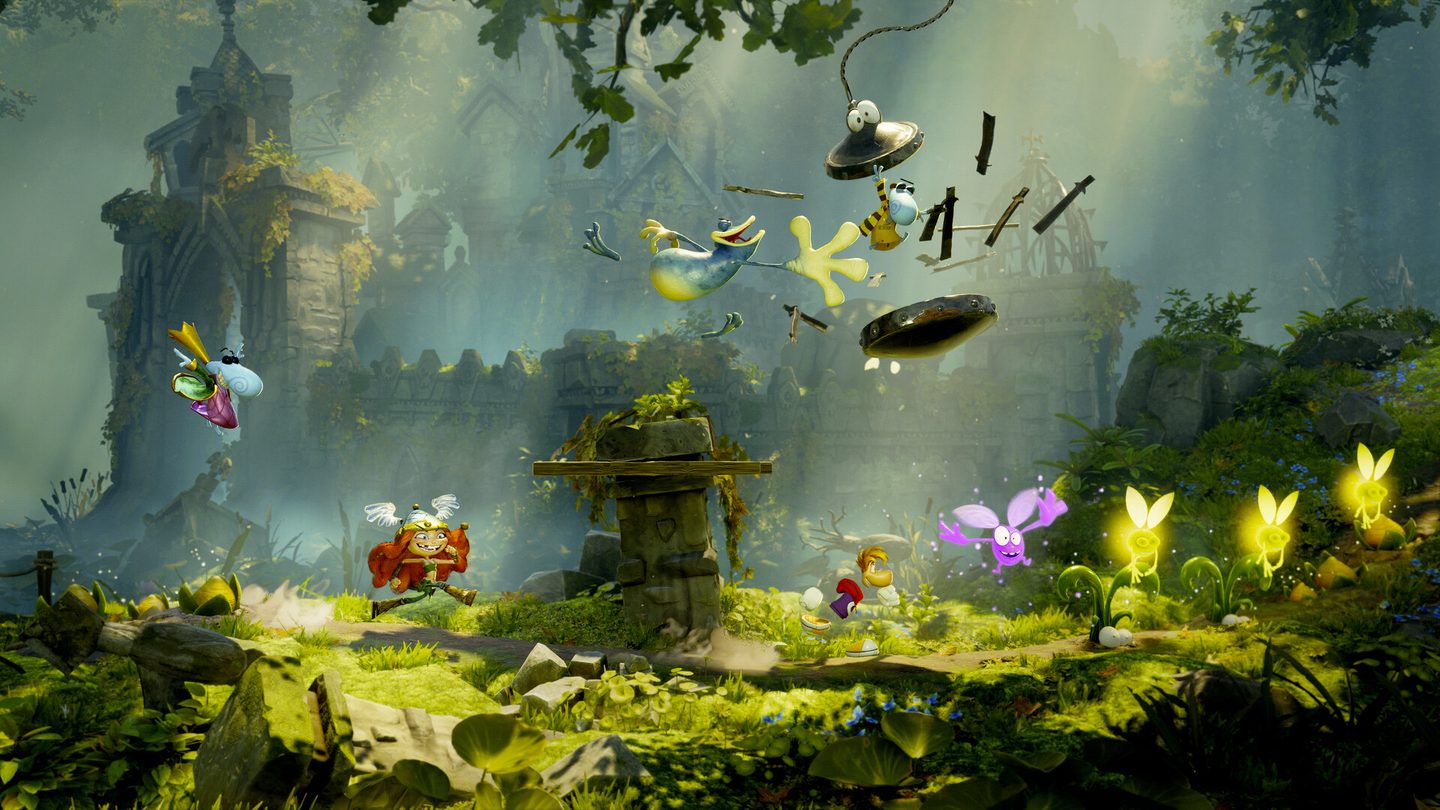
Ubisoft Milan and Ubisoft Montpellier did not upscale Rayman Legends. They rebuilt it in Snowdrop, the engine behind The Division and Avatar, as a 2.5D game with real geometry, a camera that moves, and lighting that is calculated rather than painted. Backgrounds are re-authored and far denser. The characters have been remodelled. There is a sixth realm that never existed, a new villain, four new musical stages, voiced cinematics, some on-rails dragon sequences, and an expanded score from Christophe Héral and Grant Kirkhope. The standard edition also carries Rayman Origins: Enhanced Edition, the 2011 game at 4K and 60fps.
The engine change under that list is where the work went.
The original Legends shipped in 2013 on UbiArt Framework, and UbiArt’s entire reason to exist was to delete the pipeline. An artist drew a figure, rigged it with bones over the drawing, and that drawing was the asset that reached the screen. No unwrapping, no material author, no lightmaps, no shading pass — the light in a Legends level was painted into the art by the person who made it, and the engine’s job was to not get in the way. Anyone who has spent a week hand-tuning a normal map understands exactly how radical that was.
Snowdrop works the other way round. It is a physically based renderer with dynamic lights and ray tracing, which means every one of those painted surfaces has to become a surface that answers to a light source it does not control. Flat art re-lit by a moving light is new art. The albedo has to be stripped of the shadow that was drawn into it, the shape it implied has to be modelled, and the roughness that was a brushstroke becomes a value someone has to pick.
All of it gets made again.
What “gold” covers when the art is new
On a port, done is a fixed target. Match the original, hit the frame rate, pass cert. On a re-authored art pass with a moving camera, done is a judgement, and here it is four judgements, because the game ships on Switch 2, PS5, Xbox Series and PC on the same day.
The Switch 2 build is the interesting one. In a VGC interview earlier this year the team put its Switch 2 target roughly level with an Xbox Series S, and said it was pushing Snowdrop to run ray tracing at 60fps, using DLSS to reach 1080p in handheld and 4K docked. That is an aggressive promise on that hardware. It is the same class of promise 4A Games made about ray tracing and 60fps on a base PS5, and there the answer was that corridors make it affordable — a tightly framed 2.5D platformer has a similar advantage, since the camera only ever sees a slice of the world.
That advantage has limits, though. A ray-traced 60 either holds or it does not, and it is the one class of problem you cannot ship and patch quietly. A missing collectible goes out in a day-one update. A frame rate that drops in the water levels means cutting lighting, which means going back to the art, which is weeks and not days.
Ubisoft has not said this is what happened. It is simply the kind of thing two months buys on a build that is otherwise finished, and it is more plausible than the alternative — that a certified game needed eight more weeks of polish on content nobody has complained about yet.
Moving out of an empty week into a full one
1 October was a quiet date. Retold would have had most of that fortnight to itself, and it was Ubisoft’s only new release this autumn outside Just Dance, which made it the entire autumn slate.
3 December is a different proposition. It lands inside the holiday window, against everything else that wants to be under a tree, with a marketing beat that has to restart from scratch. Studios do not make that trade for fun. When a publisher moves a finished game from a calm week into the busiest four weeks of the year, whatever it is fixing is worth more to it than the shelf space.
There is a smaller cost too, and it is the one I would be watching if I were on the team. Ubisoft has a habit of continuing to adjust the visual layer of its remasters after launch — Black Flag Resynced shipped with an emissive aura on Edward’s gear that the studio eventually let players switch off in a title update. Re-lighting someone else’s art is a taste problem as much as a technical one, and taste problems keep arriving after gold.
22 September is the date that will tell you something. Ubisoft has a Game Overview trailer and the first hands-on impressions going out that day, from people who have held a controller. If the coverage talks about how the new lighting reads on the old designs, the extra two months were about the art. If it talks about frame rate, they were not.
Delay date, gold status and the 3 December release taken from Ubisoft’s own statement of 14 September 2026 as reported by Push Square and Kotaku. Engine, developer, platform and feature details from the Steam and Nintendo store listings and Nintendo Life’s coverage of the June 2026 reveal. Switch 2 performance targets from Videogameschronicle’s interview with the development team; those targets are stated intentions and have not been independently measured.