The Sinking City 2 launched on 18 August for PC, PS5 and Xbox Series X|S, and the reviews landed the same day. Metacritic has it sitting at 79 on PS5, 84 on Xbox, 75 on PC. OpenCritic’s aggregate is 81, “Strong”, with 77% of critics recommending it across 48 reviews.
Averaging the seven outlets I could find a published number for, on a 1-10 scale, gives 8 — working at the foot of this piece. That is a real jump from the original Sinking City, which launched in 2019 to reviews in the low-to-mid 60s and a well-documented mess of a publishing dispute with Nacon on top of it. Frogwares, a Ukrainian studio that kept shipping through a full invasion of its home country, has apparently earned the sequel the first game didn’t get.
What actually changed
The pitch for the original Sinking City was investigation: an open, half-flooded version of a fictional New England city, Sherlock Holmes-style deduction mechanics, combat as an occasional interruption. It was ambitious and it was baggy, and a decent chunk of the criticism at the time was about pacing — too much city, not enough reason to be in most of it.
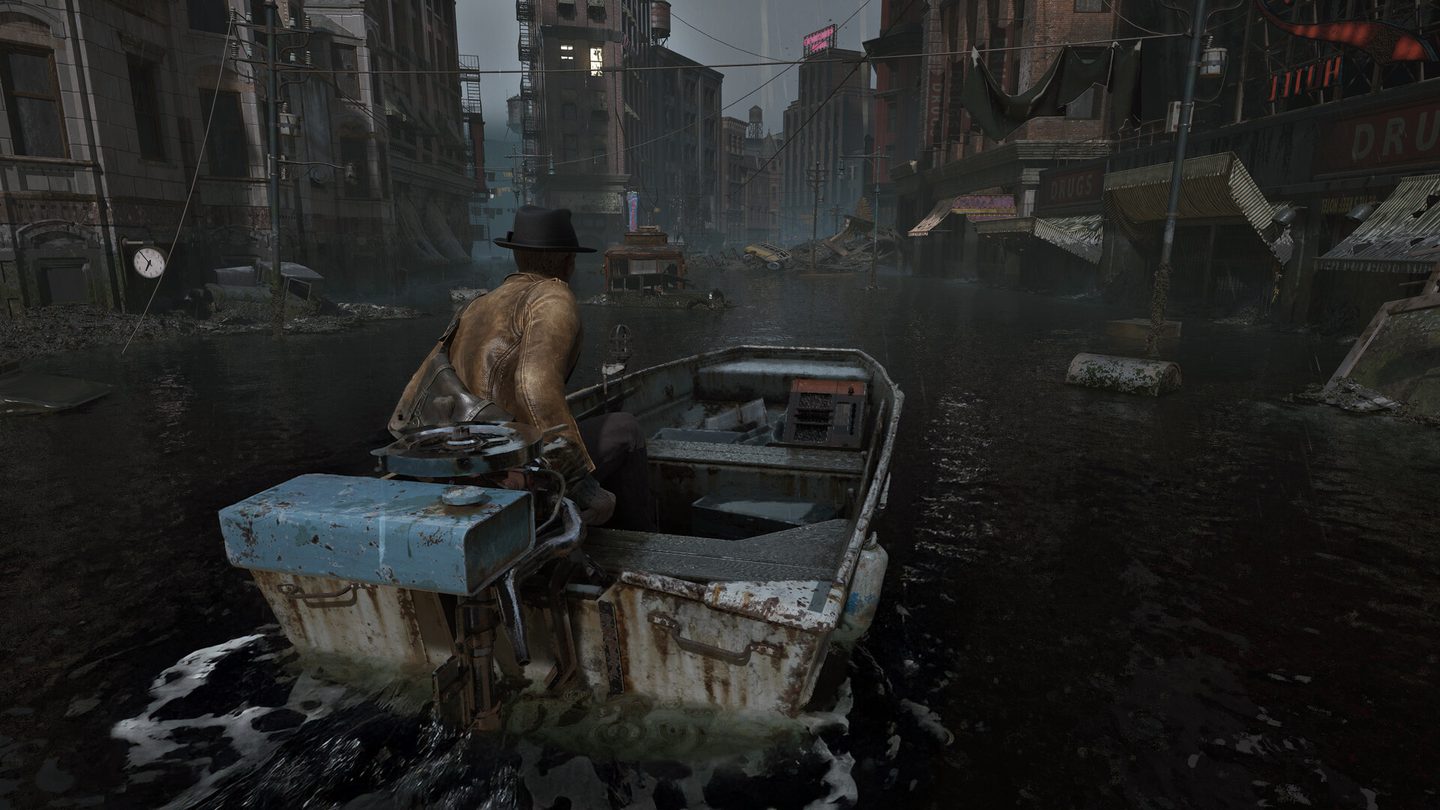
The sequel throws that structure out. You’re Calvin Rafferty, an occult adventurer, not a detective, and the city — a supernaturally drowned 1920s Arkham — is no longer an open world to wander. Eurogamer’s hands-on piece called it a shift toward “classic survival horror,” and the review consensus agrees: tighter spaces, resource pressure, a much higher ratio of things trying to kill you to things asking you to solve a puzzle. GamesRadar+ pitched it as Resident Evil crossed with Silent Hill, which is doing a lot of work as shorthand but isn’t wrong about the register.
The part nobody’s reviewing: what a flood actually saves you
Here’s where I want to stop reporting the consensus and talk about what I think is really going on underneath it, because “we made it scarier” isn’t the whole explanation for why this plays so much better with the same-sized team and the same troubled studio behind it.
An open, walkable flooded city is one of the most expensive environment art briefs there is. Every street the player can freely approach needs to read at full resolution from every angle, at every time of day the game supports, with a navmesh that accounts for waterlines, boat traffic, climbable debris, and a dozen entry points per building. You’re not modelling a level. You’re modelling a city that has to survive being looked at from anywhere, which means you can’t cheat depth, you can’t fake a skyline with a matte painting past the third row of buildings, and you can’t decide a street doesn’t need texture work because “the player probably won’t go there” — in an open world, they will.
A corridor-based survival horror sequence is the opposite problem, and it’s a cheaper one to solve well. The camera and the critical path are authored together. You know exactly which fifteen feet of drowned hallway the player is going to be standing in when the tension needs to peak, so you can put your best asset, your best lighting rig, and your only working light source exactly there — and let everything outside that beam go dark, or underwater, or simply not exist past the geometry you bothered to build. The first game had to build a city. The second only had to build the fifteen percent of the city the player is ever actually going to see up close, and stage it in the order that makes it land.
This is the same trick I wrote about with Mortal Shell II two days ago — withhold light, spend the saved budget on the few things the player’s eye is guaranteed to land on — but The Sinking City 2 gets there through structure rather than art direction alone. A linear critical path is itself a budget tool. It’s the environment-art equivalent of writing a shorter book instead of a longer one and hoping nobody notices the difference: the trick only works if what’s left is genuinely better made, and by the score jump here, Frogwares spent the savings well rather than just pocketing them.
Where critics differ
The spread runs from Cubed3 and PC Gamer at 7 up to DualShockers and Console Creatures at 9, with most of the field clustered at 8. That’s a narrower, higher band than the original game managed, and it’s consistent with what a tighter, better-controlled scope should produce — fewer places for a smaller team to visibly run out of time.
The lower scores point at pacing in the back third and some combat encounters that lean on enemy-spam over the atmosphere the opening hours build carefully. Nobody in the seven reviews I averaged called the production values cheap, which given the studio’s history and the genre they walked away from is probably the actual headline.
Worth your time?
If you wanted the original’s slow-burn detective work, this isn’t that game anymore, and it isn’t trying to be. If you wanted Frogwares to prove the Lovecraftian-Arkham setting could support a tighter, better-paced horror game without the budget of a AAA survival horror sequel, the consensus says they did it — and if you build environments for a living, it’s worth a look specifically for how much less city it lets itself show you.
Aggregate figures as of 19 August 2026. The average above is my own arithmetic on the seven published numeric scores I could verify, not an aggregator’s weighting — Metacritic and OpenCritic use larger, differently weighted panels and will keep moving as more reviews land.