The sentence worth reading twice sits a long way down a press release dated 9 October. The concept and storytelling for The Painted Soul, Rakuten Viki says, was developed by a team of creatives at Imaginus “who utilized AI and other technologies.”
Read it slowly. It is a careful sentence. Creatives developed the thing; AI was among the tools they used; and the work described is concept and storytelling. That is pre-production. Not animation, not design, not compositing.
The show itself premieres on 21 October — tomorrow — in the Americas, Europe, the Middle East, Oceania, India and Southeast Asia, ten episodes, exclusively on Viki. It is a fantasy romance. An apprentice spirit painter named Yun Hwa breaks into a forbidden annex and wakes Seol Jin, a legendary painter sealed inside a painting, and his curse turns out not to touch her. Viki’s own release says he was sealed for decades; the coverage that followed says fifty years in one place and a century in another, which tells you how much of the plot summary going around came from the release and how much came from somebody watching the teaser.
Where the AI sits
Concept and storytelling is the front of the pipeline, and it is the part of a production where being wrong is survivable. A character who does not work on a whiteboard gets redrawn on the whiteboard. A character who does not work in episode four, after the model sheets are locked and the in-betweens are out at a partner studio, gets shipped.
That is the whole reason this is the place a studio tries it first, and the numbers elsewhere point the same way. CESA’s 2026 survey of the Japanese industry put generative-AI use at 85.8 per cent and left visuals near the bottom of the task list. Adoption is close to universal. It lands away from the drawing.
What the release does not do is describe the animation. No technique, no production breakdown, no partner studio. For a live-action drama that silence would be ordinary. For an animated series the technique is the show — 2D on threes reads nothing like cel-shaded 3D, and a viewer clocks the difference in four seconds even if they could not name it. Headlines have already compressed all of this into “AI-assisted Korean-animated series,” which is a good deal more than the release claims.
There is one place to go and look. Viki put a teaser up on 13 October, on its own page for the series, and that teaser plus the handout art that went out with the announcement is the whole visual record until the premiere. Go hunting for more and you come back with the same two files as everybody else. No episode stills. No production gallery, no named partner studio, no technique breakdown.
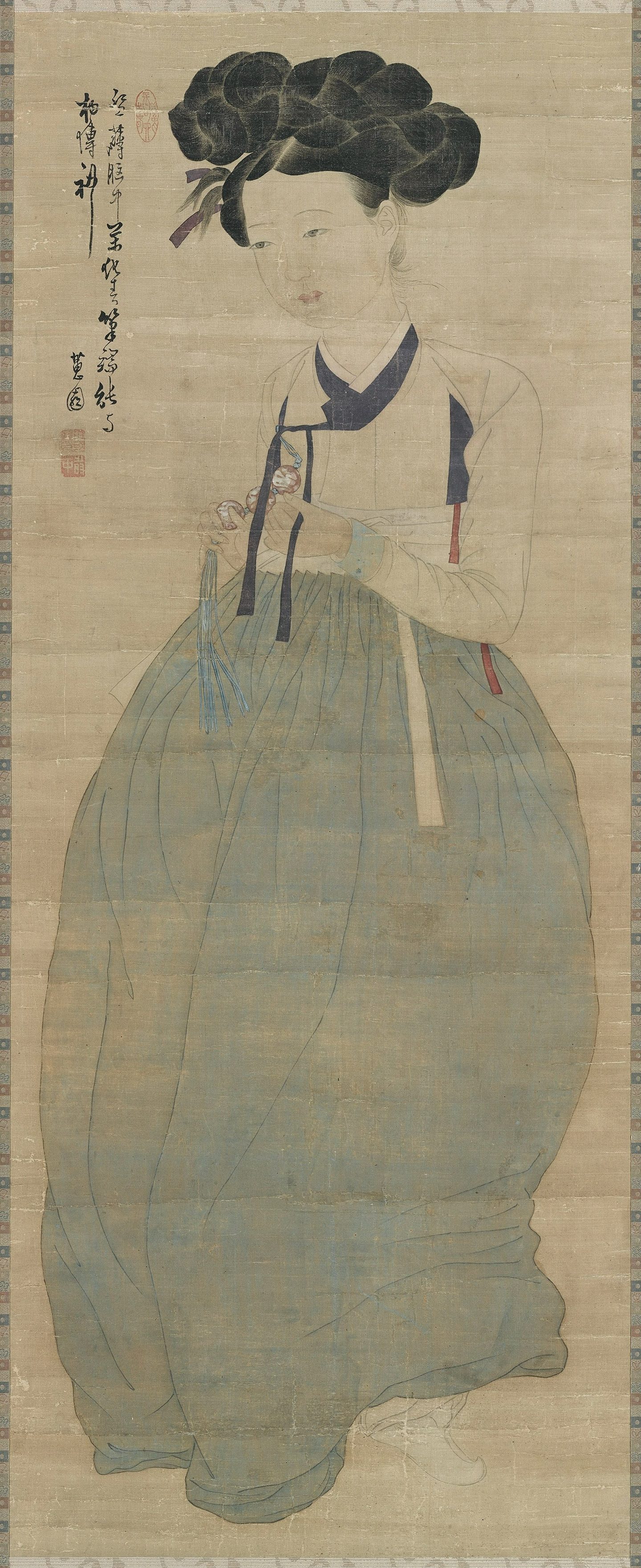
Key art is the last place to look for an answer about technique anyway. It gets illustrated on its own terms, often by a different hand from the one drawing the show, and it is built to sell a mood at thumbnail size on a shelf of competing thumbnails. Series have shipped behind a beautiful poster with animation on threes waiting underneath it. Which is why the picture at the top of this piece is a two-hundred-year-old painting rather than a frame from the show: Shin Yun-bok’s A Beautiful Woman, public domain, standing in for artwork the production has not released. It is the right century and the right craft, and it says as little about how these ten episodes were animated as the official poster does. So a streamer with a pipeline question hanging over its first animated commission has answered with a teaser, a synopsis and a poster.
The gap between a studio’s description of its own work and the label the internet puts on it runs in both directions. Amplitude shot a Humankind 2 trailer at Nu Boyana with twenty-five actors and a hundred and fifty crew and got called AI slop for it anyway. By now the word mostly registers as a suspicion about how something was made.
Who is making it
Imaginus arrives with a pedigree. The company was set up in December 2021 by Jinnie Choi, who was Studio Dragon’s inaugural CEO and ran it for five years — which is to say she built the production machine behind the K-drama boom and then left to start something with ten subsidiary labels under it. Its slate is otherwise live action: Tempest, Typhoon Company, Can This Love Be Translated.
Directing is Choi Junbae, credited on Mouse and Stealer: The Treasure Keeper. Both live action. Moving a drama director onto an animated series is a real decision and not a safe one — the timing instincts transfer, the shot economics do not. In live action a reaction shot costs a camera setup. In animation it costs a drawing, and the director who does not feel that in their hands tends to write coverage nobody can afford to draw.
Viki’s chief content officer Jaehee Hong said the platform plans to bring more animation to the service and that this is “just the start,” which is a streamer’s way of saying the pilot is the strategy.
The other half of the week
Two days before the premiere, Lezhin Entertainment put Teaz into Korea on 19 October — an AI character chat service built on official webtoon IP from Lezhin Comics and Bomtoon. Only Korean-language coverage of the launch has surfaced so far, so treat the date as announced rather than witnessed. Users drop into a specific point in a story and talk to the characters, taking a role or watching from outside, and the characters’ reactions shift with what you say.
Here is the part a working artist should notice. Teaz gamifies progress, and the reward you unlock is hidden illustrations drawn by the original creators.
So in the same week, in the same industry, AI is doing the concept pass at one company and the conversation at another — and at both, the drawn image is the thing held back as valuable. The model generates the approach and the chatter. The artist’s hand is the payoff.
That is where it sits in October 2026, in two products shipping two days apart. Both put the model where the work is still cheap to throw away, and both keep a human drawing as the thing worth paying for.