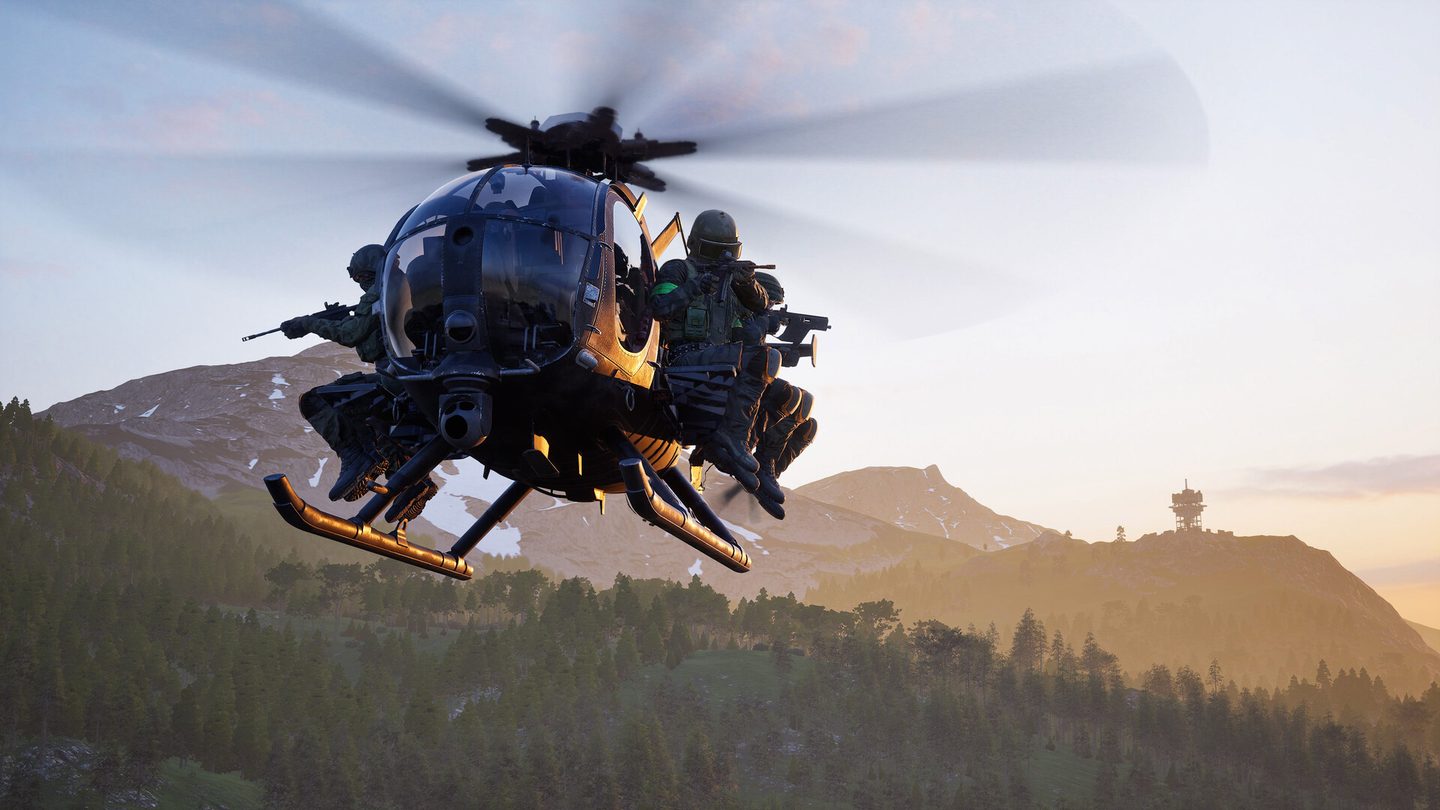
Two numbers came out of Wardogs before it reached Steam early access this morning at $39.99. The map is 256 square kilometres. And Bulkhead planned its servers for five thousand concurrent players.
Both are worth sitting with, because between them they explain most of how the game is built.
Where the 256 square kilometres goes
256 km² is sixteen kilometres on a side. Drop a hundred players into that and you get roughly one player per two and a half square kilometres, which is a hiking simulator with guns.
So the match doesn’t happen there. Each round selects a random 2×2 km patch of that terrain and designates it the Control Zone. Three teams push in, whoever has the most bodies inside collects points on a tick, and the first team to a hundred takes the match. A smaller hot zone can appear inside it, paying double cash and double points to whoever holds it.
Four square kilometres, then. That’s the playing field, and a hundred players inside four km² is a density people already recognise from every large-scale shooter of the last fifteen years.
Which makes the 256 a budget rather than a boast. What Bulkhead built is a sixteen-kilometre library, from which one small battlefield is drawn each time. For an environment team that is a very different brief. The terrain has to be consistently plausible and consistently fightable — no dead pockets, no accidental fortress, no valley that only works if you approach it from the south. It does not have to be individually memorable at every point, because no single square kilometre carries a match on its own.
The technical dividend is the part I keep turning over. Only one 2×2 km window is ever hot. Streaming, replication, physics, destruction state, the AI on vehicles — all of it is scoped to a patch you can predict at the start of a round and tear down at the end of one. Buildings in Wardogs can be damaged, fortified and flattened as the match runs, and persisting that kind of state across 256 km² of terrain would be ruinous. Across four km², for the length of one round, it is ordinary work.
The size is what keeps the selection from repeating. Sixty-four possible non-overlapping windows, before you count every offset in between.
Three teams changes the level design, not just the tactics
Everyone writing about Wardogs has noticed that three-way fights behave differently from two-way ones, and they do — every trade you make with one enemy is a gift to the other. That part is easy to see in a trailer.
The consequence for whoever builds the zone is quieter. A two-team map can be symmetrical, and most of them are: mirror the layout, mirror the cover, and the argument about fairness is over. Three approach vectors into a central objective cannot be mirrored. You are balancing sightlines, elevation and cover against three positions at once, on terrain that was authored before anyone knew which 2×2 km slice would be chosen.
Which is the sort of problem immersive sim designers spent decades on with far smaller spaces — how a room reads from every door into it, rather than from the one the designer imagined you using. Wardogs is asking a procedural selector to answer that question sixty-four times over.
It helps that the mode is not new. Wardogs descends from King of the Hill, the Arma 3 community mod, and Bulkhead has been working with Sa-Matra — the mod’s creator — from the start of the project. That mode has been load-tested by an actual playerbase for years. Buying the design and the person who tuned it, at the same time, is a cheaper route to a balanced objective than a year of internal playtests.
Five thousand, and then 245,118
Bulkhead’s closed beta peaked at 245,118 concurrent players on Steam. The studio’s planning figure was five thousand. Roughly forty-nine times the number the infrastructure was scoped for.
CEO Joe Brammer’s response to the surge was unusually plain about what comes next: Wardogs will keep losing players for months as the hype dies down, that this doesn’t make it a bad game or a problem, that the studio planned for 5k concurrent, and that it will build toward 1.0 and boom again. His words, roughly — he wrote it on X while the beta numbers were still climbing.
Saying that out loud is rarer than it should be. The default posture for a studio holding a 245,000-player weekend is to treat the peak as the new floor, staff to it, scope to it, and then explain the cliff six weeks later. Bulkhead named the cliff in advance and set the floor at a number it can actually survive. That decision reaches the art and engineering teams directly: content cadence, server spend, how much of the 1.0 roadmap is committed to now versus kept flexible. Plenty of live games have been cut back hard after scoping to a launch spike rather than to a sustainable one.
Worth noting on the studio itself: Bulkhead made Battalion 1944, was owned by Tencent, and was sold last year to a consortium. The coverage generally calls it independent again, which is true in the sense that its developers hold equity and false in the sense that the consortium includes Everplay Group — the parent company of Team17, which publishes Wardogs. Independent of Tencent, certainly. Standing at arm’s length from its publisher, less so.
None of which tells you whether the game is any good after week three. Early access at $39.99 buys a version explicitly labelled unfinished. What I want to see is whether the 2×2 km selection still throws up a fight worth turning up for on the four hundredth round, once the novelty of sixteen kilometres of terrain has worn off and what is left is the four square kilometres you are standing in.